





UAlbany Students Receive Hands-On Training in Powering the Grid

By Bethany Bump
ALBANY, N.Y. (April 9, 2026) — You’re on deadline working on an important project when you hear a thunderstorm.
“What is your confidence level that you’re going to be able to work uninterrupted with your power with severe weather coming?” Terry Benton asked an auditorium of UAlbany students who showed up to NY Creates’ Albany NanoTech Complex last month for a workshop on energy storage and microgrids.
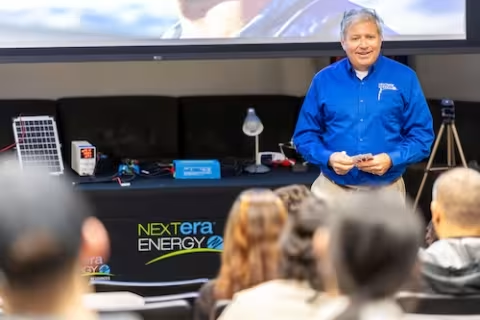
The answer to that question is of critical importance, Benton explained — not just to students on deadline, but to communities, industry and any institution requiring continuous power to deliver essential and life-saving services. These institutions often rely on microgrids, which use renewable energy and battery storage to ensure reliable power when the main grid experiences an outage or disruption.
The March 26 workshop — offered by NextEra Energy Resources, a global leader in renewable energy and energy storage, and UAlbany’s College of Nanotechnology, Science, and Engineering (CNSE) — gave students a hands-on opportunity to test just how resilient a microgrid is to disruptions. Students performed a microgrid resiliency test using a solar array simulator, demonstrating how batteries and renewable energy can help ensure grid stability by maintaining power during an outage.
Collaborations between universities like UAlbany and industry leaders like NextEra Energy Resources are essential. In addition to developing a skilled workforce for the future of renewable energy, these programs help ensure students engage directly with the technologies and opportunities shaping the power grid in real time.
“Being able to work with a smaller system like this, it gives you an idea of what a job might look like going into the field,” said Jay Van Allen, a freshman nanoscale science major who helped lead the simulation. “It honestly makes me more interested in potentially going into this type of work, and understanding what it would be like to be behind the scenes running these things.”
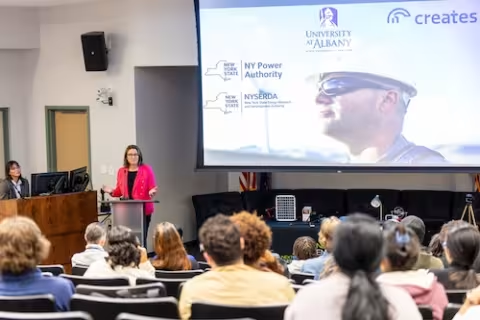
The training was provided to more than three dozen students across CNSE, including students taking courses in Disruptive Nanotechnologies and Electrical Energy Storage. It kicked off with remarks from CNSE Dean Michele J. Grimm, NYSERDA President and CEO Doreen Harris and New York Power Authority President Justin Driscoll, who discussed the need for a skilled workforce that is able to design, build and operate the next generation of clean energy systems.
“Right now, we have over 180,000 clean energy workers in the state of New York,” said Harris, adding that number is expected to more than double as the state works to achieve energy goals in areas such as solar, wind, energy storage and building decarbonization.
For Benton, an energy systems training engineer with NextEra Energy Resources, the workshop represents more than a single training session.
“These students are entering the energy industry at a pivotal time, as the nation works to modernize and strengthen the power grid,” he said. “That effort represents a long-term opportunity to build a meaningful career, and it requires a skilled workforce with the strong technical foundation these students are developing today.”
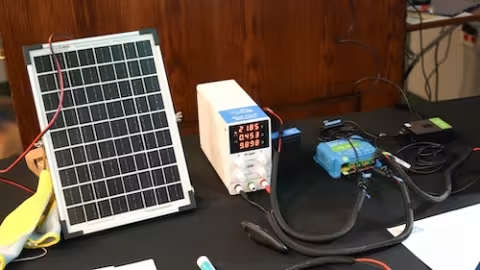
The workshop took students on a deep dive into the architecture of modern energy systems while also covering basic electrical principles. Benton emphasized the importance of following property safety protocols to reduce the risk of accidents such as electrocution, slips and falls, before leading students in the hands-on demonstration.
The training is one of many hands-on learning opportunities for students interested in renewables and energy storage, said CNSE Professor Harry Efstathiadis, noting a two-week electrical energy storage workshop he puts on for students each year that combines classroom learning, lab training and site visits.
“It’s very important connecting what they learn from class with the hands-on experience so they can see how it is applied in real life,” he said.
That was a major goal for Alex Mohan, a master’s student in nanoscale engineering who began working for NextEra Energy Resources six years ago and helped to organize the workshop.
“You are often taught fundamentals and not necessarily real-world applications,” he said. “I wanted students to be able to connect what they are learning here to what’s happening out there and see that there are job opportunities waiting for them.”