





UAlbany Researchers Partner with NASA to Build AI Tool for Predicting Power Outages

By Mike Nolan
ALBANY, N.Y. (Sept. 10, 2026) — Driven by increasingly severe weather events, power outages are costing the U.S. economy between $50 billion and $150 billion annually in direct losses and lost productivity.
New York ranks among the most affected states in the nation, with more than 18.3 million customer outages recorded during major weather-driven blackouts over the past decade.
A new tool being built by researchers at the University at Albany aims to give utility companies a head start on protecting and restoring the electric grid by predicting power outages before severe weather strikes.
The two-year project, funded by NASA, will pair researchers at UAlbany with peers at the NASA Marshall Space Flight Center and the University of Alabama in Huntsville to build an open-source outage prediction system.
Unlike existing outage prediction products, the tool will combine NASA’s satellite remote sensing data with publicly available outage and weather datasets to sharpen forecasts of where and when severe weather is most likely to damage electric infrastructure.
"Power outage prediction is becoming an increasingly challenging problem," said Sukanta Basu, a Professor of Empire Innovation at UAlbany's Atmospheric Sciences Research Center and the project's lead researcher. "By combining NASA's cutting-edge AI models with satellite data and input from utility partners, we are developing a high-powered tool that goes far beyond the machine learning approaches being used today."
Predicting Outages Days in Advance
Along with Basu, the project brings together a team of interdisciplinary researchers that include Xin Li, a UAlbany computer science professor, June Wang, a UAlbany expert in weather observational data collection, Timothy Lang, a remote sensing expert at NASA Marshall and Georgios Priftis, a research scientist at the University of Alabama in Huntsville.
Their goal is to solve the problem that has long challenged utilities — forecasting exactly where and when severe weather will damage electric infrastructure, up to hours to days before it happens.
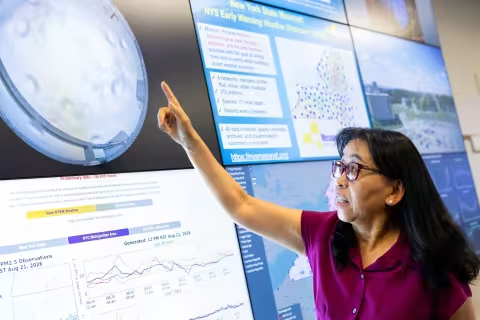
The team will apply two of NASA's newest AI systems to the tool, Prithvi Weather and Climate (Prithvi-WxC) and Prithvi-Earth Observations (Prithvi-EO), along with incorporate factors like tree canopy, soil moisture and seasonal conditions that shape how storms translate into damage on the ground.
The tool will sharpen forecasts of high-intensity winds in particular, which is the single largest driver of weather-related power outages nationwide, responsible for an estimated 80 to 90 percent of storm-related grid damage in the U.S.
“There is growing demand for increasingly large volumes of weather data to develop, train and evaluate AI-based weather forecasting models, particularly at the local level,” said Wang, who directs the New York State Mesonet at UAlbany, the nation's largest and most advanced weather observation network. “This project offers a unique opportunity to leverage dense surface observations from mesonet networks, such as ours, to train and validate AI-driven hyperlocal weather prediction systems.”
"This is an excellent opportunity for us to explore the potential of AI in climate science, a critical application that can greatly benefit from closer collaboration between computer scientists and AI researchers,” added Li, a professor in UAlbany’s College of Nanotechnology, Science, and Engineering.
Real-World Testing with Utilities
The tool will initially focus on three regions: the Northeast, the South and California, with a functionality designed to extend nationwide.
Along with the team of researchers, the project will also be guided by industry collaborators from four major utility companies in the U.S.
It adds to another collaborative project between UAlbany and UConn announced earlier this year, called the North American Forecasting Weather, Outage, Load & Damage Initiative. That tool is using advanced weather models and artificial intelligence, combined with publicly available outage data, to improve system outage predictions over regions in New England, New York and California.
"Our new project builds directly on the momentum we're building at UAlbany around power outage prediction," Basu said. "While these efforts tackle the issue from different angles, they're pointed at the same goal — giving utilities better tools to protect the grid and lower energy costs for customers."
The project's end product will be hosted on GitHub, allowing utilities and researchers to apply their own meteorological and satellite data to predict outages.
The researchers will also host workshops, webinars and a virtual course to train utility partners and the broader community on how to use AI models for outage prediction and beyond.