





Mental Health Experts Navigate Responsible AI Innovation at Annual Summit

By Erin Frick
ALBANY, N.Y. (Oct. 21, 2026) — More than a billion people worldwide are estimated to be living with a mental health condition. With demand far outstripping available human providers, millions are turning to AI chatbots to get the support they need. In the U.S., around 20% of adults and children report using AI for metal health care.
These tools are convenient, available and can feel helpful. But most were not designed for mental health care, and the safeguards and standards needed to make AI-supported care safe and equitable are only beginning to take shape.
These gaps were the focus of the fourth annual summit of the Global Center for AI in Mental Health (GCAIMH), “Scaling Care, Not Inequality: Building What’s Missing in AI for Mental Health,” held Sept. 25 at the SUNY Global Center in New York City. Attendees included researchers, clinicians, humanitarian responders, technologists and policymakers.
“There is tremendous concern right now over the way AI is being used to support mental health,” said University at Albany’s Amy Nitza, co-director of the Global Center for AI in Mental Health. “Need far outweighs clinician capacity, yet, by and large, these tools were not made for mental health care, don't reflect best-practice approaches and risk causing more harm than good. AI holds real potential to help meet unmet mental health needs, but only if we build safe tools with rigorous guardrails, informed by unbiased data — and always keep a human in the loop.”
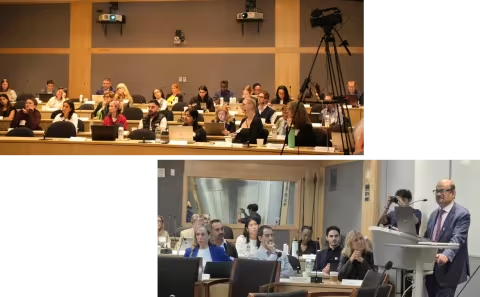
Exploring AI's role in psychotherapy, humanitarian response and support for survivors of terrorism, the summit asked how AI-enabled tools can extend care when services are absent, stretched thin or when need surges suddenly, such as after a natural disaster.
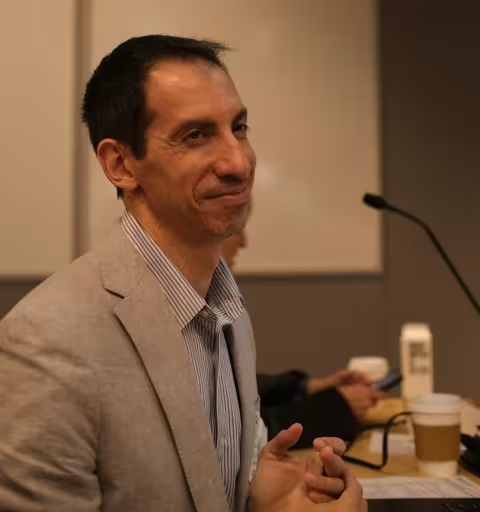
“Globally, one in two people will experience a mental disorder by age 75, but the workforce needed to provide that level of care does not exist,” said Center Co-Director Salvador Dura-Bernal, associate professor of physiology and pharmacology at SUNY Downstate Health Sciences University.
“There’s also a stark equity problem. High-income countries have roughly 67 mental health workers per 100,000 people, while the lowest-income countries have one. AI could help solve this, but we also know that chatbots give harmful responses six times more often than human therapists. Our goal is to build tools that safely narrow the gap.”
Voices from the Field
The summit featured three panel sessions which brought together mental health clinicians, academic researchers, humanitarian and disaster relief leaders, United Nations officials, state mental health and victim services leaders, a survivor-advocate and a Google DeepMind scientist.
Among these, UAlbany Associate Professor John Justino, director of UAlbany’s Center for Global Health, moderated a conversation exploring how AI could extend support in crisis settings while ensuring cultural relevance and equity and protecting protect vulnerable groups, including children.
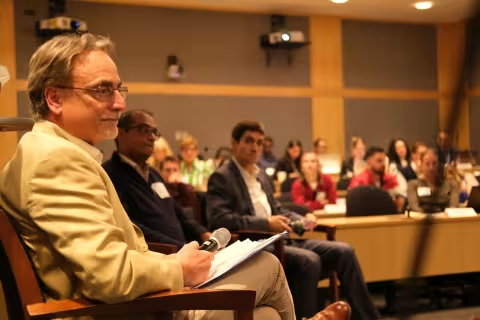
“We are biologically driven to be social animals, to interact with other human beings through touch, through talk, through peer support,” said Raffi Gregorian of the Aurora Humanitarian Initiative, who served on the panel. “If AI can be harnessed to amplify that, make it more efficient and reach more people, I think that’s great, but it should not replace that.”
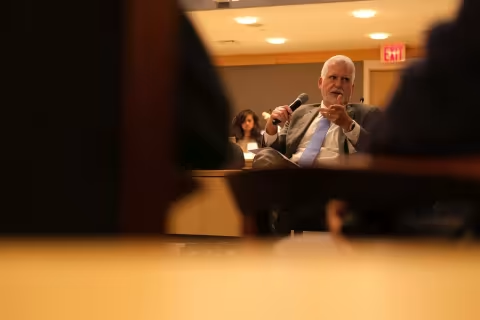
Showcasing Solutions
After a morning focused on challenges, the afternoon turned to solutions. An innovation showcase featured four AI-enabled mental health tools in development:
- Lakshika Vaishnav, a doctoral student in UAlbany’s Massry School of Business, presented research on training a small language model for mental health support. Working with UAlbany’s Sanjay Goel, Morris Massry Endowed Professor and chair of information security and digital forensics, their goal is to create a chat tool to help people who have traditionally avoided seeking mental health care due to stigma. The project’s current focus is determining whether AI can remember a user over time, notice patterns and catch problems earlier.
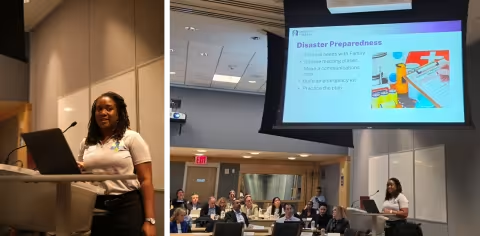
- DeeDee Bennett Gayle, UAlbany professor of emergency management and homeland security, presented a virtual reality program called “All Hazards” that prepares older adults for natural disasters. Deployed using a VR headset, the program is designed to “gamify” tasks such as building an emergency kit, discussing needs with family, establishing a meeting place and practicing the plan. [Hear more from Bennett Gayle on gamifying disaster preparedness on The Short Version podcast.]
- Ondrej Kopecky of Spring Health presented an open-access benchmarking tool designed to help measure the safety of AI-enabled mental health technologies. Aimed at chatbots, the tool assesses parameters such as ability to detect and confirm risk, offer supportive conversation and guide the user directly to human care if needed.
- Sean Kidd, professor of psychiatry at the University of Toronto and co-founder of App4Independence (A4i), presented an app that supports people with serious mental illness between live clinical sessions. Originally developed for people in recovery from psychosis and schizophrenia, the app is now being extended to people living with opioid use disorder.
Building What’s Missing
The Global Center’s team presented updates on its two tools in development, plus a new benchmark for assessing AI mental health tool safety.
Ther-Assist helps therapists adhere to best practices and learn where they could improve. Designed to run during a therapy session and face the provider, Ther-Assist analyzes the conversation and offers evidence-based recommendations for treatment approaches to try or avoid. UAlbany’s James Boswell, professor of psychology, explained that globally, the mental health care delivery crisis is one of quality as well as capacity. Ther-Assist is built to address these twin challenges.
“If you are fortunate enough to access psychotherapy, we have effective treatments,” said Boswell, “But even then, not all care is delivered equally well. Ther-Assist is meant to essentially act like a ‘supervisor in your pocket,’ offering feedback to shape each session as it’s happening, and tailor the next.”
Amy Nitza presented JulienPFA, an app to help frontline responders deliver psychological first aid (PFA) in the wake of disasters and mass violence.
“Psychological first aid is often administered by non-specialists working under extreme stress with little training or supervision,” Nitza said. “When we enter a disaster zone, there are often very few mental health professionals on hand. Sometimes, it’s just me. Then, in the scheme of a day, or even a few hours, we teach people with no mental health background how to administer psychological first aid. We call this method ‘train and hope.’ I think we can do better. That’s where JulienPFA comes in.”
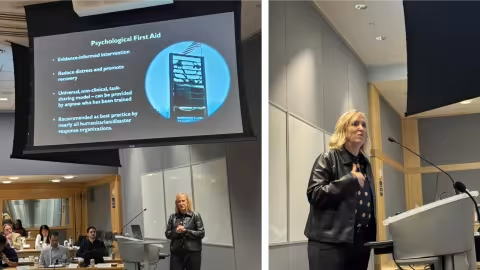
Designed to be used on a smartphone during a conversation between a responder and a survivor, JulienPFA analyzes the survivor’s responses and guides the responder on which core element of psychological first aid to prioritize.
Becasue there is no accepted standard for judging whether an AI mental health tool is clinically sound, safe or fair, the Center is building one. Its benchmark scores AI mental health tools for clinical quality, safety in high-risk situations and equity across populations.
What Comes Next
“As we continue to finetune our Ther-Assist and JulienPFA tools, the Global Center team is actively seeking new collaborators and feedback,” said Nitza. “In addition to securing additional funding and implementation partners, we are also focusing on honing our tools for particular users and cultural contexts. For example, we are exploring the adaptation of our for tools for children, and have begun collaborating with the UN Office of Counter-Terrorism to tailor our tools for victims of terrorism. Were also aiming to broaden our linguistic and cultural reach, prioritizing regions in the Middle East, Ukraine, Latin America and Africa.”
The Global Center for AI in Mental Health is a collaboration between the University at Albany, SUNY Downstate Health Sciences University and the Health Innovation Exchange. Learn more at gcaimh.org.