

'Goggles and Galleries' Exhibit Shows Off Student Art Celebrating the Brain

By Erin Frick
ALBANY, N.Y. (Jan. 26, 2026) — Our knowledge of the human brain often advances in the lab, but University at Albany’s Ewan McNay believes that creatively exploring the brain’s complex structures and functions can improve depth of learning and expand how well we understand the most complex structure known.
McNay joined UAlbany in 2008, after earning his PhD in Neuroscience from the University of Virginia and spending several years as a research scientist and assistant professor at Yale. After nearly two decades of teaching and research as a Great Dane, McNay is retiring this month. Before his departure, colleagues Cheryl Andam and Arun Richard Chandrasekaran wanted to shine a light on a practice that has been part of McNay’s curriculum for about 10 years — a popular extra credit offering that encourages students to think differently about thinking. The premise is simple: Create a piece of brain art.
“I've always started each class with both a new finding and a neuroscience-related image — of which there are many, many gorgeous examples,” said McNay, whose specialty is behavioral neuroscience. “One of the students in my lab showed me a sketch that they had done inspired by one of those images, and it was really good! I had been asked a couple of times by undergrads if there was anything that they could do to boost their grade, so I thought this would be a good way to allow students to draw on non-class skills and have some fun, as well as get them to perhaps process the neuroscience from a different angle.”
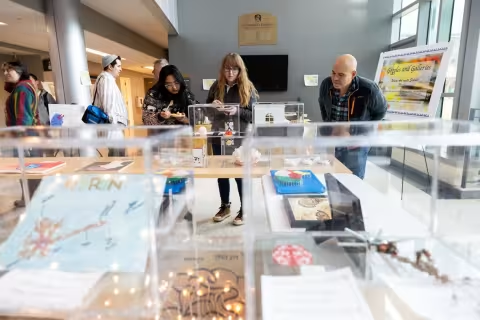
McNay displayed the artworks in his office, where the collection caught the eye of Associate Professor of Biological Sciences Cheryl Andam, who, with Assistant Professor of Nanoscale Science & Engineering Arun Richard Chandrasekaran, is in the early stages of developing an event series called “Goggles and Galleries” with the goal to spur creative expression at the intersection of art and science across campus.
“Plans for the ‘Goggles and Galleries’ series are in development, so more on that to come,” said Andam, who, in her own lab, maintains the tradition of encouraging her members to create self-portraits using Escherichia coli grown on agar. [Scroll down for examples.] “But when I saw Ewan’s collection of brain art, particularly in light of his impending retirement, I knew we had to stage an initial event in the short term. I told him, ‘Before you pack all of this away, we need to host an exhibit. You can’t leave before we’ve had a chance to show these off.’”
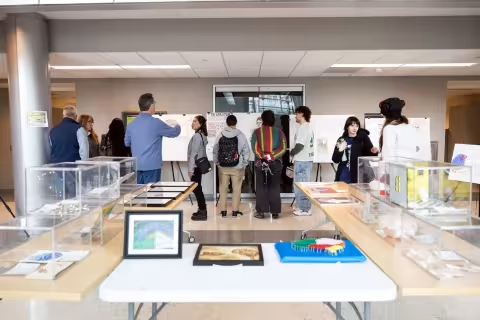
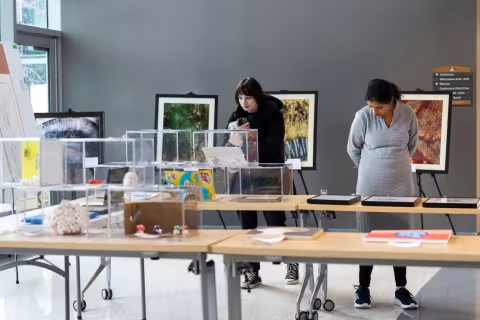
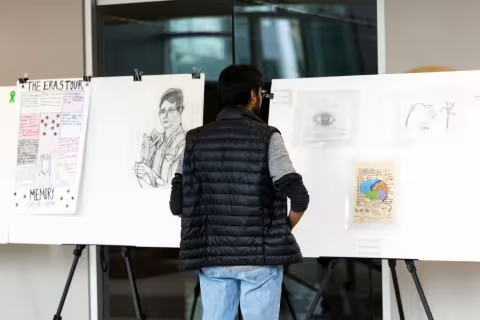
In December 2025, the first “Goggles and Galleries” exhibit and reception took place in the Life Sciences Research Building Atrium with 43 student projects on display.
We caught up with McNay to learn more about encouraging STEM students to pursue art, how the assignment has evolved over the years, and what he hopes students take away from the experience of examining the subject of their scientific studies from a new perspective.
What were your favorite classes to teach at UAlbany?
I love teaching neuroscience in general — one of the most frequent comments I get is that I come across as being delighted about the field, and that's absolutely true.
I've been fortunate to have the chance to teach in the Honors College for several years now, and that's always been enjoyable because of the smaller-class environment that allows more interaction and small-group work. At the graduate level, I've run a class on neurobiology of learning and memory that has been very different each time because it has always followed the latest findings and we get into reading both classic papers in the field and the most recent work.
Have students' responses to the ‘brain art’ assignment evolved over the years?
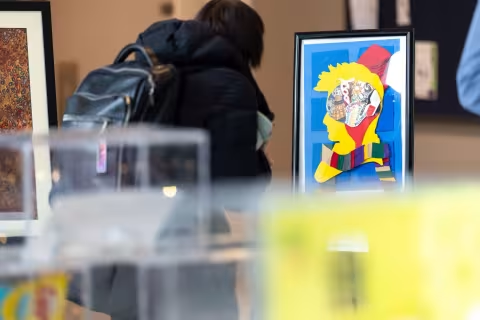
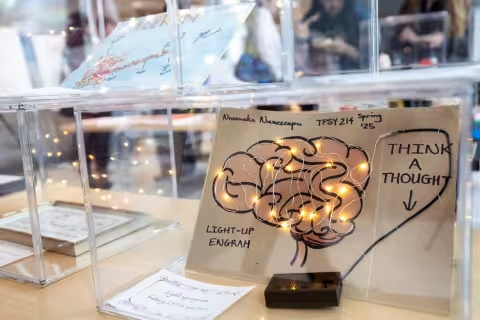
The variety of media has increased. What started as almost all drawing now includes frequent modelling, baking, knitting, mixed media and visual arts. So, for instance, this year I had three students write a very clever Hamilton-themed rap about the senses and perform it in 18th-century wigs!
Other than the rap battle, the model of a bathroom (because flushing a toilet is a great analogy for the firing of a neuron) is pretty neat. My favorite is an anatomical sketch done in coffee (because my students know I love coffee). I’ve also received an embroidery of the chemical structure of glucose and caffeine, as well as some humorous pieces like a painting that used my face as a neurotransmitter encoding memories of grandmas carrying axes (IYKYK).
What do you see as the most valuable outcome of integrating art and science?
Beauty. Reminding people that pleasure and joy are not diminished by greater understanding but rather enhanced — the gorgeous colors of a fluorescent antibody-binding image are better appreciated when you also understand how they came about and what they mean.
Do you create art yourself?
Cooking, perhaps. My students would probably be astonished to know that during high school I danced and acted! But nothing permanent, no. The British education system that I grew up in promotes specialization relatively young, so I never took an art class in school after age 9.
What do you hope students take away from this assignment?
See above on beauty, but also depth of processing. One of the things we know about memory from neuroscience is that the more angles you have on a piece of knowledge, the better you understand and retain it. So, for instance, setting neuroscience into lyrics and singing them is going to encode that information much more strongly than simply reading the same content. Making a model neuron that lights up to simulate firing means that you have to really understand the underlying process that you're trying to model. And also, that being a scientist does not mean abandoning art!