





Engineering, Life Sciences Lead R&D Growth at UAlbany

ALBANY, N.Y. (Jan. 20, 2026) — Research and development activity at the University at Albany rose to nearly $472 million in fiscal year 2024, breaking into the top 10 nationally for public research institutions without medical schools, according to the latest survey by the National Science Foundation published in December.
Overall, UAlbany ranked No. 75 nationally, No. 50 among public institutions and No. 2 within the State University of New York.
UAlbany’s 2024 R&D more than doubled the $142 million the University reported in the NSF Higher Education Research and Development (HERD) survey in fiscal year 2023. The year-over-year increase was driven largely by the return in 2023 of the Department of Nanoscale Science & Engineering and its semiconductor industry R&D partnerships at the NY Creates Albany NanoTech Complex, where the department is located.
UAlbany founded the College of Nanotechnology, Science, and Engineering (CNSE) in 2004 — then known as the College of Nanoscale Science & Engineering —as the first of its kind dedicated to nanotechnology to build on the early success of Albany NanoTech, and it remains a key academic R&D partner at the site in areas like photoresists for EUV lithography. The 2024 HERD survey is the first that reflects the return of nanotechnology research and education programs to UAlbany after about a decade of separation as well as the re-incorporation of industry R&D spending statistics from NY Creates ecosystem into UAlbany’s HERD data.
New York Invests in Science, Technology
“We are fulfilling Gov. Hochul’s charge to make SUNY’s research universities engines for innovation, technological leadership and economic growth,” said Thenkurussi “Kesh” Kesavadas, UAlbany’s vice president for research and economic development. “UAlbany faculty are conducting cutting-edge R&D in fields like semiconductors, microelectronics, artificial intelligence, biotechnology, weather, climate and disaster resilience with a single-minded focus on how we can translate our discoveries into better products and better public policy that advances the public good. With New York’s landmark investments in Albany NanoTech, Empire AI and in UAlbany’s RNA Institute, we will continue to push the boundaries of our knowledge to help New Yorkers, and all people, live healthier, safer and more comfortable lives.”
Kesavadas said UAlbany’s most comparable peer group is other public universities without medical schools because medical programs can tap into larger pools of funding linked to clinical work. Among that cohort, UAlbany ranks No. 9 in the United States.
“At the University at Albany, one of the nation’s most diverse Research 1 universities, we are committed to conducting research that benefits the public good. In public health, artificial intelligence, cybersecurity, semiconductor manufacturing, atmospheric sciences, and countless other disciplines, UAlbany researchers are making discoveries with real-world impact. As our research portfolio has expanded, so has our impact on the Capital Region, across New York State, and globally. I am proud of the work UAlbany’s researchers are doing to ensure that UAlbany is leading innovation and economic growth today and for the future,” said UAlbany President Havidán Rodríguez.
Of the $472 million in R&D reported by UAlbany in 2024, $104.8 million was federally funded. Overall, $322 million of that R&D activity was classified as engineering, nearly two-thirds of which was generated by R&D work performed at the NY Creates Albany NanoTech Complex, which is ground leased from the UAlbany, and $54.4 million by the federal government.
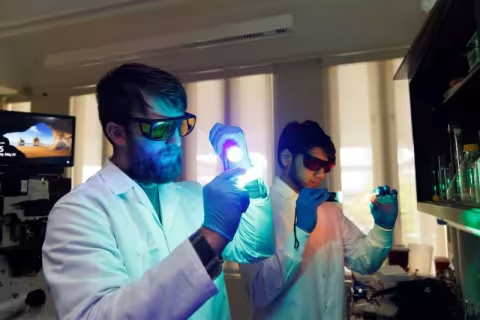
In addition to engineering, UAlbany’s other signature research areas had strong years in 2024, including:
- $45.7 million in Life Sciences ($32.6 million federally funded), led by biological and biomedical sciences and health sciences, including UAlbany’s RNA Institute and College of Integrated Health Sciences
- $26.5 million in Computer and Information Sciences ($1.3 million federally funded), which reflects the University’s investment in its new on-campus AI supercomputer, among other things.
- $19.2 million in Social Sciences ($3.7 million federally funded), including anthropology; economics; political science and government; sociology, demography, and population studies
- $17 million in Geosciences, Atmospheric Sciences, Ocean Sciences ($7 million federally funded), including the Atmospheric Sciences Research Center and Department of Atmospheric and Environmental Sciences
- $7.4 million in Physical Sciences ($3.4 million federally funded), including chemistry and physics
- $4.9 million in Psychology ($1 million federally funded)
The most recent HERD data reflects the fiscal year ending in 2024, which for most institutions ended June 30, 2024. More information about the methodology and data is available from the National Science Foundation.
A recent report by the Center for Economic Growth looking at 2025 data reported by the National Institutes of Health — a different dataset and time period than the most recent HERD survey — pointed to UAlbany's six-year high in NIH funding as a bright spot in the Capital Region.