


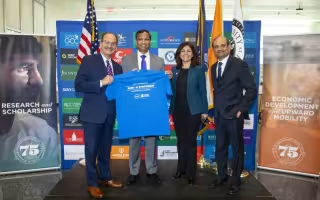
UAlbany, IBM Announce New Artificial Intelligence Research Projects
The projects are the first five funded through the Center for Emerging Artificial Intelligence Systems (CEAIS), a $20 million UAlbany-IBM research collaboration announced last year by Gov. Kathy Hochul that included the installation of state-of-the-art prototype IBM AI hardware at UAlbany.
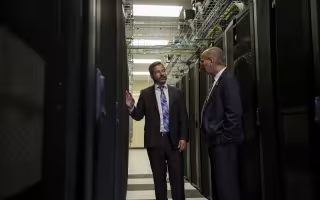
Q&A: Designing and Building UAlbany's AI Supercomputer
The University’s new AI supercomputer wouldn’t be possible without the complex IT infrastructure that supports it. That infrastructure is built and maintained by UAlbany’s Information Technology Services overseen by Chief Information Officer Brian Heaton.
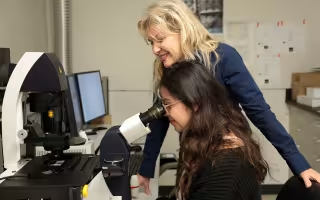
Sullivan Award Supports CNSE Student Scholarship
Thanks to funding through the John J. Sullivan Professional Development Award, doctoral students Maria Belen Paredes-Espinosa, Shadi Omranpour, Ezra Pasikatan and Jeelka Solanki have been able to take part in prestigious conferences that further their research and scholarship.
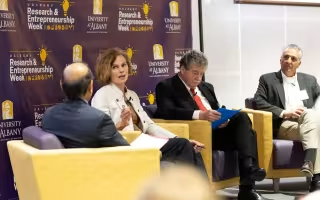
R&E Week Highlights AI, Innovation and Creative Works
UAlbany's second annual Research and Entrepreneurship Week brought together scholars from throughout New York and beyond to put the spotlight on the explosive growth of artificial intelligence in the Capital Region, along with highlighting the substantial scholarly work of UAlbany researchers and inventors.
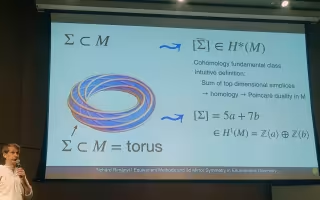
UAlbany Hosts Prestigious AMS Fall Sectional Meeting
For the first time in 41 years, the University at Albany served as host institution for a meeting of the American Mathematical Society (AMS), the preeminent organization advancing research and mathematics education in the United States.
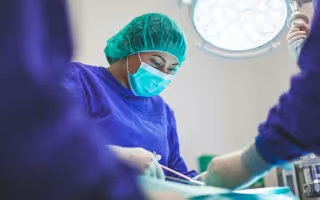
New Report Examines Barriers to Oral Health Services for New Yorkers
A new Center for Health Workforce Studies report indicates that improving access to oral health services in New York requires a broader understanding of oral health needs and the challenges that underserved populations face.

Albany NanoTech to Host National Semiconductor Technology Center
The news is a major boost for the Capital Region’s high-technology sector and the industry-university partnerships that have helped fuel it for three decades.