National Radio Dynamic Zones Partnership

National Radio Dynamic Zones Partnership

National Radio Dynamic Zones Logo

People

Leadership

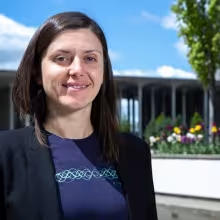
Mariya Zheleva portrait taken on the University at Albany Podium

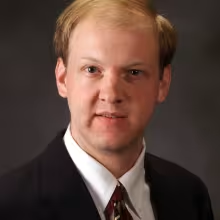
Christopher R. Anderson, PhD

Christopher R. Anderson received the BS, MS, and PhD degrees in electrical engineering from Virginia Tech in 1999, 2002, and 2006, respectively. He is currently an Associate Professor of Electrical Engineering at the United States Naval Academy. From 2016-2018 he served as a Visiting Researcher at the National Telecommunications Information Administration (NTIA) Institute for Telecommunication Sciences in Boulder, CO where he concentrated on developing propagation models for cluttered environments. Dr. Anderson is the Founder and Director of the USNA Wireless Measurements Group, a focused research group that specializes in spectrum, propagation, and field strength measurements in diverse environments and at frequencies ranging from 300 MHz to 28 GHz. His research has been funded by the National Science Foundation, the Office of Naval Research, NASA, the Defense Spectrum Organization, and the Federal Railroad Administration. His research includes radiowave propagation measurements and modeling, embedded software-defined radios, and dynamic spectrum sharing. Dr. Anderson is a former Editor of the IEEE Transactions on Wireless Communications and was a Guest Editor of the IEEE Journal On Selected Areas In Signal Processing Special Issue on Non-Cooperative Localization Networks. He was the General Chair of the 2018 NTIA International Symposium on Advanced Radio Technologies.

Workshops

The NRDZ research partnership and workshop series will run over the course of two years and will consist of quarterly workshops designed to facilitate technical discussions and research collaborations on the design and implementation of National Radio Dynamic Zones. Details about past and upcoming meetings/workshops will be posted here.

Nov. 10, 2020 -- NRDZ Partnership Kick-off Meeting.


Meeting Outcomes:


General Information:

Nov. 10, 2020. 4 - 6 p.m. EST
Virtually via Zoom (Zoom access information will be provided to registered attendees).


Scope and Goal:

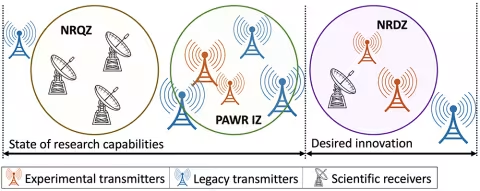
National Radio Dynamic Zones (NRDZ) are being advocated for as a means to advance the state of wireless communications and to support the design of next generation wireless networks with practical, real-world, regional test sites. The utility of the radio spectrum depends on the harmonious coexistence of active communications systems, passive scientific systems, and orbital remote sensing systems. Coexistence is currently handled through manual interference deconfliction, quiet zones, or innovation zones, and essentially reflect a static configuration of the spectrum. NRDZ's have the potential to provide a geographically bounded region where innovative transmitters and receivers can operate in such a way as to protect passive and existing users, while simultaneously supporting dynamic use of the radio spectrum by experimental devices.

The goal of this kick-off meeting is to bring together academics, government and industry researchers from both the active communications and passive sensing communities to define a vision and a roadmap for the creation of a National Radio Dynamic Zone. The outcome of this kick off meeting will inform future quarterly workshops organized by the research partnership, which will provide a venue for a deeper technical dive around issues concerning NRDZ design, collaboration and publication of research ideas and results.


Meeting Organizers:

Research Partnership Co-chairs:

  • Christopher R. Anderson, Electrical and Computer Engineering, United States Naval Academy.
  • Mariya Zheleva, Computer Science, University at Albany, SUNY.


Agenda

Nov. 10, 2020. 4 - 6 p.m. EST

All times listed are Eastern Standard Time (EST).


4 - 4:10 p.m. - Welcome and overview of the Research Partnership goals and outcomes.

  • Mariya Zheleva and Chris Anderson

4:10 - 4:30 p.m. - Thoughts from NSF

  • Alex Sprintson and B. Ashley Zauderer

4:30 - 5:10 p.m. - Short keynotes and QnA

5:10 - 5:40 p.m. - Lightning talks from NRDZ award recipients

Speakers will be asked to talk about their vision of NRDZs, their research investigations related to NRDZs and their opinion on what should the Research Partnership pursue.

  • Dr. Josep Jornet, Electrical and Computer Engineering, Northeastern University
  • Dr. Honggang Wang, University of Massachusetts (UMass) Dartmouth
  • Dr. Miguel Morales, Department of Physics, University of Washington
  • Dr. Adam Cohen, President and CEO, Associated Universities Inc.
  • Dr. Tommaso Melodia, Electrical and Computer Engineering, Northeastern University

5:40 - 6 p.m. - Moving forward – general discussion of activities

Workshops -- potential tracks and working groups. Potential focus areas include (1) theory and algorithms, (2) sensors and devices, (3) platforms and architectures, (4) signal processing, (5) data analytics, (6) passive user protection, (7) passive/active applications and (8) regulatory issues.

Technical deep-dive format


Documents

National Radio Quiet and Dynamic Zones, Thomas Kidd, CHIPS: The Department of the Navy's Information Technology Magazine


Mar. 16 - 17, 2021 -- NRDZ Partnership Workshop #1

Passive/Active communities working together: Understanding each other's needs, concerns and capabilities


Meeting Outcomes:


General Information:

Mar. 16 - 17, 2021
Virtually via Zoom (Zoom access information will be provided to registered attendees).


Scope and Goal:

National Radio Dynamic Zones (NRDZ) are being advocated for as a means to advance the state of wireless communications and to support the design of next generation wireless networks with practical, real-world, regional test sites. The utility of the radio spectrum depends on the harmonious coexistence of active communications systems, passive scientific systems, and orbital remote sensing systems. Coexistence is currently handled through manual interference deconfliction, quiet zones, or innovation zones, and essentially reflect a static configuration of the spectrum. NRDZ's have the potential to provide a geographically bounded region where innovative transmitters and receivers can operate in such a way as to protect passive and existing users, while simultaneously supporting dynamic use of the radio spectrum by experimental devices.

The goal of this workshop is to explore the technical challenges of providing interference protection to passive users while allowing comprehensive active use of the spectrum inside the NRDZ.


Workshop Organizers:

  • Research Partnership Co-chairs:
  • Christopher R. Anderson, Electrical and Computer Engineering, United States Naval Academy.
  • Mariya Zheleva, Computer Science, University at Albany, SUNY.
  • Kevin Gifford, Computer Science, University of Colorado Boulder.
  • Eloise Morris, Computer Science, University of Colorado Boulder.


Agenda

DAY 1: Passive instrumentation tutorials. Mar. 16, 2021. 10:30 a.m. - 3:30 p.m. EDT

10:30 - 10:35 a.m. Welcome and overview from the organizers.

  • Mariya Zheleva, Chris Anderson and Kevin Gifford

10:35 a.m. - 12:35 p.m. Tutorial 1: Earth Exploration-Satellite Service instrumentation

Materials

12:30 - 1:30 p.m. Lunch break

1:30 - 3:30 p.m. Tutorial 2: Radio astronomy instrumentation

Materials

DAY 2: Main workshop day. Mar. 17, 2021. 12:30 - 5 p.m. EDT

12:30 - 12:40 p.m. - Welcome and overview from the organizers

  • Mariya Zheleva, Chris Anderson and Kevin Gifford

12:40 - 1 p.m. - Thoughts from NSF

  • B. Ashley Zauderer

1 - 2 p.m. - Fireside chat and Q&A: First Do No Harm, now how do we exist together?

Fireside chat and Q&A: First Do No Harm, now how do we exist together? Video

2 - 3 p.m. - Panel on passive/active applications and coexistence

Speakers will be asked to give their perspective on a passive/active technology and emerging spectrum coexistence issues.

  • Moderated by Eloise Morris

Panel on passive/active applications and coexistence Video

  • Steven C. Reising, Electrical and Computer Engineering, Colorado State University
    Passive weather sensing
  • Josep Jornet, Electrical and Computer Engineering, Northeastern University
    Terahertz communications
  • Michael Marcus, Marcus Spectrum Solutions LLC
    Satellite communications
  • Charles Powell, Climate and Space Science Engineering, University of Michigan
    Earth Exploration-Satellite Service
  • Dennis Roberson, Roberson and Associates, LLC
    Mobile Broadband
  • Frank Lind, MIT Haystack Observatory
    Radio astronomy

3 - 3:10 p.m. - Break

3:10 - 3:20 p.m. - Q&A with panelists

3:20 - 4:20 p.m. - Breakout rooms (20-minute rotations)

Breakouts will be facilitated by pairs of panelists. Breakout themes will be:

  • [Passive] Radio Astronomy + [Active] Mobile Broadband
  • [Passive] EESS + [Active] Satellite Mega-Constellations
  • [Passive] Passive weather sensing + [Active] THz communications

4:20 - 5 p.m. - Breakout room debrief


Documents

National Radio Quiet and Dynamic Zones, Thomas Kidd, CHIPS: The Department of the Navy's Information Technology Magazine

Nov. 16 - 17, 2021 -- NRDZ Partnership Workshop #2

Shattering siloed spectrum sharing mechanisms for future NRDZs


Meeting Outcomes:


General Information:

Nov. 16 - 17, 2021
Virtually via Zoom (Zoom access information will be provided to registered attendees).


Scope and Goal:

National Radio Dynamic Zones (NRDZ) are being advocated for as a means to advance the state of wireless communications, to support the design of next generation wireless networks with practical, real-world, regional test sites, and to ensure the continued successful operation of passive services in an increasingly crowded spectrum. The utility of the radio spectrum depends on the harmonious coexistence of active communications systems, passive scientific systems, and orbital remote sensing systems. The state in spectrum coexistence mechanisms across these technologies is vastly different: from automated and measurement-driven spectrum allocation for commercial broadband to manual leases across scientific users, and disparate users are generally not aware of each other's capabilities.

The goal of this workshop is to familiarize the broader community of active, scientific and remote sensing users with the state-of-the-art in their respective spectrum management and allocation mechanisms. A hackathon 'sprint' will challenge participants to develop and propose solutions to grand challenges faced by spectrum sharing inside NRDZs.


Workshop Organizers:

  • Christopher R. Anderson, Electrical and Computer Engineering, United States Naval Academy.
  • Mariya Zheleva, Computer Science, University at Albany, SUNY.
  • Chris De Pree, National Radio Astronomy Observatory.
  • Joel Johnson, Electrical and Computer Engineering, The Ohio State University.
  • Mustafa Aksoy, Electrical and Computer Engineering, University at Albany, SUNY.


Agenda

Before The Workshop

View the Workshop 2 read-ahead material. Please review this material before the workshop to understand key NRDZ issues and topics, which have also informed the agenda for this workshop.

DAY 1: Spectrum coexistence tutorials. Nov. 16, 2021. 12:55 - 4 p.m. EDT

Day 1 will feature several tutorials on the state-of-the-art in spectrum sharing from experts in the passive and active communities.

12:55 - 1 p.m. Welcome and overview from the organizers.

  • Mariya Zheleva, Chris Anderson, Chris DePree, Joel Johnson and Mustafa Aksoy

1 - 2:20 p.m. Tutorial 1: Examples of Methods Used to Protect Incumbents in 3.5 GHz CBRS and 6 GHz AFC with Relevance to Passive/Active Spectrum Sharing

Materials:

2:20 - 2:30 p.m. Break

2:30 - 4 p.m. Tutorial 2: Spectrum management for radio astronomy -- VLA telescope scheduling

Materials

DAY 2: Main workshop day. Nov. 17, 2021. 12:30 - 5:20 p.m. EDT

12:30 - 12:40 p.m. - Welcome and overview from the organizers.

  • Mariya Zheleva, Chris Anderson, Chris De Pree, Joel Johnson and Mustafa Aksoy

12:40 - 1 p.m. - Thoughts from NSF

Materials

1 - 2 p.m. - Fireside chat and QnA: Now that there is pie on the table, how do we divide it?

Fireside chat and QnA: Now that there is pie on the table, how do we divide it? Video

2 - 3:10 p.m. - Panel: Building the coffee shop in the library.

This panel will bring together experts across spectrum sharing technologies and application domains. The panel will present several grand challenges to NRDZ spectrum sharing that emerged from our community efforts over the past year. Panelists will offer their expert opinion on approaches to tackle these challenges and open problems that will require a collaborative approach.

  • Moderated by Liese van Zee, Department of Astronomy, Indiana University – Bloomington.

Panel: Building the coffee shop in the library Video

  • James Neel, Senior Technologist, Federated Wireless
    Centralized SAS-based spectrum management
  • Danijela Cabric, Professor, Electrical and Computer Engineering, UCLA
    Distributed algorithms for resource allocation in coexisting networks
  • Greg Taylor, Professor, Department of Physics and Astronomy, UNM
    Low frequency radio astronomy
  • Jeff Piepmeier, Chief Passive Microwave Instrument Engineer, NASA
    Remote sensing; spectrum management for Earth Science Technologies
  • Kimberly Baum, Vice President Spectrum Engineering and Strategy, OneWeb
    Satellite megaconstellations
  • Kobus Van der Merwe, Professor, School of Computing, University of Utah
    POWDER-RENEW testbed. NRDZs in existing testbeds.

3:10 - 3:20 p.m. - Break

3:20 - 3:50 p.m. - QnA with panelists

3:50 - 4:50 p.m. - Grand challenges sprints

The sprints will be facilitated by pairs of panelists. Participants will work collaboratively to leverage their knowledge in existing spectrum sharing towards solving grand challenges in shared spectrum access for NRDZs.

  • Policy sprint -- build a policy framework for NRDZ. There are two extremes for a potential policy framework including (i) no licensing procedures; all unlicensed, show up, plug into the system and do whatever experiments you need in the zone; and (ii) fully-fleshed FCC+NTIA licensing. Where does an NRDZ need to be on this spectrum to allow quick experimentation with stakeholder protections? How do we realize this?
  • Monitoring sprint -- conceptualize a spectrum monitoring system for NRDZ that can support (i) the wide range of target frequencies (30MHz - 200GHz and potentially into THz); (ii) the vastly different sensitivity levels required by participating technologies (i.e. 120dB difference between radio astronomy and active communications); and (iii) the differences in the geographical footprint of NRDZ technologies?
  • Experiment management sprint -- conceptualize an experiment management system to allocate NRDZ resources to experiments considering all stakeholders needs. Develop a schema for information exchange across disparate stakeholders in support of NRDZ resource allocation.

4:50 - 5:15 p.m. - Sprints review and retrospective

Each sprint team will be asked to provide a brief update on the outcomes of their discussion.

5:15 - 5:20 p.m. - Closing remarks


Documents

Current Findings from the NRDZ Initiative. These findings are based on meetings with stakeholders in the period April 2021 - October 2021. Please, read these ahead of the workshop to understand key issues and topics in the context of NRDZ, which have also informed the agenda for this workshop.

National Radio Quiet and Dynamic Zones, Thomas Kidd, CHIPS: The Department of the Navy's Information Technology Magazine
News

Mar. 3, 2023

We published a popular article in The Conversation on the threats of terrestrial and airborne interference to Radio Astronomy, and the opportunities provided by NRDZs.


Feb. 10, 2023

A visioning article of NRDZ architecture, opportunities and grand challenges was accepted to IEEE Communications Magazine and is forthcoming in April 2023.


Jan. 10, 2023

Happy New Year!! The Lean Coffee Table event on Jan. 17, 2023 4 - 5:30 p.m. ET will tackle the topic of “Policy in the zone and broader regulatory issues”.


Dec. 1, 2022

The Lean Coffee Table event on Dec. 8, 2022 4 - 5:30 p.m. ET will tackle the question “How does remote sensing (RS) fit within the framework of an NRDZ? ”. Summary will be distributed to participants.


Nov. 10, 2022

The Lean Coffee Table event on Nov. 17, 2022 4 - 5:30 p.m. ET will tackle the question “How does radio astronomy fit within the framework of an NRDZ?”. Summary will be distributed to participants.


Oct. 10, 2022

Mark your calendars for three upcoming Lean Coffee Table events on Nov. 17, 2022, Dec. 8, 2022 and Jan. 17, 2023. Details forthcoming on our mailing list (please reach out to the organizers to be added).


Jan. 1, 2022

The summary from the Second NRDZ Workshop is now available.


Dec. 1, 2021

Video recordings of the Tutorials, Fireside chat and Panel from our second workshop are available on the Workshops page.


Oct. 1, 2021

NRDZ Partnership Second Workshop will take place on Nov. 16 - 17, 2021, visit the Workshops page for more information.


Aug. 1, 2021

NRDZ Lean Coffee #3 and #4 happening on Aug. 31, 2021, 4 - 5:30 p.m. EDT and Sep. 13, 2021, 4 - 5:30 p.m. EDT. We will be discussing key features and use cases for an NRDZ. The Aug. 31 session will focus on active users, whereas the Sep. 13 session will focus on passive/scientific users of the spectrum.


Jul. 1, 2021

NRDZ Lean Coffee #2 happening on Jul. 21, 2021, 4 - 5:30 p.m. EDT. We will be planning for our second Workshop in the series.


May 10, 2021

The summary from the First NRDZ Workshop is now available.


Apr. 1, 2021

Video recordings of the Tutorials, Fireside chat and Panel from our first workshop are available on the Workshops page.


Feb. 10, 2021

NRDZ Partnership First Workshop take place on Mar. 16 - 17, 2021, visit the Workshops page for more information.


Oct. 25, 2020

NRDZ Partnership Kick-Off meeting to take place on Nov. 10, 2020, visit the Workshops page for more information.


Sep. 1, 2020

Chris Anderson and Mariya Zheleva to launch and co-lead the NRDZ Research Partnership.