Microwave Remote Sensing Laboratory at the University at Albany

Advancing Earth and Planetary Remote Sensing Using Microwave Technologies!

Microwave Remote Sensing Laboratory

MRSL & UAlbany Logo


The Microwave Remote Sensing Laboratory (MRSL), directed by Prof. Mustafa Aksoy, in the Department of Electrical and Computer Engineering at the University at Albany, develops theories and technologies for Earth and Planetary Remote Sensing applications at microwave frequencies.


Most Recent News

(November 2025) Our hashtagresearch on tackling radio frequency interference (RFI) that's threatening the reliability of U.S. weather satellites was featured on hashtagUAlbany News and hashtagEurekAlert!

(October 2025) Dr. Rahul Kar, an alumnus of UAlbany MRSL, started a new position as a Postdoctoral Researcher in the Department of Earth and Environmental Sciences in the College of Arts and Sciences at Syracuse University!

(August 2025) Prof. Aksoy has been appointed as an Associate Editor for IEEE Transactions on Geoscience and Remote Sensing (TGRS), the flagship IEEE journal in the field of remote sensing!

(August 2025) PhD students John Bradburn and Lennox Apudo from UAlbany Microwave Remote Sensing Laboratory presented our research at the 2025 International Geoscience and Remote Sensing Symposium (IGARSS2025) in Brisbane, Australia. The four papers they presented will be available on IEEE Xplore this fall.

(June 2025) Rahul Kar successfully defended his dissertation! His research has demonstrated that wideband microwave radiometry holds great potential for observing and understanding Earth's Cryosphere. Congrats, Dr. Kar! 

(June 2025) We, in collaboration with NASA Jet Propulsion Laboratory, NASA Goddard Space Flight Center, The Ohio State University, and Noctua Technologies, have secured a ~$1.1 million grant from NOAA to develop interference detection and management strategies for the next-generation NOAA radiometers! The MRSL team will lead the development of machine-learning based interference detection algorithms. 

(May 2025) Multiple graduate student and post-doctoral researcher positions are available at the Microwave Remote Sensing Laboratory. Please check the "Openings!" tab for more details and application instructions. 

(May 2025) Prof. Aksoy received his IEEE Senior Member plaque! Being recognized as a Senior Member is an honor, and he is grateful for the support of his mentors, colleagues, students, and the IEEE community!

(March 2025) Four papers from our lab have been accepted for presentation at the 2025 International Geoscience and Remote Sensing Symposium (IGARSS2025)! In Brisbane, Australia this summer, we will present our work on polar remote sensing and novel calibration and interference detection algorithms for microwave radiometers.

(February 2025) Please see our new open access paper, published in MDPI Remote Sensing, introducing a framework to calibrate constellations of CubeSat radiometers as single systems. 
 

hashta

For more news and details about our lab members, research projects, publications, etc., explore the tabs at the top of our webpage.


Microwave Remote Sensing Laboratory
CNSE Downtown, B001, University at Albany, 1400 Washington Avenue, Albany, NY, 12222
Microwave Remote Sensing Laboratory News


November 2025 - Our Research was Featured on UAlbany News and EurekAlert!

Our hashtagresearch on tackling radio frequency interference (RFI) that's threatening the reliability of U.S. weather satellites was featured on hashtagUAlbany News and hashtagEurekAlert!

UAlbany News story: https://www.albany.edu/news-center/news/2025-ualbany-researcher-developing-radio-frequency-interference-solutions-us

EurekAlert Story: https://www.eurekalert.org/news-releases/1107241


October 2025 - Dr. Rahul Kar started a Postdoctoral position at Syracuse University!

Dr. Rahul Kar, an alumnus of UAlbany MRSL, started a new position as a Postdoctoral Researcher in the Department of Earth and Environmental Sciences in the College of Arts and Sciences at Syracuse University. Congrats Dr. Kar!


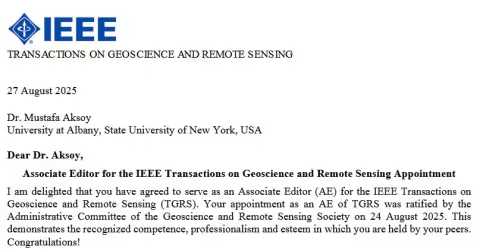
August 2025 - Prof. Aksoy Appointed as an Associate Editor of IEEE TGRS

TGRS AE

Prof. Aksoy has been appointed as an Associate Editor for IEEE Transactions on Geoscience and Remote Sensing (TGRS), our flagship journal in the field of remote sensing! He is grateful for this opportunity and looking forward to helping fellow experts advance geoscience and remote sensing technologies.


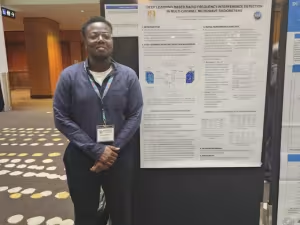
August 2025 - John and Lennox at IGARSS 2025!

Apudo IGARSS2025
Bradburn IGARSS2025

PhD students John Bradburn and Lennox Apudo from UAlbany Microwave Remote Sensing Laboratory presented our research on polar remote sensing, radiometer calibration techniques, and interference detection and mitigation algorithms for microwave radiometers at the 2025 International Geoscience and Remote Sensing Symposium (IGARSS2025) in Brisbane, Australia. The four papers they presented will be available on IEEE Xplore this fall.


June 2025 - Rahul defended his dissertation!

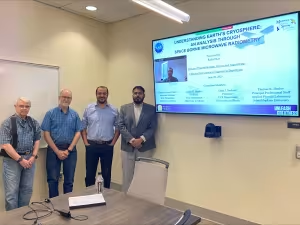
Rahul Kar's Dissertation Defense

Huge congrats to Rahul Kar for nailing his dissertation defense! Rahul’s research has made significant contributions to the microwave remote sensing literature, and demonstrated that wideband microwave radiometry holds great potential for observing and understanding the most vulnerable regions of our home planet. We are proud of his achievements and excited for the impact he’ll continue to have in remote sensing and beyond. Congratulations, Dr. Kar!


June 2025 - New NOAA Grant!

We, in collaboration with NASA Jet Propulsion Laboratory, NASA Goddard Space Flight Center, The Ohio State University, and Noctua Technologies, have secured a ~$1.1 million grant from NOAA to develop interference detection and management strategies for the next-generation NOAA radiometers! The MRSL team will lead the development of machine-learning based interference detection algorithms. 


May 2025 - New openings at MRSL!

Multiple graduate student and post-doctoral researcher positions are available at the Microwave Remote Sensing Laboratory. Please check the "Openings!" tab for more details and application instructions. 


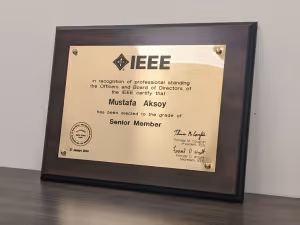
Prof. Aksoy IEEE Senior Member Plaque

May 2025 - Prof. Aksoy has been elevated to Senior Member of IEEE!

Prof. Aksoy received his IEEE Senior Member plaque! Being recognized as a Senior Member is an honor, and he is grateful for the support of his mentors, colleagues, students, and the IEEE community!


March 2025 - Papers accepted for IGARSS 2025!

Four papers from our lab have been accepted for presentation at the 2025 International Geoscience and Remote Sensing Symposium (IGARSS2025)! In Brisbane, Australia this summer, we will present our work on polar remote sensing and novel calibration and interference detection algorithms for microwave radiometers.

IGARSS 2025


February 2025 - New Paper on CubeSat Radiometer Calibration!

Please see our new open access paper, published in MDPI Remote Sensing, introducing a framework to calibrate constellations of CubeSat radiometers as single systems.


January 2025 - Presentations at URSI NRSM and AMS 2025!

Our group is kicking off the new year with three presentations at the 2025 National Radio Science and AMS Annual meetings! Please see them if you are attending those conferences and interested in remote sensing science and technologies for Earth observations. 

At the 2025 National Radio Science Meeting, John Bradburn, a PhD student in our group will present his machine-learning based radiometer calibration studies. His presentation, on Jan 9 between 4:50 - 5:10 pm MT, is titled "Evaluating a Convolutional Neural Network Calibration Algorithm using a 500GHz Radiometer."

At the 2025 AMS Annual meeting, Rahul Kar, another PhD student in our group, will present his analyses of in-situ precipitation measurements near the Ross Ice Shelf of Antarctica between 2017 and 2019. Rahul spent his summer at NSF NCAR - The National Center for Atmospheric Research as a graduate student fellow, and this is the result of his work at NCAR. His poster presentation, titled "Analysis of In-situ Precipitation Measurement across Four sites near the Ross Ice Shelf of Antarctica for Identification of Snowfall Events," will be on Jan 12, between 6.30 pm - 8.30 pm CT.

Finally, Sidharth Misra from NASA Jet Propulsion Laboratory will present our new collaborative project to develop novel interference detection, mitigation, and management strategies for future NOAA radiometry missions at the 2025 AMS Annual Meeting. The presentation, on Jan 15 between 11.45 am - 12 pm CT, is titled "NOAA-Passive Radiometer Interference Management for Earth-Observing Systems (N-PRIME)."


January 2025 - Undergraduate Research Funding!

Microwave Remote Sensing Laboratory has received $3,150 from the Minerva Center at the University at Albany to support undergraduate researchers working on Planetary Remote Sensing projects during the Spring 2025 term. 


September 2024 - The Conversation Article!

Prof. Aksoy authored an article ha on hashtagCubeSats and their potential to revolutionize hashtagssp space exploration! The article has been published by The Conversation U.S and shared on SpaceDaily.com.


August 2024 - Prof. Aksoy's Promotion to Associate Professor with Tenure!

Effective 9/1/2024, Prof. Aksoy has been promotoed to Associate Professor with tenure! This wouldn't have happened without the support of his current and former advisors, colleagues, and students at the University at Albany, NASA Goddard Space Flight Center, University of Maryland Baltimore County, ElectroScience Laboratory, The Ohio State University, and Bilkent University. He is grateful to all of them, and looking forward to working together in the future as well.


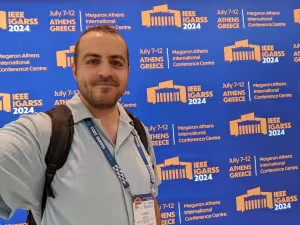
July 2024 - IGARSS 2024!

IGARSS 2024

Three hashtagpresentations at hashtagIGARSS2024! 

We will be presenting our studies on (1) hashtaginterference hashtagdetection methods in hashtagmicrowave hashtagradiometry (on 7/9), (2) novel hashtagradiometer hashtacalibration techniques (on 7/10), and (3) passive hashtagremote hashtagsensing of the hashtaglunar regolith (7/11)! 

And looking forward to meeting with other remote sensing enthusiasts and learning more about their work.


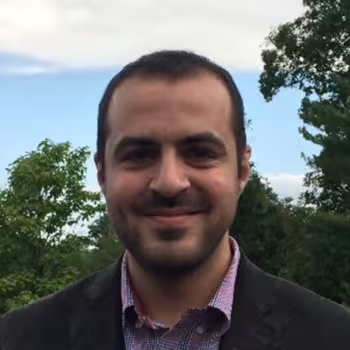
Prof. Mustafa Aksoy (Principal Investigator)

Mustafa Aksoy


Mustafa Aksoy (LinkedIn, Google Scholar, X, CV) is an Associate Professor, an Equity and Excellence in Education Fellow, and the Undergraduate Program Director in the Department of Electrical and Computer Engineering at the University at Albany, State University of New York. Currently, he is also serving as an Associate Editor for IEEE Transactions on Geoscience and Remote Sensing.

He obtained his B.S. in Electrical and Electronics Engineering from Bilkent University in Turkey, and his M.S. and Ph.D. in Electrical and Computer Engineering from The Ohio State University. Before joining the University at Albany, Dr. Aksoy was a Post-Doctoral Research Associate at the University of Maryland Baltimore County and NASA Goddard Space Flight Center.

Prof. Aksoy’s research interests span across Earth and planetary remote sensing, microwave technologies, electromagnetic theory, and signal processing; and he has authored more than 70 refereed journal articles and conference papers, focusing on topics like microwave radiometry for Earth and Planetary observations, radio frequency interference detection and mitigation in passive remote sensing, and innovative radiometer calibration techniques. Prof. Aksoy has been recognized for his contributions to those fields, receiving prestigious awards such as the NSF Faculty Early Career Development (CAREER) Award and the NASA Early Career Faculty Award. His research has been supported by significant grants from NSF, NASA, ORAU, NOAA, and SUNY amounting to approximately $3.6 million, with him as the sole investigator for projects worth about $2.5 million.

Dr. Aksoy is a Senior Member of IEEE and a member of the American Geophysical Union.

To learn more about Dr. Aksoy and his research, please check his Microwave Remote Sensing Laboratory website.


Contact Information:
Email: [email protected]
Phone: +1-518-442-2597
Office: CNSE Downtown, 305F, University at Albany, 1400 Washington Ave, Albany, NY, 12222, USA


Members


Current Members

John W. Bradburn (email: [email protected]): John Bradburn joined MRSL as a graduate student in June 2019. He graduated in Spring 2019 with a Bachelor’s degree in Computer Science from the University at Albany, and started working as a graduate research assistant in the Department of Electrical and Computer Engineering in Summer 2019. Currently, he is pursuing his PhD studies focusing on novel radiometer calibration algorithms.

Lennox Apudo (email: [email protected]): Lennox Apudo joined MRSL in Spring 2024 as a PhD student. His research interests include machine learning algorithms for microwave radiometer calibration.


Past Members

Rahul Kar, PhD (Spring 2020 – Summer 2025, Graduated with PhD, Research Topic: Microwave Remote Sensing of Earth's Cryosphere) 

Imara Nazar, PhD (Fall 2020 – Spring 2024, Graduated with PhD, Research Topic: Radio Frequency Interference Detection and Mitigation in Microwave Radiometry)

Jerusha Ashlin Devadason (Fall 2020 – Spring 2021, Graduated with MS, Project Title: Verification of Radiative Transfer Models Developed for Ice Sheets)

Falon Treis (Fall 2020 – Spring 2021, Project Title: Microwave Remote Sensing of the Moon, Falon was a MS student in the Geographic Information Science Program)

Prethiga Sugumar (Fall 2019, Graduated with MS, Project Title: Simulation of Surface Microwave Emissions from the Antarctic Ice Sheet)

Hamid Rajabi (Summer 2018 – Fall 2019, Graduated with MS, Project title: RFI Detection and Mitigation in Microwave Radiometry)

Lauren Aldrin Bernard (Spring 2025, Undergraduate Researcher, Project title: Electrical Characterization of the Lunar Regolith for Future Lunar Remote Sensing Missions)

Varvara Vukolov (Summer 2023, Undergraduate Researcher, Project title: ACCURACy: Adaptive Calibration of CUbesat RAdiometer Constellations)

Angela Totaro (Spring 2023, Undergraduate Researcher, Project title: ACCURACy: Adaptive Calibration of CUbesat RAdiometer Constellations)

Kathryn M. Rooney (Spring 2023, Undergraduate Researcher, Project title: Characterization of Antarctic Firn by Multi-Frequency Passive Remote Sensing from Space)

Harshitha Kona (Spring 2023, Undergraduate Researcher, Project title: Characterization of Antarctic Firn by Multi-Frequency Passive Remote Sensing from Space)

Dua Kaurejo (Summer 2021 – Summer 2022, Undergraduate Researcher, Project title: Characterization of Antarctic Firn by Multi-Frequency Passive Remote Sensing from Space)

Dylan Vanallen (Summer 2021, Undergraduate Researcher, Project title: ACCURACy: Adaptive Calibration of CUbesat RAdiometer Constellations)

Henry Ashley (Summer 2020 – Spring 2021, Undergraduate Researcher, Project title: ACCURACy: Adaptive Calibration of CUbesat RAdiometer Constellations, Henry was a Mathematics/Physics major)

Dennis Lee (Spring 2020, Undergraduate Researcher, Project title: Microwave Remote Sensing of the Lunar Regolith)

Pranjal Atrey (Summer 2019 – Spring 2020, Undergraduate Researcher, Project title: Characterization of Antarctic Firn by Multi-Frequency Passive Remote Sensing from Space)

Research


The Microwave Remote Sensing Laboratory at the University at Albany focuses on advancing science and technologies for Earth and planetary microwave remote sensing. Our research addresses critical challenges in understanding Earth's cryosphere and lunar regolith, and develops novel radiometer calibration and radio frequency interference (RFI) techniques for microwave radiometers, contributing to both environmental monitoring and space exploration.

Our laboratory has been actively engaged in several cutting-edge research, supported by the National Science Foundation (NSF), the National Aeronautics and Space Administration (NASA), the National Oceanic and Atmospheric Administration (NOAA), Oak Ridge Associated Universities (ORAU), and the University at Albany with a total research budget of ~$3,6 million as of 2025.

Below are highlights of some of our recent research projects:
 

NOAA-Passive Radiometer Interference Management for Earth-Observing Systems (N-PRIME) (2025-2027)

NOAA Logo

This project, supported by NOAA, focuses on developing advanced RFI detection and mitigation strategies for passive microwave radiometers used in Earth observation. Our work aims to enhance the accuracy of environmental data collected by NOAA's satellite systems, supporting improved weather forecasting and climate monitoring.
 

Enabling the Next Generation Wideband Microwave Radiometers for the Remote Sensing of the Cryosphere (2022-2027)

NSF Logo

This NSF CAREER project is developing next-generation wideband microwave radiometers to study the cryosphere, particularly Antarctic and Greenland ice sheets. By improving radiometer design and calibration, we aim to retrieve critical subsurface properties, such as firn density and temperature, to better understand ice sheet dynamics and their response to climate change.
 

Enabling Low-Power Smart Sensors with Machine Learning Calibration (2021-2025)

NASA Logo

This project, supported by NASA's Space Technology Graduate Research Opportunities program, leverages machine learning to develop low-power calibration techniques for microwave radiometers. By reducing power requirements, we enable the deployment of compact, cost-effective sensors, such as CubeSats, for remote sensing applications in both Earth and planetary science missions.
 

ACCURACy: Adaptive Calibration of CubeSat Radiometer Constellations (2019-2025)

NASA Logo

The ACCURACy project, supported by NASA's Early Career Faculty program, pioneers a novel calibration framework for CubeSat radiometer constellations, enhancing their precision and reliability. This work supports the use of small satellites for high-resolution Earth and planetary observations, with possible applications in climate monitoring and lunar exploration.
 

Electrical Characterization of the Lunar Regolith for Future Lunar Remote Sensing Missions (2025)

UAlbany Logo

This project, supported by the Minerva Center at the University at Albany, investigates the electrical properties of lunar regolith using wideband microwave radiometry. Our findings will inform the design of future lunar remote sensing missions, supporting NASA's Artemis program and the exploration of lunar resources.
 

Characterization of Antarctic Firn by Multi-Frequency Passive Remote Sensing from Space (2019-2023)

NSF Logo

This project, supported by NSF's Antarctic Research Program, developed methods to retrieve Antarctic firn properties such as subsurface density and temperature using multi-frequency space-borne radiometer measurements provided by the Global Precipitation Measurement constellation, enhancing our understanding of ice sheet stability.
 

Characterization of Lunar Regolith and Bedrock Using Wideband Microwave Radiometry (2019-2022)

NASA Logo

This project, supported by NASA's Lunar Data Analysis Program, explored lunar surface properties using multi-frequency microwave radiometer measurements. Chinese Chang'E-1 and Chang'E-2 orbiter data were analyzed to retrieve physical, thermal, and chemical properties of the lunar regolith, and the results provided valuable insights about measurement and instrument requirements for future lunar radiometry missions.
 

Study of the Greenland Ice Sheet Using Wideband Microwave Radiometry (2019-2021)

ORAU Logo

This project, supported by an ORAU Ralph E. Powe Junior Faculty Enhancement award, investigated Greenland ice sheet properties using wideband radiometry data provided by the Global Precipitation Measurement constellation. The results demonstrated that wideband microwave radiometer measurements may enable retrieval of subsurface ice sheet properties versus depth. 
 

Ensemble Detector: A Novel Tool for Analysis of Non-Stationary Processes (2018-2020)

NASA Logo

This project, supported by NASA, developed a novel method to analyze the gain and offset of microwave radiometers. Project results revealed that an analytical relationship between calibration parameters and errors & uncertainties in the calibrated radiometer products can be derived in case radiometer processes are stationary. This relationship has enabled adjusting calibration parameters to minimize errors and uncertainties in radiometer measurements. 
 

Publications


Microwave Radiometry for Cryosphere Studies

  1. Kar, R., Aksoy, M., & Apudo, L. (2025, August). A Study of Ice Dielectric Constant versus Temperature and Frequency. In IGARSS 2025-2025 IEEE International Geoscience and Remote Sensing Symposium (Accepted). IEEE.
  2. Kar, R., & Aksoy, M. (2024). Passive Microwave Remote Sensing of the Antarctic Ice Sheet: Retrieval of Firn Properties Near the Concordia Station. IEEE Geoscience and Remote Sensing Letters, 21, 1-5.
  3. Kar. R., & Aksoy, M. (2024, January). Revisiting the Water Permittivity: 0-50 GHz Measurements at Temperatures up to 50 ºC. In 2024 United States National Committee of URSI National Radio Science Meeting (USNC-URSI NRSM) (pp. 316-317). IEEE.
  4. Jezek, K., Johnson, J. T., Tsang, L., Brogioni, M., Macelloni, G., Aksoy, M., Kaleschke, L., Wang, S., Leduc-Leballeur, M., Yardim, C., Andrews, M., Xu, H., Demir, O., Tan, S., & Miller, S. (2022). A Review of Recent Developments in Low-Frequency Ultra-Wideband Microwave Radiometry for Studies of the Cryosphere. Frontiers in Earth Science, 10, 1029216.
  5. Kar, R., Aksoy, M., & Kaurejo, D. (2022, July). Retrieving Physical Properties of the Antarctic Firn via Spaceborne Microwave Radiometry. In IGARSS 2022-2022 IEEE International Geoscience and Remote Sensing Symposium (pp. 3975-3978). IEEE.
  6. Kaurejo, D., Aksoy, M., & Kar, R. (2022, July). Analysis of Polar Firn Density and Grain Size Models Using Available Data. In IGARSS 2022-2022 IEEE International Geoscience and Remote Sensing Symposium (pp. 3987-3990). IEEE.
  7. Duan, Y., Yardim, C., Duran, M., Jezek, K., Johnson, J. T., Bringer, A., Tan, S., Tsang, L., & Aksoy, M. (2022). Feasibility of Estimating Ice Sheet Internal Temperatures Using Ultra-Wideband Radiometry. IEEE Transactions on Geoscience and Remote Sensing, 60, 1-11.
  8. Kar, R., Aksoy, M., Kaurejo, D., Atrey, P., & Devadason, J. A. (2022). Antarctic Firn Characterization via Wideband Microwave Radiometry. Remote Sensing, 14(9), 2258.
  9. Kar, R., Aksoy, M., & Kaurejo, D. (2022, May). Multi-Frequency Microwave Radiometry for Retrieving Antarctic Firn Subsurface Temperatures. In 2022 3rd URSI Atlantic and Asia Pacific Radio Science Meeting (AT-AP-RASC) (pp. 1-4). IEEE.
  10. Kar. R., Aksoy, M., & Kaurejo, D. (2022, January). Antarctic Firn Characterization through Wideband Microwave Radiometry. In 2022 United States National Committee of URSI National Radio Science Meeting (USNC-URSI NRSM) (pp. 246-247). IEEE.
  11. Johnson, J. T., Jezek, K. C., Macelloni, G., Brogioni, M., Tsang, L., Dinnat, E. P., Walker, J. P., Ye, N., Misra, S., Piepmeier, J. R., Bindlish, R., LeVine, D. M., O’Neill, P. E., Kaleschke, L., Andrews, M. J., Yardim, C., Aksoy, M., Durand, M., Chen, C., Demir, O., Bringer, A., Miller, J. Z., Brown, S. T., Kwok, R., Lee, T., Kerr, Y., Entekhabi, D., Peng, J., Colliander, A., Chan, S., MacGregor, J. A., Medley, B., DeRoo, R., & Drinkwater, M. (2021). Microwave Radiometry at Frequencies From 500 to 1400 MHz: An Emerging Technology for Earth Observations. IEEE Journal of Selected Topics in Applied Earth Observations and Remote Sensing, 14, 4894-4914.
  12. Kar, R., Aksoy, M., Devadason, J., & Atrey, P. (2021, July). Potential of the Global Precipitation Measurement Constellation for Characterizing the Polar Firn. In IGARSS 2021-2021 IEEE International Geoscience and Remote Sensing Symposium (pp. 5607-5610). IEEE.
  13. Aksoy, M., Kar, R., Sugumar, P., & Atrey, P. (2020, September). Multi-Frequency Passive Remote Sensing of Ice Sheets from L-Band to W-Band. In IGARSS 2020-2020 IEEE International Geoscience and Remote Sensing Symposium (pp. 2995-2998). IEEE.
  14. Aksoy, M. (2018, July). Retrieval of Near-Surface Ice Sheet Properties Using the Global Precipitation Measurement (GPM) Radiometer Constellation. In IGARSS 2018-2018 IEEE International Geoscience and Remote Sensing Symposium (pp. 5161-5164). IEEE.
  15. Jezek, K. C., Johnson, J. T., Tan, S., Tsang, L., Andrews, M. J., Brogioni, M., Macelloni, G., Durand, M., Chen, C-C., Belgiovane, D. J., Duan, Y., Yardim, C., Li, H., Bringer, A., & Aksoy, M. (2017). 500–2000-MHz Brightness Temperature Spectra of the Northwestern Greenland Ice Sheet. IEEE Transactions on Geoscience and Remote Sensing, 56(3), 1485-1496.
  16. Johnson, J. T., Jezek, K. C., Aksoy, M., Bringer, A., Yardim, C., Andrews, M., ... & Duan, Y. (2016, July). The Ultra-wideband Software-Defined Radiometer (UWBRAD) for ice sheet internal temperature sensing: Results from recent observations. In 2016 IEEE International Geoscience and Remote Sensing Symposium (IGARSS) (pp. 7085-7087). IEEE.
  17. Duan, Y., Durand, M., Jezek, K., Yardim, C., Bringer, A., Aksoy, M., & Johnson, J. (2016, July). Testing the feasibility of a Bayesian retrieval of Greenland ice sheet internal temperature from Ultra-Wideband Software-Defined Microwave Radiometer (UWBRAD) measurements. In 2016 IEEE International Geoscience and Remote Sensing Symposium (IGARSS) (pp. 7092-7093). IEEE.
  18. Tan, S., Aksoy, M., Brogioni, M., Macelloni, G., Durand, M., Jezek, K. C., Wang, T-L., Tsang, L., Johnson, J. T., Drinkwater M. R., & Brucker, L. (2015). Physical Models of Layered Polar Firn Brightness Temperatures from 0.5 to 2 GHz. IEEE Journal of Selected Topics in Applied Earth Observations and Remote Sensing, 8(7), 3681-3691.
  19. Jezek, K. C., Johnson, J. T., Drinkwater, M. R., Macelloni, G., Tsang, L., Aksoy, M., & Durand, M. (2014). Radiometric Approach for Estimating Relative Changes in Intraglacier Average Temperature. IEEE Transactions on Geoscience and Remote Sensing, 53(1), 134-143.
  20. Aksoy, M., Johnson, J. T., Jezek, K. C., Durand, M., Drinkwater, M., Macelloni, G., & Tsang, L. (2014, July). An examination of multi-frequency microwave radiometry for probing subsurface ice sheet temperature. In 2014 IEEE Geoscience and Remote Sensing Symposium (pp. 3614-3617). IEEE.
  21. Macelloni, G., Brogioni, M., Aksoy, M., Johnson, J. T., Jezek, K. C., & Drinkwater, M. R. (2014, July). Understanding SMOS data in Antarctica. In 2014 IEEE Geoscience and Remote Sensing Symposium (pp. 3606-3609). IEEE.
     

Microwave Remote Sensing of the Lunar Regolith

  1. Aksoy, M. (2024, July). Remote Sensing of the Lunar Regolith: A Study of the Apollo 15 Site via Wideband Microwave Radiometry. In IGARSS 2024-2024 IEEE International Geoscience and Remote Sensing Symposium (pp. 6088-6091). IEEE.
  2. Aksoy, M., Hollibaugh Baker, D. M., Piepmeier, J. R., & De Amici G. (2023, July). L- to X-Band Passive Microwave Remote Sensing of the Lunar Regolith. In IGARSS 2023-2023 IEEE International Geoscience and Remote Sensing Symposium (pp. 4151-4153). IEEE.
  3. Aksoy, M. (2021). Detection of Water Ice in the Lunar Regolith via Microwave Radiometry. In 2021 XXXIVth General Assembly and Scientific Symposium of the International Union of Radio Science (URSI GASS) (pp. 1-4). IEEE.
  4. Aksoy, M., Walter, I., Hollibaugh Baker, D. M., & Piepmeier, J. R. (2020). Impact of Water Ice Presence in Lunar Regolith on Surface Brightness Temperatures from 1 to 10 GHz. LPI Contributions, 2241, 5125.
     

Radio Frequency Interference (RFI) Detection and Mitigation in Microwave Radiometry

  1. Aksoy, M., Nazar, I. M., & Apudo, L. (2025, August). Deep Learning Based Radio Frequency Interference Detection in Multi-Channel Microwave Radiometers. In IGARSS 2025-2025 IEEE International Geoscience and Remote Sensing Symposium (Accepted). IEEE.
  2. Nazar, I. M. & Aksoy, M. (2024, July). A One-Class Bayesian Algorithm for Radio Frequency Interference Detection in Microwave Radiometry. In IGARSS 2024-2024 IEEE International Geoscience and Remote Sensing Symposium (pp. 763-766). IEEE.
  3. Nazar, I. M. & Aksoy, M. (2023, July). Radio Frequency Interference Detection in Microwave Radiometry Using Multi-Dimensional Semi Supervised Learning. In IGARSS 2023-2023 IEEE International Geoscience and Remote Sensing Symposium (pp. 589-591). IEEE.
  4. Mohamed Nazar, I., & Aksoy, M. (2023). Radio Frequency Interference Detection in Passive Microwave Remote Sensing Using One-Class Support Vector Machines. IEEE Journal of Selected Topics in Applied Earth Observations and Remote Sensing, 16, 6682-6692.
  5. Zheleva, M., Anderson, C. R., Aksoy, M., & Johnson, J. T. (2023). Radio Dynamic Zones: Motivations, Challenges and Opportunities to Catalyze Spectrum Coexistence. IEEE Communication Magazine, 61(6), 156-162.
  6. Aksoy, M., & Nazar, I. M. (2022, July). A Multi-Dimensional Radio Frequency Interference Detection Algorithm for Microwave Radiometry. In IGARSS 2022-2022 IEEE International Geoscience and Remote Sensing Symposium (pp. 5278-5281). IEEE.
  7. Aksoy, M., Rajabi, H., Atrey, P., & Mohamed Nazar, I. (2021). Characteristics of the Global Radio Frequency Interference in the Protected Portion of L-Band. Remote Sensing, 13(2), 253.
  8. Nazar, I. M., & Aksoy, M. (2022, May). Radio Frequency Interference Detection in Microwave Radiometry: A Novel Feature-Based Statistical Approach. In 2022 3rd URSI Atlantic and Asia Pacific Radio Science Meeting (AT-AP-RASC) (pp. 1-4). IEEE.
  9. Nazar, I. M., & Aksoy, M. (2022, January). Radio Frequency Interference Detection in Microwave Radiometry Using Bayesian Detection. In 2022 United States National Committee of URSI National Radio Science Meeting (USNC-URSI NRSM) (pp. 249-250). IEEE.
  10. Nazar, I. M., & Aksoy, M. (2021). Radio Frequency Interference Detection in Microwave Radiometry Using Density Based Spatial Clustering. In 2021 XXXIVth General Assembly and Scientific Symposium of the International Union of Radio Science (URSI GASS) (pp. 1-4). IEEE.
  11. Mohamed Nazar, I., & Aksoy, M. (2020). Radio Frequency Interference Detection in Microwave Radiometry Using Support Vector Machines. Radio Science Letters, 2, 20-0034.
  12. Nazar, I. M., & Aksoy, M. (2020). Radio Frequency Interference Detection in Microwave Radiometry Using Support Vector Machines. Proceedings of the XXXIIIrd URSI General Assembly in Rome (virtual).
  13. Rajabi, H., & Aksoy, M. (2019). Characteristics of the L-band Radio Frequency Interference Environment Based on SMAP Radiometer Observations. IEEE Geoscience and Remote Sensing Letters, 16(11), 1736-1740.
  14. Aksoy, M., & Rajabi, H. (2019, July). Characteristics of Radio Frequency Interference in the Protected Portion of L-Band. In IGARSS 2019-2019 IEEE International Geoscience and Remote Sensing Symposium (pp. 4539-4542). IEEE.
  15. Aksoy, M. (2018, July). Evolution of the radio frequency interference environment faced by earth observing microwave radiometers in C and X bands over Europe. In IGARSS 2018-2018 IEEE International Geoscience and Remote Sensing Symposium (pp. 1226-1229). IEEE.
  16. Mohammed, P. N., Aksoy, M., Piepmeier, J. R., Johnson, J. T., & Bringer, A. (2016). SMAP L-band Microwave Radiometer: RFI Mitigation Prelaunch Analysis and First Year On-orbit Observations. IEEE Transactions on Geoscience and Remote Sensing, 54(10), 6035-6047.
  17. Johnson, J. T., Mohammed, P. N., Piepmeier, J. R., Bringer, A., & Aksoy, M. (2016, July). Soil Moisture Active Passive (SMAP) microwave radiometer radio-frequency interference (RFI) mitigation: Algorithm updates and performance assessment. In 2016 IEEE International Geoscience and Remote Sensing Symposium (IGARSS) (pp. 123-124). IEEE.
  18. Aksoy, M., Johnson, J. T., Misra, S., Colliander, A., & O'Dwyer, I. (2015). L-band Radio-Frequency Interference Observations During the SMAP Validation Experiment 2012. IEEE Transactions on Geoscience and Remote Sensing, 54(3), 1323-1335.
  19. Aksoy, M., Johnson, J. T., & Misra, S. (2014, July). Radio frequency interference observations using an L-Band direct sampling receiver during the SMAPVEX12 airborne campaign. In 2014 IEEE Geoscience and Remote Sensing Symposium (pp. 219-222). IEEE.
  20. Bradley, D., Morris, J. M., Adali, T., Johnson, J. T., & Aksoy, M. (2014, March). On the detection of RFI using the complex signal kurtosis in microwave radiometry. In 2014 13th Specialist Meeting on Microwave Radiometry and Remote Sensing of the Environment (MicroRad) (pp. 33-38). IEEE.
  21. Piepmeier, J. R., Johnson, J. T., Mohammed, P. N., Bradley, D., Ruf, C., Aksoy, M., Garcia, R., Hudson, D., Miles, L., & Wong, M. (2013). Radio-frequency Interference Mitigation for the Soil Moisture Active Passive Microwave Radiometer. IEEE Transactions on Geoscience and Remote Sensing, 52(1), 761-775.
  22. Aksoy, M., & Johnson, J. T. (2013). A Comparative Analysis of Low-level Radio Frequency Interference in SMOS and Aquarius Microwave Radiometer Measurements. IEEE Transactions on Geoscience and Remote Sensing, 51(10), 4983-4992.
  23. Misra, S., Johnson, J., Aksoy, M., Peng, J., Bradley, D., O'Dwyer, I., ... & Gaier, T. (2013, July). SMAP RFI mitigation algorithm performance characterization using airborne high-rate direct-sampled SMAPVEX 2012 data. In 2013 IEEE International Geoscience and Remote Sensing Symposium-IGARSS (pp. 41-44). IEEE.
  24. Aksoy, M., Johnson, J., Misra, S., & O'Dwyer, I. (2013, January). RFI characterization for SMAP using L-band direct sampled data obtained during the SMAPVEX12 airborne campaign. In 2013 US National Committee of URSI National Radio Science Meeting (USNC-URSI NRSM) (pp. 1-1). IEEE.
  25. Misra, S., Johnson, J., Aksoy, M., Bradley, D., Li, H., Mederios, J., ... & O'Dwyer, I. (2013, January). Performance characterization of the SMAP RFI mitigation algorithm using direct-sampled SMAPVEX 2012 data. In 2013 US National Committee of URSI National Radio Science Meeting (USNC-URSI NRSM) (pp. 1-1). IEEE.
  26. Aksoy, M., & Johnson, J. T. (2012). A Study of SMOS RFI over North America. IEEE Geoscience and Remote Sensing Letters, 10(3), 515-519.
  27. Aksoy, M., Park, J., & Johnson, J. T. (2011, August). Joint analysis of radio frequency interference from SMOS measurements and from airborne observations. In 2011 XXXth URSI General Assembly and Scientific Symposium (pp. 1-4). IEEE.
  28. Johnson, J. T., & Aksoy, M. (2011, July). Studies of radio frequency interference in SMOS observations. In 2011 IEEE International Geoscience and Remote Sensing Symposium (pp. 4210-4212). IEEE.
     

Radiometer Calibration

  1. Apudo, L., Bradburn, J., & Aksoy, M. (2025, August). Current Status of ACCURACy: Adaptive Calibration of CubeSat Radiometer Constellations. In IGARSS 2025-2025 IEEE International Geoscience and Remote Sensing Symposium (Accepted). IEEE.
  2. Bradburn, J., Aksoy, M., & Apudo, L. (2025, August). Evaluating a Convolutional Neural Network Calibration Model with Laboratory Data. In IGARSS 2025-2025 IEEE International Geoscience and Remote Sensing Symposium (Accepted). IEEE.
  3. Bradburn, J., Aksoy, M., Apudo, L., Vukolov, V., Ashley, H., & VanAllen, D. (2025). ACCURACy: A Novel Calibration Framework for CubeSat Radiometer Constellations. Remote Sensing, 17(3), 486.
  4. Bradburn J., & Aksoy, M. (2025, January). Evaluating a Convolutional Neural Network Calibration Algorithm Using a 500 GHz Radiometer. In 2025 United States National Committee of URSI National Radio Science Meeting (USNC-URSI NRSM) (p. 256). IEEE.
  5. Bradburn, J. W. & Aksoy, M. (2024, July). Minimizing Calibrated Measurement Uncertainties Using Convolutional Neural Networks. In IGARSS 2024-2024 IEEE International Geoscience and Remote Sensing Symposium (pp. 6268-6271). IEEE.
  6. Bradburn, J. W., Aksoy, M., & Racette. P. E. (2023, July). Reducing Instrument Power Using Neural Network Calibration. In IGARSS 2023-2023 IEEE International Geoscience and Remote Sensing Symposium (pp. 4392-4394). IEEE.
  7. Bradburn, J. W., Aksoy, M., & Racette. P. E. (2023, January). Enabling Low-power Radiometers with Machine Learning Calibration. In 2023 United States National Committee of URSI National Radio Science Meeting (USNC-URSI NRSM) (pp. 224-225). IEEE.
  8. Bradburn J., & Aksoy, M. (2022). ACCURACy: Adaptive Calibration of CubeSat Radiometer Constellations. GSICS Quarterly: Winter Issue 2022, Vol. 15 No 4, 2022, doi: 10.25923/1yfk-a604.
  9. Aksoy, M., & Bradburn, J. W. (2022, July). A Novel Calibration Framework for CubeSat Radiometer Constellations. In IGARSS 2022-2022 IEEE International Geoscience and Remote Sensing Symposium (pp. 4292-4295). IEEE.
  10. Bradburn, J. W., Aksoy, M., Racette, P. E., McClanahan, T., & Loftin, S. (2022, July). Enabling Low-Power Radiometers with Machine Learning Calibration. In IGARSS 2022-2022 IEEE International Geoscience and Remote Sensing Symposium (pp. 7218-7221). IEEE.
  11. Bradburn, J. W., & Aksoy, M. (2022, January). ACCURACy: Adaptive Calibration of Cubesat Radiometer Constellations. In 2022 United States National Committee of URSI National Radio Science Meeting (USNC-URSI NRSM) (pp. 26-27). IEEE.
  12. Bradburn, J. W., Aksoy, M., Racette, P. E., McClanahan, T., & Loftin, S. (2022, January). Enabling Low-power Radiometers with Machine Learning Calibration. In 2022 United States National Committee of URSI National Radio Science Meeting (USNC-URSI NRSM) (pp. 24-25). IEEE.
  13. Bradburn, J., Ashley, H., & Aksoy, M. (2021, July). ACCURACy: A Novel Approach to Calibrate CubeSat Radiometer Constellations. In IGARSS 2021-2021 IEEE International Geoscience and Remote Sensing Symposium (pp. 996-999). IEEE.
  14. Bradburn, J. W., Aksoy, M., & Ashley, H. R. (2021, January). ACCURACy: Adaptive Calibration of CUbesat RAdiometer Constellations. In 2021 United States National Committee of URSI National Radio Science Meeting (USNC-URSI NRSM) (pp. 96-97). IEEE.
  15. Aksoy, M., & Bradburn, J. W. (2020, October). Accuracy: Adaptive Calibration of Cubesat Radiometer Constellations. In IGARSS 2020-2020 IEEE International Geoscience and Remote Sensing Symposium (pp. 6357-6360). IEEE.
  16. Aksoy, M., Rajabi, H., Racette, P. E., & Bradburn, J. (2020). Analysis of Nonstationary Radiometer Gain Using Ensemble Detection. IEEE Journal of Selected Topics in Applied Earth Observations and Remote Sensing, 13, 2807-2818.
  17. Coakley, K. J., Splett, J., Walker, D., Aksoy, M., & Racette, P. (2020). Microwave Radiometer Instability Due to Infrequent Calibration. IEEE Journal of Selected Topics in Applied Earth Observations and Remote Sensing, 13, 3281-3290.
  18. Aksoy, M., & Racette, P. E. (2019). A Preliminary Study of Three-Point Onboard External Calibration for Tracking Radiometric Stability and Accuracy. Remote Sensing, 11(23), 2790.
  19. Aksoy, M., Racette, P. E., & Bradburn, J. W. (2019, July). Analysis of Non-Stationary Radiometer Gain Via Ensemble Detection. In IGARSS 2019-2019 IEEE International Geoscience and Remote Sensing Symposium (pp. 8893-8896). IEEE.
  20. Aksoy, M., & Racette, P. E. (2018, March). Tracking Radiometer Calibration Stability Using Three-Point Onboard Calibration. In 2018 IEEE 15th Specialist Meeting on Microwave Radiometry and Remote Sensing of the Environment (MicroRad) (pp. 1-4). IEEE.
  21. Aksoy, M., & Racette, P. E. (2017, July). Tracking calibration stability in climate monitoring microwave radiometers using onboard 3-point calibration. In 2017 IEEE International Geoscience and Remote Sensing Symposium (IGARSS) (pp. 2118-2120). IEEE.

Openings!


Postdoctoral Research Associate

Position Overview:

The Microwave Remote Sensing Laboratory, directed by Prof. Mustafa Aksoy, seeks a highly motivated Postdoctoral Research Associate to contribute to cutting-edge research in Earth and planetary remote sensing, microwave radiometry, and signal processing. The successful candidate will work on projects funded by NSF, NASA, and NOAA, focusing on remote sensing of Earth's Cryosphere, lunar remote sensing, and novel algorithms for radiometer calibration and radio frequency interference detection and mitigation.

Responsibilities:

  • Conduct independent and collaborative research in microwave remote sensing, including data analysis, algorithm development, and modeling.
  • Publish findings in peer-reviewed journals and present at international conferences.
  • Assist in grant proposal development and project management.
  • Mentor graduate and undergraduate students.

Qualifications:

  • Ph.D. in Electrical Engineering, Remote Sensing, Physics, Earth Sciences, Planetary Sciences, or a related field by the start date.
  • Expertise in microwave radiometry, electromagnetic theory, or signal processing.
  • Proficiency in programming (e.g., MATLAB, Python) and data analysis tools.
  • Excellent communication and teamwork skills.
  • Strong publication record and experience with grant-funded research preferred.

Appointment Details:

  • Full-time, 12-month position with a competitive salary and benefits.
  • Start date: Flexible, preferably Fall or Winter 2026.
  • Initial appointment for one year, renewable based on performance and funding.

Application Instructions:

Submit a cover letter, CV, research statement (max. 2 pages), and contact information for three references to [email protected]. Review of applications will begin immediately and continue until the position is filled.
 

Graduate Student Positions

Position Overview:

The Microwave Remote Sensing Laboratory, led by Prof. Mustafa Aksoy, invites applications from students interested in obtaining Ph.D. and M.S. from the University at Albany, State University of New York to join our dynamic research team. Students will engage in innovative projects in Earth and planetary remote sensing with opportunities to work on NSF, NASA, and NOAA-funded research.

Responsibilities:

  • Conduct research under Dr. Aksoy’s mentorship, including simulations, data analyses, and algorithm development.
  • Contribute to peer-reviewed publications and conference presentations.
  • Participate in lab activities, such as electrical characterization of Earth and Planetary samples and development of radiometer hardware.
  • Complete coursework and thesis/dissertation requirements for M.S. or Ph.D. degrees.

Qualifications:

  • B.S. or M.S. in Electrical Engineering, Physics, Computer Science, Earth Sciences, Planetary Science, or a related field.
  • Interest in microwave technologies, remote sensing, or electromagnetic theory.
  • Strong academic record and enthusiasm for research.
  • Effective communication and collaborative skills.
  • Experience with programming (e.g., Python, MATLAB) and microwave measurement tools (e.g., spectrum analyzers) is a plus.

Position Details:

  • Fully funded positions with monthly stipends, tuition waivers, and health benefits.
  • Start date: Flexible, preferably Fall or Winter 2026, or Spring 2027.

Application Instructions:

Interested candidates should apply to the University at Albany’s Electrical and Computer Engineering graduate program (M.S. or Ph.D.) and mention interest in Dr. Aksoy’s lab in their application. Additionally, email a CV and brief statement of research interests to [email protected]. Applications are reviewed on a rolling basis.