





5 Questions with Responsible AI Educator, UAlbany Alum Grace Begany

By Bethany Bump
ALBANY, N.Y. (Nov. 5, 2026) — When Grace Begany and her team set out to address social isolation and loneliness at the AI for Good Challenge held at UAlbany last month, they knew they wanted to design something to help young adults who report the highest rates of daily loneliness in the U.S.
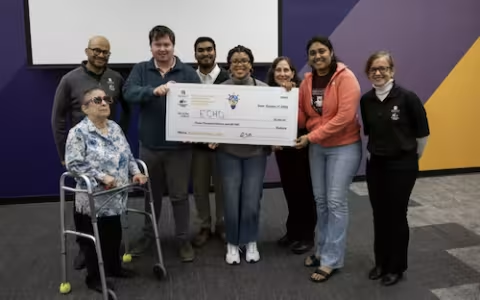
Her team, which included students and faculty from three different SUNY campuses, ended up taking home first place for ECHO, an AI-powered platform that helps college students build social skills and connect with others in real life.
For Begany, a UAlbany alumna who teaches courses on digital ethics and AI at SUNY Cobleskill, the challenge demonstrated that students are thinking critically and responsibly about AI.
“Our measure of success isn’t how much time students spend using ECHO. It’s what they feel ready to do without it,” her team said during its pitch presentation.
The challenge was one of three programs organized by UAlbany’s AI & Society College this year, made possible by a Leveraging AI grant from SUNY last spring. The grant is part of the broader Empire AI initiative, Gov. Kathy Hochul’s effort to advance AI research and education for the public good. Through the initiative, UAlbany is working with SUNY Oneonta, SUNY Cobleskill and Hudson Valley Community College to build AI capacity across campuses by supporting faculty development, cross-campus courses and microcredentials, and hands-on research and learning opportunities for students.
Begany, who got her PhD in Information Science from UAlbany in 2018, is chair, associate professor and director of the new Center for Applied Artificial Intelligence in the Department of Computing, Cybersecurity & Emerging Technologies at SUNY Cobleskill. In addition to the challenge, she took part in an AI Preparedness Academy and Faculty Exchange Program hosted by the AI & Society College this summer.
We caught up with the UAlbany alum about what she learned from the experience, the lessons she’s taking back to Cobleskill, and what cross-campus AI collaboration could mean for her students.
Why did you participate in the AI for Good Challenge?
I was inspired by the opportunity to join an interdisciplinary team focused on using AI in a meaningful way to solve a serious social issue, namely social isolation and loneliness. I was particularly drawn to the idea that the challenge was not simply about seeing who could build the most technically sophisticated AI application — but about asking how AI could be used thoughtfully to address a genuine human and community need. I also valued the cross-campus nature of the event because bringing together students and faculty from different institutions, disciplines, backgrounds and levels of technical experience creates the kind of creative environment in which people can learn from each other and approach a problem from perspectives they might not otherwise encounter.
What did your team come up with?
Our team worked together to create “ECHO,” an AI-powered social intelligence platform for college students. The ECHO app helps students who find social settings challenging learn to read social cues, navigate conversations and build meaningful connections through practice. It offers short lessons that build social skills and provide guidance in the moment through role-play scenarios and adaptive, personal feedback. Then, ECHO recommends real campus events and communities matched to the student's goals and interests, so students can more confidently connect with others in person.
What did the challenge reveal about how students are thinking about AI?
I learned that although many students have real concerns about where AI is headed and its ethical implications for society, they also have strong hope in its potential. As such, students really appreciated the challenge’s focus on responsible AI and embraced the requirement to evaluate their AI application through an ethical lens. This was an important opportunity for teams to explore what responsible AI innovation actually looks like in practice: not just asking whether we can use AI to solve a problem, but whether we should use it, who will benefit, who might be left out, what unintended consequences could result, and how we can design technology that ultimately serves people and communities.
How did the AI Preparedness Academy influence your approach to teaching with and about AI?
The academy gave me dedicated time to reflect more deeply on how I use AI in my teaching and encouraged me to make greater use of intentional scaffolding, helping students build their knowledge and reasoning gradually through structured practice, feedback and increasing independence. This is especially valuable in my AI literacy course, where students are often asked to evaluate complex and sometimes conflicting claims about artificial intelligence. The academy also inspired me to place greater emphasis on Socratic inquiry, particularly in my digital ethics course, where many questions surrounding AI do not have simple or certain answers. Going forward, I want to connect these approaches more deliberately by scaffolding not only what students learn, but also how they question, analyze and form judgments.
How will the Faculty Exchange Program benefit your students?
Developing cross-campus AI offerings gives our students access to a much broader range of expertise, courses, perspectives and learning opportunities than any one campus could provide on its own. Artificial intelligence is developing so quickly and touches so many disciplines that collaboration allows us to expose students not only to the technical dimensions of AI, but to its applications in areas such as agriculture, business, cybersecurity, data science and the social sciences, and important questions involving ethics and responsible use.
For students at smaller campuses like ours, a cross-campus model can greatly expand what is available to them without requiring every institution to independently develop the same courses, faculty expertise or infrastructure.
It also creates opportunities for students to learn from faculty and classmates at other institutions, work on interdisciplinary projects and build professional networks beyond their home campus.