





UAlbany Summer: Boiling River Expeditions Offer Lessons from the Rainforest to the Classroom

By Bethany Bump
ALBANY, N.Y. (Sept. 8, 2026) — UAlbany PhD student Alejandro Mundo spent part of the past two summers deep in the Peruvian Amazon as a member of an exclusive scientific and educational expedition to Shanay-timpishka, more commonly known as the Boiling River of the Amazon.
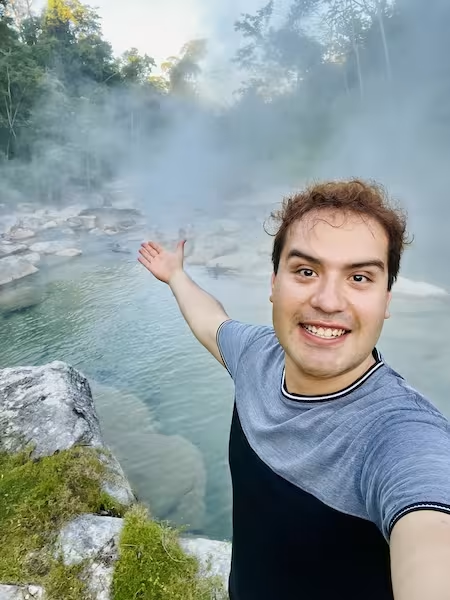
Selected from a competitive pool of more than 200 applicants to The Explorers Club's inaugural Teacher Fellowship Program, Mundo became one of the organization's first-ever Teacher Fellows last year, working alongside scientists, educators and indigenous community members to study the river and its surrounding rainforest. He returned this summer to continue that work.
The expeditions have brought Mundo into contact with one of the planet’s most biodiverse and culturally rich ecosystems. The geothermal wonder, made famous through decades of research led by geoscientist and expedition leader Andrés Ruzo, lives up to its name. With temperatures over 200 degrees Fahrenheit, the Boiling River is hot enough to instantly cook anything that falls into it.
"Seeing water at those temperatures flowing naturally through the jungle challenges everything you think you know about rivers," said Mundo, who is pursuing a PhD in Science and Mathematics Education through UAlbany’s Department of Educational Theory and Practice in the School of Education. "It's Earth science happening in real time.”
"It's about stepping into a living classroom, where Earth systems, climate, culture and community are all interconnected in ways you can't fully understand from a textbook,” he added.
From the Concrete Jungle to the Amazon Jungle
As someone who lives and taught Earth sciences to high schoolers in New York City for the past seven years, Mundo is aware of how difficult it can be for students to see and understand environmental challenges such as deforestation. From an urban classroom, rainforest loss can feel distant and abstract.
"In the city, students don't get to see deforestation or its impacts firsthand," he said. "You can teach about it, but it's not the same as standing in the jungle and seeing how land use, logging and environmental change affect ecosystems and communities in real time."
Stepping away from the city and into the Amazon allowed Mundo to witness these impacts directly. Bringing those experiences back into his classroom through curriculum, storytelling and data collection has made his teaching more powerful, offering students access to places they may never physically visit, he said.
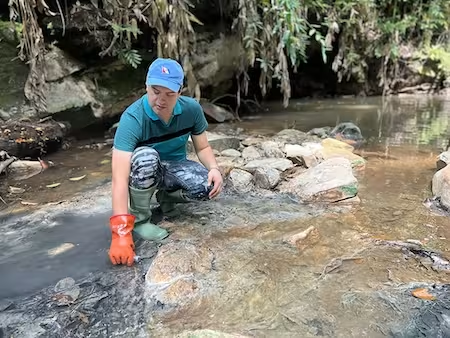
During the expedition, Mundo participated in hands-on scientific research, measuring and analyzing water turbidity, collecting water samples, studying the geology of the Boiling River, conducting mapping activities and examining rock samples from the surrounding region. These investigations helped document the river's geothermal characteristics and the broader Earth systems shaping the Amazon landscape.
"Collecting data in the field completely changes how you understand science," Mundo said. "It pushed me to think like both a researcher and an educator at the same time."
Learning From the Shipibo People
A central part of the expedition involved learning from the indigenous Shipibo people, whose ancestral knowledge of the forest, trees and river has been passed down for generations. Mundo spent time listening to community stories and engaging with Shipibo women who sell intricately designed quilts and clothing. Their artwork captures visions of the rainforest through symbols such as the ayahuasca flower, jaguars, anacondas and other animals central to Shipibo cosmology.
"This experience pushed me to think more deeply about these communities and how they are being affected by deforestation," Mundo said. "Their stories hold generations of ecological knowledge, and if they aren't shared, they risk being lost. Being more active in telling their stories is one way others can learn from them and contribute to protecting the rainforest."
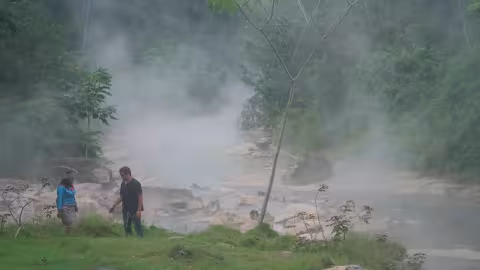
Mundo is now developing curriculum directly inspired by the expedition. His lesson plans focus on the Shipibo people and their relationship with the land, the geology and geothermal science of the Boiling River, climate change, sustainability, and the broader systems that make up the Amazon rainforest.
"The Amazon is often called the lungs of the Earth," Mundo said. "Seeing it firsthand reshaped how I think about climate systems and strengthened my responsibility as an educator to connect science with real people and places."
Students will be invited to compare the Amazon to urban environments, analyze deforestation and water quality, and explore how local actions connect to global climate systems.
"Exploration doesn't end when you leave the field," he said. "It continues every time you teach, tell a story, or help students see themselves as scientists and caretakers of the Earth."