


UAlbany Celebrates the Diversity of Disability
Disability Pride Month celebrates disability identity and community, marks the anniversary of the Americans with Disabilities Act (ADA), and pushes for full inclusion in everyday life. It is observed every July.
The 2026 Disability Pride Month theme — selected by The Arc’s National Council of Self-Advocates (NCSA), a disabled-led national council — is “The World Works Better With Us.”
When people with disabilities are included, respected and supported, our community becomes stronger for everyone. As students, faculty and staff, we all play a critical role in making the University more inclusive.
Did you know?
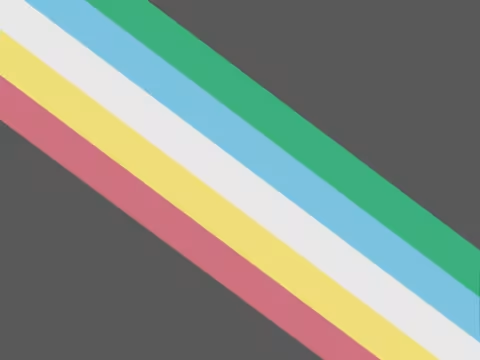
The Disability Pride Flag, created by disabled advocate Ann Magill, features a charcoal gray background with five muted diagonal stripes — each representing a different aspect of disability.
Learn about disabilities and inclusion
learn
Documentaries
The Ride Ahead (PBS): Turning 21, Samuel Habib wants to date, leave home and go to college. Yet every rite of passage is fraught with challenges. Seizures and uncontrollable movements. Friends' homes inaccessible to his wheelchair. Degrading ableist encounters. “No one tells you how to be an adult,” he says, “let alone an adult with a disability.” Can a community of disability activists help him follow his dreams?
Change, Not Charity: The Americans with Disabilities Act (PBS): The emotional and dramatic story of the decades-long push for equality and accessibility that culminated in the passage of the ADA in 1990. A story of courage and perseverance, the film highlights the determined people who literally put their bodies on the line to achieve their goal and change the lives of all Americans.
Murderball (Amazon Prime): Quadriplegics, who play full-contact rugby in wheelchairs, overcome unimaginable obstacles to compete in the Paralympic Games in Athens, Greece.
Crip Camp (Netflix): A groundbreaking summer camp galvanizes a group of teens with disabilities to help build a movement, forging a new path toward greater equality. Access the Crip Camp discussion guide.
Ice Gold: From Worst to First (Peacock): The true story of the underdog 2002 U.S. Paralympic Sled Hockey team that went from dead last to Gold Medal champions.
Lives Worth Living (PBS): People with disabilities are one of the largest minorities in the United States. But for most of American history, they occupied a sub-class of millions without access to everyday things most citizens take for granted: schools, apartment buildings, public transportation, and more. Some were forcibly sterilized under state laws. Others were committed to horrifying institutions where they were left and forgotten. After World War II, however, things began to change, thanks to a small group of determined people with an unwavering determination to live their lives like anyone else, and to liberate all disabled Americans of the limitations their government refused to accommodate. Lives Worth Living traces the development of consciousness of these pioneers who realized that to change the world they needed to work together.
Becoming Helen Keller (PBS): Revisit the complex life and legacy of the author, advocate and human rights pioneer. Helen Keller, who was deaf and blind, used her celebrity and wit to champion rights for women, people with disabilities and people living in poverty.
Deej (Kanopy): Abandoned by his birth parents, DJ Savarese finds a loving family which helps him learn to communicate. As he makes his way through high school and dreams of college, he advocates on behalf of non-speaking autistic people.
My Beautiful Broken Brain (Netflix): After suffering a stroke at age 34, a woman documents her struggles, setbacks and eventual breakthrough as she relearns to speak, read and write.
The Reason I Jump (Roku Channel): Filmmaker Jerry Rothwell examines the lives of five non-speaking young people who live with autism spectrum disorder, blending their stories with writer Naoki Higashida's insights into autism.
Feature Films
Out of My Mind (Disney Plus): Melody Brooks, a sixth grader with cerebral palsy, has a quick wit and a sharp mind, but because she is non-verbal and uses a wheelchair, she is not given the same opportunities as her classmates. When a young educator notices her student’s untapped potential and Melody starts to participate in mainstream education, Melody shows that what she has to say is more important than how she says it.
CODA (Apple TV): As a child of deaf adults (CODA), Ruby is the only hearing person in her home. When she discovers a passion for singing, Ruby must choose between family obligations and her dreams.
Finding Dory (Disney Plus): Dory, a fish who has short-term amnesia and anxiety, searches for her parents with the help of friends, many of whom have disabilities.
TV Shows
You Can’t Ask That (Netflix): In this award-winning documentary series, people from marginalized groups respond candidly to questions about their identities and experiences.
Everything’s Gonna Be Okay (Hulu): Nicholas is an anxious 20-something visiting his dad and teenage half-sisters, one of whom is on the autism spectrum. When Nicholas' trip is extended due to his father's untimely death, the siblings are left to cope with not only a devastating loss, but also the realization that Nicholas is the one who will have to rise to the occasion and hold it all together.
Baylen Out Loud (Hulu): Follow the journey of Baylen Dupree, a young woman living with an extreme case of Tourette Syndrome. Despite her daily challenges, Baylen and her family aren't afraid to laugh and embrace the chaos that makes their everyday lives in West Virginia unique. With Baylen yearning for independence, she'll need to rely less on her family and her long-term boyfriend, as she takes steps toward being in the world on her own.
Love on the Spectrum (Netflix): Seven adults with autism dive headlong into a dating group to explore the unpredictable world of romance, tackling misconceptions about both themselves and how they want to live.
Down for Love (Netflix): Follow six New Zealanders with Down syndrome as they search for love and happiness while navigating the trials and triumphs of dating.
Speechless (Amazon Prime): This family comedy centers on Maya DiMeo, a mom on a mission who will do anything for her husband and three kids Ray, Dylan, and JJ, her eldest son with cerebral palsy.
Short Videos
I'm not your inspiration, thank you very much (YouTube): Stella Young is a comedian and journalist who happens to go about her day in a wheelchair — a fact that doesn't, she'd like to make clear, automatically turn her into a noble inspiration to all humanity. In this very funny TED talk, Young breaks down society's habit of turning disabled people into "inspiration porn."
Disabusing Disability: Seeing the World Through Pearl’s Eyes (YouTube): After facing a spinal cord injury in his third year of orthopedic surgery residency at Yale that paralyzed him from the chest down, Dr. Feranmi Okanlami has worked to spread his message that DISability doesn’t mean INability. During this TEDx event talk, he shines a light on society’s perception and advocates that disability is not something that needs to be “fixed.”
Using a Screen Reader (University of Washington): Expert Hadi Rangin demonstrates how web content sounds to someone using screen reader software and shares characteristics of accessible web pages.
Disability Reframed (PBS News): PBS NewsHour’s Judy Woodruff takes a broad look at the unique challenges facing Americans with disabilities in this news series.
Making basketball more accessible (Facebook): OneCourt’s tactile broadcast devices use vibration and audio to help blind and low-vision fans experience Bucks games through touch.
Paris Paralympics Opening Ceremony Performance (YouTube): The International Paralympic Committee's vision is to make for an inclusive world through Para sport. Their mission is to lead the Paralympic Movement, oversee the delivery of the Paralympic Games and support members to enable Para athletes to achieve sporting excellence.
How XBox is making gaming accessible for all (BBC News): Xbox has released a new adaptive controller that can be used by more people with a range of disabilities. Microsoft was the first company to introduce an adaptive joystick back in 2018. Tech Now’s Paul Carter went to see the latest developments in accessible technology for disabled gamers and tested out Xbox’s new design.
The True Gifts of a Dyslexic Mind (YouTube): Advocate and educator Dean Bragonier goes beyond the common misconceptions about dyslexia to explain the neuroscience of how the dyslexic brain is actually structured differently — and what cognitive strengths that difference produces. Drawing on brain science and his work with researchers at Harvard and Tufts, Bragonier makes the case during this TEDx presentation that dyslexia is not a reading problem but a fundamentally different — and often powerful — way of processing the world.
Henry Winkler Shares How Being Diagnosed with Dyslexia Liberated Him (YouTube): The actor Henry Winkler spent 11 seasons playing The Fonz on Happy Days — and for much of that time, he was struggling with an undiagnosed learning disability. His parents called him "Dummer Hund" (Dumb Dog) and teachers said he wasn't living up to his potential. He didn't read a book until he was 31. This short interview clip is a compelling, personal window into what unidentified dyslexia looks like across a lifetime — and what changes when you finally have a name for it.
AXIS Dance Company (YouTube): Led by Artistic Director Nadia Adame and Managing Director Danae Rees, AXIS is one of the nation’s most acclaimed ensembles of disabled and non-disabled performers. AXIS was founded in 1987 and creates world-class productions that challenge perceptions and redefine dance and disability.
Disability Arts Ensemble Takes Access & Dance to New Heights (YouTube): Meet Kinetic Light, a disability arts ensemble led by disabled artists, as they create a thrilling aerial dance in the San Francisco Bay Area, home of the disability rights movement.
Books
The Anti-Ableist Manifesto: How to Build a Disability-Inclusive World by Tiffany Yu (University Libraries): Tiffany Yu takes readers on a revelatory examination of disability — how to unpack biases and build an inclusive and accessible world. As the Asian American daughter of immigrants, living with PTSD, and sustaining a permanent arm injury at age nine, Tiffany Yu is well aware of the intersections of identity that affect us all. She navigated the male-dominated world of corporate finance as an investment banker at Goldman Sachs before founding Diversability, an award-winning community business run by disabled people building disability pride, power, and leadership, and creating the viral Anti-Ableism series on TikTok. Organized from personal to professional, domestic to political, Me to We to Us, The Anti-Ableist Manifesto frames context for conversations, breaks down the language of ableism, identifies microaggressions, and offers actions that lead to authentic allyship. How do we remove ableist language from our daily vocabulary? How do we create inclusive events? What are the advantages of hiring disabled employees, and what market opportunities are we missing out on when we don't consider disabled consumers? With contributions from disability advocates, activists, authors, entrepreneurs, scholars, educators, and executives, Yu celebrates the power of stories and lived experiences to foster the proximity, intimacy, and humanity of disability identities that have far too often been 'othered' and rendered invisible.
Being Heumann: An Unrepentant Memoir of a Disability Rights Activist by Judy Heumman (University Libraries): One of the most influential disability rights activists in US history tells her personal story of fighting for the right to receive an education, have a job, and just be human. A story of fighting to belong in a world that wasn't built for all of us and of one woman's activism; from the streets of Brooklyn and San Francisco to inside the halls of Washington; Being Heumann recounts Judy Heumann's lifelong battle to achieve respect, acceptance, and inclusion in society. Paralyzed from polio at eighteen months, Judy's struggle for equality began early in life. From fighting to attend grade school after being described as a "fire hazard" to later winning a lawsuit against the New York City school system for denying her a teacher's license because of her paralysis, Judy's actions set a precedent that fundamentally improved rights for disabled people. As a young woman, Judy rolled her wheelchair through the doors of the US Department of Health, Education, and Welfare in San Francisco as a leader of the Section 504 Sit-In, the longest takeover of a governmental building in US history. Working with a community of over 150 disabled activists and allies, Judy successfully pressured the Carter administration to implement protections for disabled peoples' rights, sparking a national movement and leading to the creation of the Americans with Disabilities Act. Candid, intimate, and irreverent, Judy Heumann's memoir about resistance to exclusion invites readers to imagine and make real a world in which we all belong.
Demystifying disability: what to know, what to say, and how to be an ally by Emily Ladau (University Libraries): People with disabilities are the world's largest minority, an estimated 15 percent of the global population. But many of us — disabled and nondisabled alike — don't know how to act, what to say, or how to be an ally to the disability community. 'Demystifying Disability' is a friendly handbook on the important disability issues you need to know about, including: how to appropriately think, talk, and ask about disability; recognizing and avoiding ableism (discrimination toward disabled people); practicing good disability etiquette; ensuring accessibility becomes your standard practice, from everyday communication to planning special events; appreciating disability history and identity; and, identifying and speaking up about disability stereotypes in media. Authored by celebrated disability rights advocate, speaker, and writer, Emily Ladau, this practical, intersectional guide offers all readers a welcoming place to understand disability as part of the human experience.
Disability Visibility: First-Person Stories from the Twenty-First Century by Alice Wong (University Libraries): A groundbreaking collection of first-person writing on the joys and challenges of the modern disability experience: Disability Visibility brings together the voices of activists, authors, lawyers, politicians, artists, and everyday people whose daily lives are, in the words of playwright Neil Marcus, "an art ... an ingenious way to live." According to the last census, one in five people in the United States lives with a disability. Some are visible, some are hidden--but all are underrepresented in media and popular culture. Now, just in time for the thirtieth anniversary of the Americans with Disabilities Act, activist Alice Wong brings together an urgent, galvanizing collection of personal essays by contemporary disabled writers. There is Harriet McBryde Johnson's "Unspeakable Conversations," which describes her famous debate with Princeton philosopher Peter Singer over her own personhood. There is columnist s. e. smith's celebratory review of a work of theater by disabled performers. There are original pieces by up-and-coming authors like Keah Brown and Haben Girma. There are blog posts, manifestos, eulogies, and testimonies to Congress. Taken together, this anthology gives a glimpse of the vast richness and complexity of the disabled experience, highlighting the passions, talents, and everyday lives of this community. It invites readers to question their own assumptions and understandings. It celebrates and documents disability culture in the now. It looks to the future and past with hope and love.
The Reason I Jump: The Inner Voice of a Thirteen-Year-Old Boy with Autism by Naoki Higashida (University Libraries): Written a very smart, very self-aware, and very charming thirteen-year-old boy with autism, it is a one-of-a-kind memoir that demonstrates how an autistic mind thinks, feels, perceives, and responds in ways few of us can imagine. Parents and family members who never thought they could get inside the head of their autistic loved one at last have a way to break through to the curious, subtle, and complex life within. Using an alphabet grid to painstakingly construct words, sentences, and thoughts that he is unable to speak out loud, Naoki answers even the most delicate questions that people want to know.
Podcasts
Disability Visibility Project: This is life from a disabled lens. Disability Visibility is a podcast hosted by San Francisco night owl Alice Wong featuring conversations on politics, culture, and media with disabled people. If you’re interested in disability rights, social justice, and intersectionality, this show is for you.
The Accessible Stall: The Accessible Stall is a disability podcast hosted by Kyle Khachadurian and Emily Ladau that keeps it real about issues within the disability community. Because we each have different disabilities and mobility levels, we approach everything we talk about with two unique viewpoints, offering our listeners a fresh insight into how differences in disability can color your experiences and perspectives.
Disability After Dark: This is a podcast that looks at disability stories. it’s like sitting down with a really close friend to have real conversations about disability, sexuality and everything else about the disability experience that we don’t talk about; the things about being disabled we keep in the dark. The show is hosted by Disability Awareness Consultant Andrew Gurza.
The Neurodiversity Podcast: The world needs neurodiversity. The gifted brains, unusual talents, and fresh perspective of neurodivergent people drive innovation and change things for the better. The Neurodiversity Podcast introduces you to these brilliant, quirky, amazing people, and brings you thought-provoking conversations with leaders in psychology, education, and technology, as we work to broaden the definition of normal.
ADHD reWired: ADHD reWired is a weekly podcast hosted by Eric Tivers, LCSW, ADHD-CCSP. It features conversations with both ADHD experts and everyday ADHDers just like you.
Reflect on your lived experiences
More than one in four U.S. adults — more than 70 million people — have some type of disability. This Disability Pride Month, we encourage you to reflect on how disability has impacted your life and communities:
- Consider your perceptions and biases around disability
- Talk with family, friends and coworkers and/or write in a journal
- Learn about common digital accessibility barriers
- Advocate for disability rights and inclusion in your communities
- Share what pride means to you using #DisabilityPride and #DisabilityPrideMonth
- Attend a Disability Pride Month event, such as the July 8, 2026, celebration in Albany
Explore other ways to celebrate Disability Pride Month.
reflect
Disability Pride is about being accepted on our own terms. It means disability isn’t something to hide or fix. It’s part of who we are. Everyone deserves inclusion, rights and respect, without having to earn them. — The Arc
Take action to make UAlbany more accessible
Learn more about UAlbany's commitment to digital accessibility.
act
First Steps for Students, Faculty & Staff
- Request a Deque University account.
- Complete foundational digital accessibility training.
- Explore additional training relevant to your work and role.
Want to get more involved? Contact UAlbany's Electronic & Information Accessibility Officer Anne McGrath at [email protected].