





Sidequest Unlocked: UAlbany Students Study Video Game Music Through New Course
By Sophie Coker, Class of 2026
ALBANY, N.Y. (May 19, 2026) — Video games have been a dominant force on culture and society for decades, but especially for Gen Z students in college. Controllers keep fidgety hands busy, and visuals foster deep immersion in games. But if you listen closely, there’s more to your Mario Kart game than meets the eye.
At the University at Albany, game design and music students are breaking down video game music through a new course. “Harmony in Pixels: Introduction to Game Music, Audio and Sound,” a cross course between the Departments of Music and Theatre and Information Sciences and Technology, is taught by Assistant Professor of Music Technology and Game Audio Thomas Wilson.
Wilson’s students learn the step-by-step process of creating audio. They record and edit sound effects and dialogue, create their own music and master audio programming by eventually putting it into a real game.
Interdisciplinary by nature, the course also helps students develop an understanding of the history of consoles and technologies related to gaming.
“When we look at history, we really dive deep into the meaning of these songs and soundtracks,” Wilson said. “Students find that even from the beginning of music being in games, there has always been a purpose tied to interactivity. It’s different than film; it’s different than television. Everything you hear while playing a game is based on your decision.”
Music and the Player Experience
The interactive aspect of video games is what drew senior Gabriel Ross to game design. An informatics major with a concentration in game design and development, Ross sees games as a unique type of creative endeavor that he’s gotten to explore further in Wilson’s class.
“There’s no other media that conveys both storytelling and entertainment quite like video games,” Ross said. “They unfold in a unique way for every player. While music is usually set in fixed time, game music can be tailored to the player’s experience. You’re not just watching a video game; you’re a part of it.”
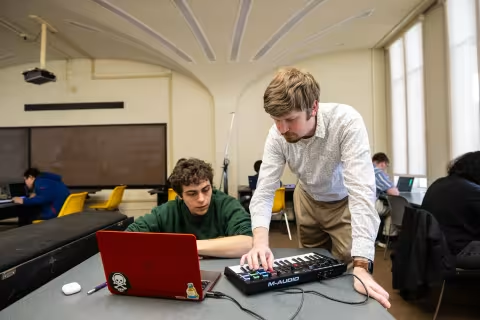
To fully understand the inner workings of game music, students set up personal technology systems and digital audio workstations to enable the production of their own creative works.
“I’ve learned a lot about quantizing notes from creative tools and software like Ableton Live 11,” said Jackie Denehy, a senior psychology major. “It makes you think more about how music makes you feel the mood and atmosphere of a game.”
Preparing for a Growing Industry
Last fall, UAlbany’s Department of Information Sciences & Technology launched a Bachelor of Science in Game Design and Development and a Master of Science in Strategic Game Design and Applied Development — the first graduate program focused on gaming in the SUNY system.
The programs arrived as the gaming industry continues to grow, including in the Capital Region. A report from the Center for Economic Growth found the region now hosts 20 gaming studios, employing more than 500 workers.
Wilson says UAlbany’s Game Design and Development programs look beyond the classroom, preparing students for careers in this growing industry.
“When we built the program, we went to Capital Region game developers and asked, ‘What are you looking for from students? What skills do you want the next generation of game developers to have?’” Wilson said. “And what they really wanted were flexible, team players. Equal emphasis is placed on the soft skills needed to make a game, like collaboration.”
For Ross, a senior aiming for a career in game design, Wilson’s class and UAlbany’s game design program have been essential to his path.
“It makes me feel hopeful for both the video game industry and game education that spaces like this are beginning to exist.”