





Ask an Expert: When Does Spring Actually Start?

ALBANY, N.Y (April 30, 2026) — June Wang is the director of the New York State Mesonet, operated by the University at Albany.
The New York State Mesonet is the most advanced and largest early-warning weather detection system in the nation. It features 127 standard weather stations, spaced an average of 17 miles apart across the state. Each site is equipped with automated sensors that measure various weather data points in real time, as well as a camera that photographs current conditions.
Wang answers today’s question: When Does Spring Actually Start?
Great question! Spring can be defined in several ways, depending on the system used. Astronomical spring is based on Earth’s position around the Sun and begins at the vernal equinox, typically between March 19 and 21 in the Northern Hemisphere. Meteorological spring, by contrast, follows a fixed calendar and runs from March 1 through May 31.
Scientists also use environmental indicators to determine when spring conditions actually begin in a specific location. These include sustained temperature patterns, growing degree days, snow cover, soil temperature, and phenological cues such as first leaf-out, flowering and bird migration. The USA National Phenology Network collects these biological observations and combines them with weather data to produce forecasts like the “Status of Spring.”
Here, we focus on the temperature-based, or “thermal,” start of spring, defined as the point when average daily temperatures remain above a threshold (typically around 41 degrees Fahrenheit in the northeastern U.S.) for five to seven consecutive days.
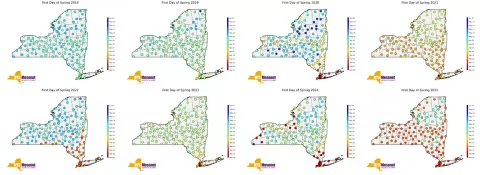
Using New York State Mesonet data from 2018 to 2026, we have identified the thermal spring date across New York State. The results show substantial spatial and year-to-year variation. Spring can begin before March 1 in some areas around New York City and as late as May 21 in colder regions of the state. On average, 2025 experienced the earliest and most widespread onset of spring, while 2018 had the latest. The data also reveal a general trend toward earlier spring onset over the past eight years, consistent with longer-term studies linking earlier spring conditions to regional warming.
Notably, as of 2026, spring has not yet arrived in the Adirondacks.
Curious about something — anything? Send us your question and we'll find an expert to answer.