





Showcase 2026: Cyber Student Explores Smartwatch Security Risks
By Mike Nolan
ALBANY, N.Y. (April 14, 2026) — Smartwatches are designed to track steps, monitor our health and keep us connected — but the same technologies that make them useful can also introduce security risks.
Every movement of our wrist is captured by the device’s built-in motion sensors, making it a potential target for hackers seeking to steal sensitive information and track user behavior patterns.
Stephen Gravereaux, a senior cybersecurity major at the University at Albany, has spent the last year studying smartwatch security vulnerabilities and exploring innovative methods to reduce risk for users.
He will present his findings later this month at Showcase 2026, UAlbany’s annual celebration of student research, scholarship and creative activity.
“What really drew me to this research was my experience with my Garmin watch and how much data it collects,” Gravereaux said. “Smartwatches use motion sensors that continuously track wrist movement. While this data is often used by third-party apps for things like counting steps or tracking workouts, it can also reveal patterns about our daily behavior. If that data falls into the wrong hands, it could be used for malicious purposes.”
Securing Wearable Devices
Gravereaux, a former data systems administrator for the U.S. Marine Corps, is conducting research in UAlbany’s Cognitive-Security, Accountability, Fairness and Explainability (CAFE) Lab, led by Sheikh Islam, an assistant professor in the Department of Cybersecurity.
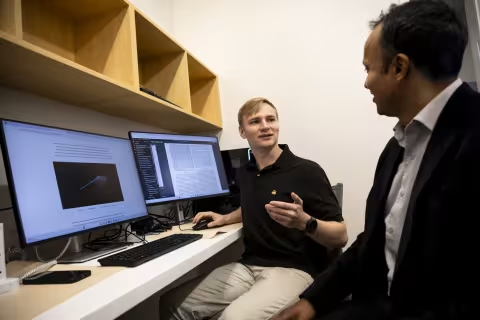
Under Islam’s mentorship, Gravereaux used two publicly available datasets to examine potential smartwatch security vulnerabilities.
The first dataset contained information from more than 50 participants wearing smartwatches and carrying phones while performing different tasks, including typing. The second dataset analyzed keystroke patterns from 100 users typing the same password.
Through his research, Gravereaux demonstrated that machine learning models could detect typing-related activity with high accuracy and even identify individual users.
“With enough information, malicious actors could infer when someone is at a specific location or using a device, giving them the ability to plan targeted attacks or attempts at manipulation,” Gravereaux said. “The more data that is available, the more leverage it provides for harmful activity.”
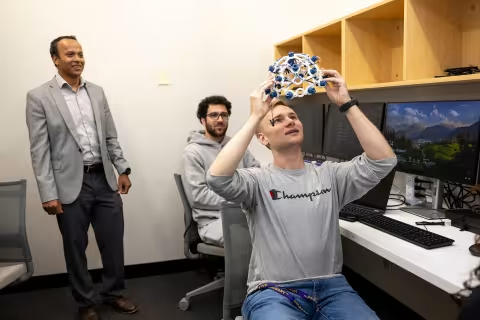
While current smartwatch privacy protection methods exist, they often disable sensor functionality during typing activities, which can limit the device's usefulness.
To address this, Gravereaux evaluated the use of differential privacy, a technique that adds controlled noise to data. This approach helps protect individual information from being identified while still keeping the data useful for everyday use.
By applying noise using IBM’s open-source differential privacy tools, Gravereaux found that attacker success rates dropped.
“My goal is to develop solutions that can protect smartwatch users without completely disabling the features that make these devices valuable in the first place,” Gravereaux said. “This project has taught me that cybersecurity isn't just about building walls. It's about finding that balance between functionality and privacy.”
Highlighting Student Research
The University will hold its fourth annual Showcase from 9 a.m. to 4:30 p.m. on Thursday, April 30. The daylong event will feature poster sessions, presentations, performances and exhibitions highlighting student research, scholarship and creative work across multiple disciplines.
UAlbany students, faculty and staff, as well as prospective students, alumni, community members and school groups, are invited to attend. The event is free and open to the public.
Along with presenting at Showcase, Gravereaux plans to publish his findings and present them to industry leaders.
“The research environment here at UAlbany has been fantastic. The professors are incredibly supportive, help guide our ideas without shutting them down and encourage us to pursue what genuinely interests us,” Gravereaux said. “It’s exciting to think my smartwatch work may have a real-world impact in the future.”