





Massry Students Step Into the Analyst Role Through UASBIG


ALBANY, N.Y. (March 10, 2026) — In the world of finance, analysts do more than study markets. They research companies, test assumptions, debate strategy and present investment proposals to senior decision-makers who ultimately determine whether capital moves.
At the Massry School of Business, students are doing exactly that.
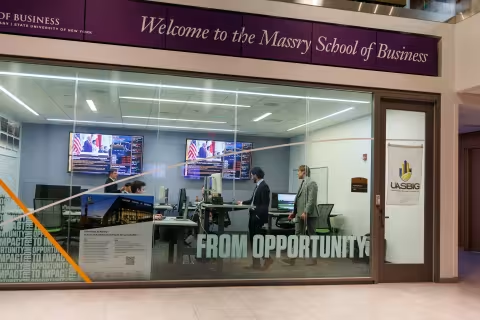
Through the University at Albany School of Business Investment Group, known as UASBIG, undergraduates manage more than $500,000 in University at Albany Foundation funds. Originally launched with a $100,000 allocation, the organization has grown significantly over time. Approximately 30 students serve as analysts, balancing coursework with market research, valuation modeling and performance reporting.
UASBIG mirrors the structure of a professional investment firm: students develop stock pitches, present first to their peers for internal review and, if approved, deliver a second, more formal presentation to its advisory board — a group of alumni, Foundation leadership and faculty advisors.
The process simulates what analysts at major firms experience daily.
Building skills through real capital
For Victoria Budesheim, a junior business administration major from Kings Park on Long Island and UASBIG's chief financial officer, the experience reshaped both her academic direction and professional ambitions.
Budesheim was raised in a family that valued education. Her mother, who emigrated from the former Soviet Union, instilled in her children the importance of earning a college degree.
At UAlbany, Budesheim began her studies in biology before discovering a stronger academic passion for finance. She committed herself to mastering markets and valuation.
"I didn’t know a single thing about business," Budesheim said of joining UASBIG. "But instead of letting that discourage me, I leaned into the discomfort."
Today, she helps oversee portfolio strategy and performance reporting while contributing to investment discussions designed to outperform the S&P 1500, a broad index representing roughly 90 percent of U.S. market capitalization, under a disciplined long-term policy.
"UASBIG showed me that success in finance is not just about technical ability, but also about initiative, communication and forming meaningful professional relationships," she said.
Admission to UASBIG is competitive. Prospective members complete resume screening followed by two interviews — one behavioral and one technical — before earning a place in the organization.
Ryan Keating, a senior business administration major from Wantagh, N.Y., and co-president of UASBIG, experienced that rigor firsthand.
"I applied as a freshman, but it ultimately did not work out," Keating said.
After strengthening his financial knowledge and gaining internship experience, he reapplied and earned a spot.
"The technical interview was very hard," he said. "Some of the questions they asked, at the time I did not learn yet. But my interviewers wanted to see how I thought through complex questions and if I put in the extra work to study on my own."
Now serving as co-president, Keating mentors newer members navigating the same process. He credits UASBIG with helping him secure three internships, including work as an equity research intern at C.L. King & Associates, where responsibilities closely mirrored the group’s research and presentation model.
"One of the things I love most about UASBIG is that what we learn in the group is so applicable and helpful to many careers in finance," Keating said.
Joshua Allen, a senior from Schenectady majoring in business administration with a financial analyst honors concentration and serving as co-president alongside Keating, said the organization provided clarity early in his college career.
"The ability to work with upperclassmen to learn finance in real-world terms as a freshman was an incredible opportunity," Allen said.
Allen prepared extensively for the interview process. He said the experience extended beyond technical training.
"The group helped me understand what is required to succeed in finance recruiting," he said.
UASBIG is an excellent example of the experiential learning opportunities available for Massry students," said Massry School of Business Dean Paquita Davis-Friday. "Its success is driven by the guidance of alumni who work in the industry and students who are willing to work hard, make mistakes, and learn from them."
Professional Oversight and Long-Term Impact
Each week, UASBIG members defend their research before peers, then present approved recommendations to the Advisory Board. The expectation is disciplined analysis and the ability to respond to detailed questioning from experienced professionals.
"Programs like UASBIG create a real bridge between the classroom and the finance industry," said Michael Borys, BS ’78, MBA ’79, a former vice president at Goldman Sachs and advisory board member for UASBIG. "Students are learning how analysts actually work by researching companies, building investment cases and presenting their ideas under scrutiny. As an alum, it’s rewarding to see UAlbany developing such a strong pipeline of talent entering the financial sector."
Faculty advisors say the model provides students with exposure to professional standards rarely encountered at the undergraduate level.
"Beyond the opportunity to manage a real-money portfolio, undergraduates are able to connect what they learn in the classroom with how investing works in practice," said Mary Wladkowski, a clinical professor of finance at UAlbany and faculty advisor to the group. "For students, UASBIG also offers opportunities to connect with alumni, take on leadership roles and learn directly from professionals in the field."
For Budesheim, Keating and Allen, the experience has provided more than résumé lines. It has required accountability, resilience and collaboration.
Two will graduate this year. One has a year remaining. All three are preparing for careers in competitive areas of finance.
Allen offers direct advice to students considering the path.
"Nothing in life comes easy; it takes hard work, dedication and even failure to truly succeed," he said. "Don’t get discouraged by rejections; instead, use them as motivation to continue to climb and succeed."
For Massry students participating in UASBIG, the analyst role begins well before commencement — in peer review sessions, advisory board presentations and the stewardship of University capital entrusted to them.
And while the setting is academic, the responsibility is real.