





CNSE Innovation Lab Receives $1.5M Federal Boost for Chips R&D

ALBANY, N.Y. (Feb. 4, 2026) — The University at Albany will receive $1.5 million in federal funding to upgrade its 200mm Innovation Lab, which helps the semiconductor industry fabricate cutting-edge new materials and devices and better understand how they perform.
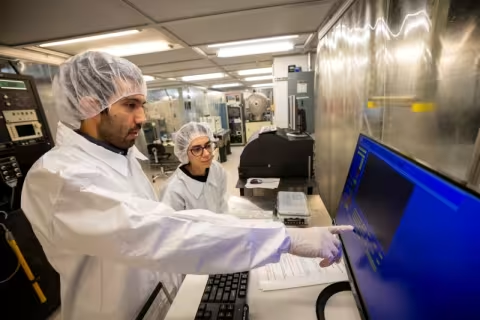
The Innovation Lab is a 6,000-square-foot collection of academic cleanrooms operated by UAlbany’s College of Nanotechnology, Science, and Engineering (CNSE) and located at the NY Creates Albany NanoTech Complex, which is also home to the college’s Department of Nanoscale Science & Engineering
The lab is a key element of CNSE’s Lab-to-Fab model that provides an academic setting for industry to pilot new ideas, materials and manufacturing processes in areas like nanoelectronics, microelectronics, quantum computing, nanobioscience and clean energy before attempting the costly jump to large-scale fabrication.
“This investment will accelerate the University at Albany’s contributions to semiconductor R&D, ensuring that our students, faculty, and researchers have access to state-of-the-art technology," said UAlbany President Havidán Rodríguez.
"I am grateful to Senator Chuck Schumer, Senator Kirsten Gillibrand, and Congressman Paul Tonko for shepherding this funding and for their tireless support of UAlbany. In collaboration with our partners in industry and government, UAlbany has made New York a global leader in nanotechnology and semiconductor education, research and workforce development.”
Researchers, students and industry partners use the lab to help accelerate new technologies through proof of concept, pilot prototyping and testing —the type of close collaboration that has been instrumental to Albany NanoTech’s success for three decades.
Advancing tech critical to AI and quantum
The lab also plays a critical educational and workforce development role by exposing CNSE’s undergraduate and graduate students to industry-focused research and giving them the practical experience needed to succeed in New York’s growing semiconductor workforce. The lab embeds hands-on learning into core CNSE academic coursework, giving students a competitive advantage in their post-collegiate careers.
The funding for the Innovation Lab was included in the recent Commerce, Justice, and Science spending bill approved by Congress thanks to the support of Schumer, Gillibrand and Tonko.
“This critical federal funding means UAlbany’s longtime semiconductor industry partners — and new ones — will continue to have access to best-in-class tools, and our faculty’s unmatched expertise, to test new ideas and help train the next generation of semiconductor innovators,” said Thenkurussi (Kesh) Kesavadas, UAlbany’s vice president for research and economic development.
“Combined with New York’s landmark investments in EUV lithography at Albany NanoTech, Albany will remain a global leader in the chips R&D essential to AI and quantum computing advances for decades to come.”
The funding will be put, in part, toward new instruments used for metrology, which helps researchers measure the characteristics of new nanoscale devices and materials, as well as equipment used for packaging, the process by which the 200mm silicon wafers used in the lab are turned into individual computer chips. In addition to students, the lab is used by industry partners working with UAlbany's Center for Advanced Technology in Nanomaterials and Nanoelectronics, which received another 10-year, $10 million commitment in state economic development funding last year.
R&D, teaching and workforce development
All in, the Innovation Lab has seen about $10 million in upgrades to its instrumentation and research infrastructure over the last 18 months from a combination of state, federal and industry funding, including about $8.5 million in improvements funded by the Northeast Regional Defense Technology Hub.
"CNSE is proud to be the home of a very unique educational environment within our Department of Nanoscale Science & Engineering — one that truly allows students to learn about and practice industry-standard manufacturing techniques,” CNSE Dean Michele J. Grimm said.
“The Innovation Lab prepares students for internships and jobs after graduation, many of which are found in the companies that conduct R&D at the Albany NanoTech Complex. While our nanoscale science and engineering students have the most direct connection to the Innovation Lab, it also provides students in our other engineering and computer science programs with the opportunity to see how they might work with an industry critical to the economic future of the Capital Region and New York.”