


UAlbany’s Thomas Bartlett: Studying Bacterial Cell Shape and Growth
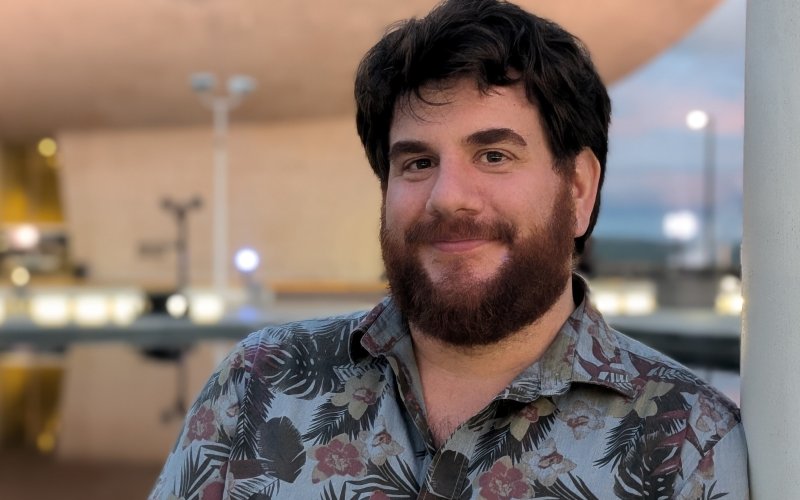
ALBANY, N.Y. (Jan. 14, 2025) – Thomas Bartlett joined UAlbany in 2024 as an assistant professor in the Department of Biomedical Sciences and serves as a principal investigator at the Wadsworth Center, the public health laboratory of the New York State Department of Health. His path to scientific discovery was not linear — a perspective that now informs both his research and his approach to mentorship.
After spending a year studying biology at a large state university, Bartlett left school to apply science in a hands-on setting at a winery. While working, he continued to build his scientific foundation independently, checking biology books out of his local library and enrolling in microbiology and chemistry night classes at Bucks County Community College.
“I didn’t see it as leaving science,” Bartlett said. “I was still learning wherever I could and trying to understand how things worked.”
A course with Professor Kevin Lampe at Bucks County Community College helped reignite Bartlett’s interest in fundamental research and put him on a new trajectory. That momentum carried him to the immunology lab of Jim Riggs at Rider University, where he learned the discipline and patience required for laboratory research, including its most routine tasks.
“I learned pretty quickly that science is built on doing small things carefully, over and over again,” Bartlett said. “It must have taken me 96 tries to load that 96-well plate, but those moments teach you how to slow down and pay attention.”
Through persistence and mentorship, Bartlett gained confidence at the bench, contributed to multiple publications and graduated with honors — experiences that prepared him for graduate study in Zemer Gitai’s lab at Princeton University.
At Princeton, Bartlett tackled fundamental questions of bacterial morphology, focusing on the characteristic curved shape of the diarrheal pathogen Vibrio cholerae. He discovered the cytoskeleton CrvAB, which patterns growth of V. cholerae into a curved form, allowing it to navigate the gut and corkscrew its way into the host intestinal lining. This work that earned him the prestigious Weintraub Award, which recognizes outstanding achievement during graduate studies in the biological sciences.
“I’ve always been drawn to what look like simple questions,” Dr. Bartlett said. “Why is this cell curved? Why is that one straight? But those questions turn out to be anything but simple to answer.”
Bartlett continued his microbiology training at Harvard Medical School with Drs. Thomas Bernhardt and David Rudner, where he investigated the molecular distinctions between round and rod-shaped bacteria, further sharpening his focus on how cells build and maintain their shape.
Today, the Bartlett Lab at the Wadsworth Center studies bacterial cell shape and envelope growth, with a primary focus on (round) Staphylococcus aureus and (curved rod) Vibrio cholerae. As a rule, bacteria achieve shape by spatially patterning the growth of their rigid cell envelope, which is a critical barrier and drug target. By exploring how pathogens like S. aureus and V. cholerae grow into different shapes, the lab seeks to uncover hidden vulnerabilities in the cell envelope that could lead to new treatments for infection and antibiotic resistance.
Bartlett emphasizes that open-ended scientific questions often require years of sustained effort.
“Starting from a broad question can feel straightforward, but answering it takes a lot of creativity, focus, and patience,” he said. Having navigated early hurdles, including navigating the rigor of academic publishing, he encourages students in the Department of Biomedical Sciences to embrace curiosity and persistence.
“If you’re asking good questions, you’re probably not getting clean answers right away,” Bartlett said. “The best science keeps opening new doors, and that’s what makes it worth doing.”