





UAlbany Summer: Developing AI Tools to Support Snow Prediction

By Mike Nolan
ALBANY, N.Y. (Aug. 12, 2025) — Growing up, Daniel Harkin was always fascinated by how weather events occur, especially winter weather like blizzards, ice storms and snowstorms.
Now a student in the University at Albany’s Department of Atmospheric and Environmental Sciences at the College of Arts and Sciences, he’s turning that fascination into a career.
“When I was seven or so, my father and I started hiking in the Catskill Mountains. Being up high on the mountain peaks, you would see a lot more snow than you would see at the ground level. It got me wondering more about the snowfall process,” said Harkin, an incoming senior at UAlbany. “That childhood curiosity has blossomed into a full-on love for weather and forecasting.”
Interning at the National Weather Service
Harkin was selected this summer for the National Oceanic and Atmospheric Administration (NOAA) William M. Lapenta internship program, which offers undergraduate and graduate students paid summer positions at NOAA-affiliated facilities.
As a Lapenta intern, Harkin has spent the last 10 weeks at National Weather Service Grand Forks, a weather forecast office responsible for monitoring weather conditions for 35 counties in North Dakota and Minnesota.
Harkin’s internship has mainly focused on supporting a project that is using artificial intelligence to improve snowfall prediction across the Northern Plains. The project is the first step toward building a more comprehensive tool that can help meteorologists forecast blizzards and other dangerous winter storms.
"By developing new machine learning models that can better predict the probability of snowfall, we can help extend the lead times that forecasters and emergency managers are given to alert the public,” said Harkin. “Being involved with a project that could help people be more prepared for winter weather events has alone made this summer an incredible experience.”
Harkin has also gained operational experience at the office by supporting severe weather monitoring and social media messaging.
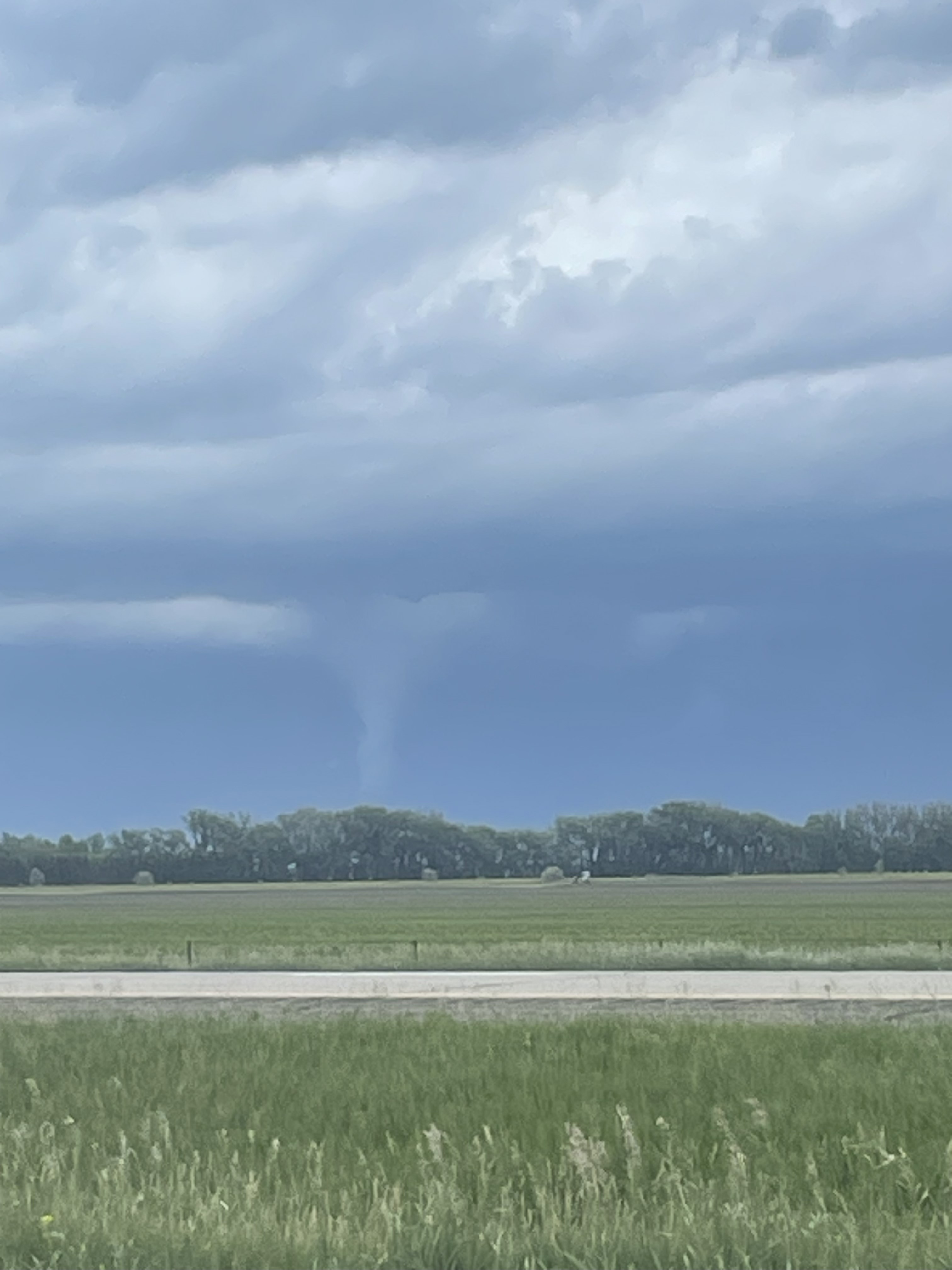
"Outside of the AI project, I’ve been asked to work in operations during severe weather events,” Harkin said. “In June, we had a tornado outbreak and a derecho in North Dakota. I supported social media messaging and helped issue local storm reports. Being able to directly relay information to the public has been an unexpected experience and incredibly rewarding.”
New York’s Weather Hub
As a junior, Harkin transferred to UAlbany from SUNY Ulster to focus on atmospheric science. Along with his Dad being an alum, Harkin was amazed by UAlbany’s ETEC research and development complex, home to the largest cluster of atmospheric, climate and environmental scientists in New York.
Since transferring, Harkin has interned with the National Weather Service office in Albany, located inside ETEC, along with the New York State Weather Risk Communication Center, a first-of-its-kind partnership that leverages UAlbany’s expertise in atmospheric sciences to help state and local emergency managers prepare for and respond to severe weather.
“None of this would've been possible without me transferring to UAlbany,” said Harkin. “Meteorology is a pretty niche major. Coming to UAlbany and being surrounded by like-minded people has allowed me to grow and gain the experience needed to be successful in this field.”
More Than Just Forecasting
Harkin will soon be presenting about his experience this summer to around 100 weather professionals, including National Weather Service staff and UAlbany faculty from his department.
While his original goal was to become a forecaster with the National Weather Service, Harkin says his experiences over the last year have opened him up to a broader range of career opportunities.
“I’ve always wanted to be a forecaster. While that still is definitely something I would enjoy, my experiences at UAlbany have allowed me to see into the research side of meteorology. If there's a researcher role that pops up after graduation, I might stick with it.”