





UAlbany Celebrates World RNA Day, Student Research and New Projects Enabled by Empire AI


By Erin Frick
ALBANY, N.Y. (Aug. 11, 2025) — The University at Albany’s RNA Institute welcomed over 200 attendees—including researchers, family members, elected officials and media—to its annual “World RNA Day” celebration held on Aug. 1. The festivities included lab tours and research presentations to showcase how studying RNA’s structure, function and modifications can unlock new approaches to combatting deadly and debilitating diseases through earlier diagnosis, effective treatments—and potentially cures.
As our understanding of RNA deepens, so does the need for advanced data processing tools to facilitate RNA research. At the event, SUNY Chancellor John B. King Jr. announced that UAlbany will be joining Empire AI with two new projects using the new Empire AI supercomputer housed at University at Buffalo. With this new collaboration, RNA Institute researchers and their collaborators will be able to harness this powerful new system to research a range of neurodegenerative diseases like muscular dystrophy, amyotrophic lateral sclerosis (ALS), and spinocerebellar ataxias.
“Each year, we look forward to hosting RNA Day to bring together students and their families, faculty and staff from across the UAlbany campus, community members, and local leaders to share the work that we do every day as we seek answers to pressing biomedical and societal challenges,” said RNA Institute Director Andy Berglund. “This year, the day was made even more exciting with the Chancellor’s announcement that UAlbany is now partnering with Empire AI on two new projects that will help us develop new ways to diagnose and treat neurodegenerative disease. This expanded computing capacity will be a vital tool as we explore new ways to use AI to fight disease.”
See coverage of the RNA Institute’s RNA Day event, plus more about how UAlbany researchers are working to understand and treat a range of neurodegenerative diseases in the Times Union, WAMC and News Channel 10.
Training the Next Generation of RNA Researchers
Student projects were at the heart of “RNA Day,” which also marked the conclusion of the Institute’s three summer research programs for undergraduates and high schoolers. This summer, 102 students conducted research alongside RNA Institute faculty through the Research Experiences for Undergraduates in RNA (REU in RNA) program, the Bioinformatics Research Program for undergrads, and the High School Bioinformatics Summer Camp.
The 2025 “REU in RNA” program engaged 17 students from colleges and universities across the U.S. The program pairs each student with a faculty mentor to pursue an independent research project over the course of the summer. Five UAlbany students were among this year’s cohort; all were supported by the Chancellor's Summer Research Excellence Fund.
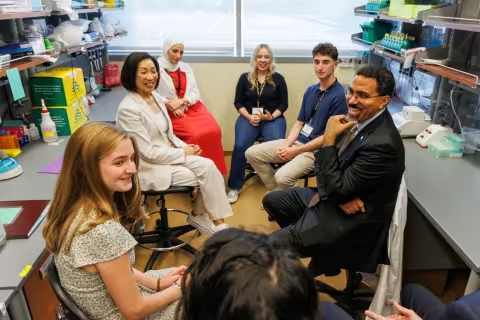
Meet UAlbany’s ‘REU in RNA’ Trainees
Gwenyth Gallagher
Gwenyth Gallagher is a rising junior who works with Assistant Professor of Nanoscale Sciences and Engineering Arun Richard Chandrasekaran. The lab focuses on using nucleic acids to design and build synthetic nanostructures for use in a variety of applications including as a future platform for drug delivery.
This summer, Gallagher worked on a research project examining alternative methods for assembling DNA nanostructures to enhance their ability to withstand conditions more closely resembling those of the human body. This involved using an unconventional buffer solution and assembling the DNA nanostructures at constant temperatures rather than using thermal annealing. The approach Gallagher is exploring could lead to more effective targeted drug delivery systems.
“Since I've been spending every day in the lab this summer, I feel so much more independent and I can do things myself without having to check in with others,” said Gallagher. “I’m also building new skills with a variety of computer software programs like Origin and Illustrator. It feels really good to be able to make schematic models to communicate what exactly it is I'm working with. The structures we’re assembling are nanoscale in size, so learning ways to share our work in the lab visually is empowering.”
Emmett Hanson
Rising senior Emmett Hanson has been working with Associate Professor of Chemistry Mehmet Yigit for over a year. Hanson is developing a new method to detect foodborne pathogens including salmonella, listeria and campylobacter using a single test. The goal, which Hanson demonstrated in prototype form this summer, is to create a fast, inexpensive, commercially available test kit that can identify multiple types of foodborne bacteria simultaneously using a detection method that fluoresces in the presence of the bacteria.
“This type of research requires real creativity,” Hanson said. “The research question doesn't just come from a previous project. You need to come up with different methods to detect all these pathogens using different synthetic biology techniques. I love using creativity to come up with new research projects and directions.”
Hanson will continue to advance this project in the fall semester.
Ethan Krupa
Biology major Ethan Krupa is a rising senior who started working with Associate Professor Cara Pager during his freshman year at UAlbany. Since then, he has been conducting research on Zika virus and most recently, has focused on creating a fluorescent tracking mechanism to study the viral RNA's interactions with host cells. Once developed, this new tool could help bolster disease surveillance and identify new host-virus interactions.
“Over the past few years, I've come from being a little freshman in the lab to now working on my own, being independent, coming in at night doing my own work—it's just been an amazing growth experience to the point where I feel like the project is me and I'm the project and we’re both working on each other at the same time,” said Krupa. “This REU program has solidified my goal to pursue a biology related PhD.”
Massa Masri
Rising senior Massa Masri is interested in pursuing a career in medicine and disease research. Under the mentorship of Distinguished Professor of Biological Sciences Andy Berglund, Masri’s research focused on how the toxic RNA found in repeat expansion diseases such as myotonic dystrophy and spinocerebellar ataxias impact the immune system in people affected by these diseases. Her initial studies using bioinformatics show that many genes are affected by the toxic RNA repeats found within diseased cells.
“Since I was little, I wanted to become a physician, but I never thought about doing this type of research,” Masri said. “When I started at UAlbany, I realized that there are so many different labs and so many different types of research areas outside of biology classes. I saw that as a great opportunity to join a lab and understand how research works.
“As a physician, you are trained to understand and alleviate symptoms of diseases, but I also want to get to the root of diseases and try to cure them. To do that, you need to understand molecular biology, and it's why I appreciate this type of research."
Angela White
Angela White is a rising senior working with Associate Professor of Chemistry Jia Sheng. This summer, White advanced two interconnected projects related to myotonic dystrophy type 2 (DM2). The first project looked at whether a certain type of toxic RNA structure accumulates in the problematic nucleotide repeats that cause DM2. The second project focused on using and enhancing a modified ribotoxin (a type of protein) to target and break down the toxic repeats in DM2.
“Over the summer, it was really nice to see that this modification does work really well in degrading the harmful repeats at the heart of this disease,” said White. “It was exciting to get results that showed that it was working, which means this could someday help towards a new treatment.
“Getting to work on a new project independently was also really exciting for me. The whole investigation portion was very open-ended, more so than a lot of research that I've done, and getting to work on a project that is entirely my own was a great new experience.”