





UAlbany Summer: Aspiring Dental Hygienist Explores Community Health Disparities
By Erin Frick
ALBANY, N.Y. (July 22, 2025) — University at Albany’s Xianna Allen is working towards a career as a dental hygienist, with a special interest in providing care to underserved communities. The rising junior is majoring in human biology on the pre-dental track, with minors in public health and communications — an academic recipe designed to build skills needed to provide her future patients with equitable, culturally-responsive care.
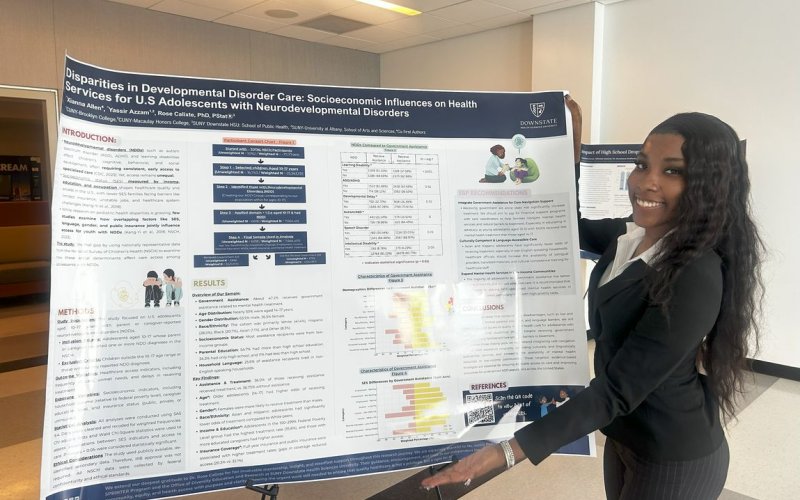
This summer, Allen conducted health equity research in her hometown of Brooklyn as part of the Summer Program in Translational Disparities and Community Engaged Research (SPRINTER) offered by SUNY Downstate Health Sciences University. The seven-week program pairs undergraduate students with faculty mentors to conduct community-based research with a focus on health disparities.
“I’ve always been passionate about improving access to healthcare, especially in underserved communities,” said Allen. “That’s what initially drew me to public health and made the SPRINTER program such an exciting opportunity.”
Under the guidance of SUNY Downstate’s Rose Calixte, Allen explored how systemic barriers such as language access, provider shortages and medical mistrust affect healthcare access and quality for adolescents with neurodevelopmental disabilities in the United States.
“I’ve been working closely with faculty mentors, medical students and fellow interns to better understand how factors like race, ethnicity, age, gender and family socioeconomic status affect healthcare received by children with neurodevelopmental disorders such as autism, ADHD and epilepsy,” said Allen. “We are learning how to analyze national census data, interpret those findings using coding techniques, and connect our research to real-world policy implications.”
Beyond mentored research, the SPRINTER program includes lectures, field trips and skill-building workshops.
“We’ve covered a range of public health topics such as environmental justice, structural bias in medicine, ethics in research and more,” said Allen. “This has been an incredible learning experience and has deepened my interest in combining research and healthcare access in my future career.
“One of the highlights of the summer was a trip to UAlbany, where we toured the RNA Institute and attended a panel discussion hosted by staff from UAlbany’s Center for the Elimination of Health Disparities. It was meaningful to connect with professionals who are doing equity-driven research, especially on my home campus, and I’m hoping to connect with RNA Institute faculty to find a research experience addressing oral health.”
Allen is also interested in the issue of medical mistrust, a topic that that she was able to explore this summer during an exercise wherein she and a partner prepared a presentation for their peers inspired by a seminar delivered during the SPRINTER program.
“Medical mistrust is a significant barrier to accessing healthcare within the Caribbean community in the U.S.,” Allen said. “My family is from Jamaica and Panama, and I see firsthand how they choose to avoid doctor visits and pay less attention to preventative care because they believe homemade or holistic medicines are enough. Rather than getting help from doctors and getting prescribed medications, they go for natural remedies.
“This mistrust often stems from lacking communication between patients and doctors and adverse experiences that result; for example, going to see a doctor, but instead of having a conversation, the doctor dismisses traditional treatments and prescribes a medication without explaining what it will do in a way that is understandable. Training in culturally responsive care could help bridge this gap. Patients also need to learn about the ways that doctors can help them. It takes better communication on both sides.”
The SPRINTER program concluded on Friday with a research symposium presented to faculty, peers and public health leaders. But the work isn’t done. Allen will continue her research with Calixte this fall, with plans to study health disparities using data from dental clinics.
“While health disparities and the need for health equity are getting more attention, there is still so much we need to learn,” said Allen. “Beyond research, these topics should be built into education at all levels—from K-12 classrooms to professional development for medical providers. Continuing to raise awareness around these issues can help entire communities lead healthier lives.”