





Showcase 2025: Community Mapping in the Capital Region
By Erin Frick
ALBANY, N.Y. (April 29, 2025) — Getting to know a community — learning about its history, its strengths, and what is important to the people who identify as members — is key to identifying what is working, and what could be done to make it better.
University at Albany students enrolled in the “Macro Practice in Social Work II” course at the School of Social Welfare spent the spring semester exploring eight distinct communities across the Capital Region. By interviewing residents, observing street-level sights and sounds, and analyzing demographic data, their work is at the heart of holistic community practice.
“In the field of social work, the ‘macro’ approach traditionally looks at ways to support entire neighborhoods or populations,” said Associate Professor Wonhyung Lee, who is at the helm of the “Community Mapping” project. “In this class, students conducted community assessments as a way to take stock of assets and challenges in a given community, engage with people who are part of that community, and gain valuable insights into local conditions. This sort of multifaceted approach is critical to guiding policy reforms or other systemic changes designed to improve the lives of entire communities.”
The 25 Master of Social Work (MSW) students in Lee's course formed eight groups, each tasked with conducting a community assessment of a particular population in the Capital Region. All will present their work at UAlbany Showcase on April 30.
“The goal of this project is for students to understand a community through a multidimensional lens one that goes beyond a ‘textbook’ framework of assessment,” said Lee. “Too often, community assessment is approached in a top-down, outsider-in, and often cursory manner. This assignment encourages students to critically reflect on the very concept of assessment: not only how to gather accurate and meaningful data, but how to do so in ways that are respectful, non-intrusive and capable of challenging dominant narratives about the community. In a way, it’s a bit like detective work, which can make the process both engaging and rewarding.”
Focus on Schenectady
One team focused on downtown Schenectady, zooming in on the Social Enterprise and Training ‘SEAT’ Center, where MSW students Mikayla Hamel and Daniella Marsicano have been working as interns since September of last year.
“SEAT Center is a Schenectady-based nonprofit dedicated to helping young adults aged 18-25 secure employment in either culinary or construction professions,” said Hamel. “In addition to offering academic courses for GED completion and intensive trade-focused training, SEAT Center provides its students with a wide offering of supportive resources including medical care and health counseling, support in navigating social services and finding childcare, as well as a stipend to help enable their participation in the program.”
For their MSW field placement, Hamel and Marsicano have been working alongside the Center’s wellness team. Their work has involved a range of assessment and advocacy tasks, focused on ensuring that the Center has a thorough understanding of its students’ health and wellness needs, and that these needs are met.
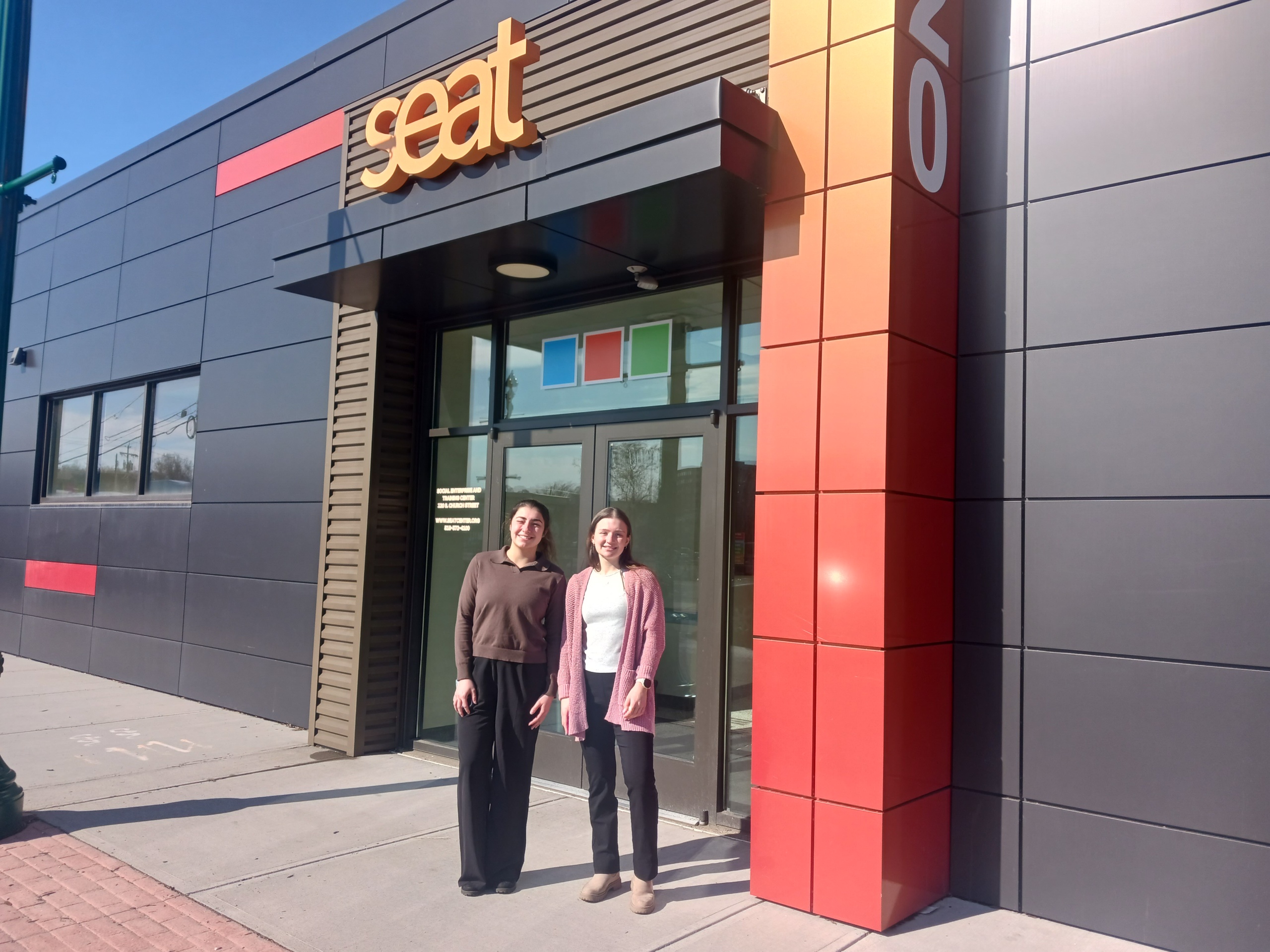
“Because Daniella and I are deeply involved in the SEAT Center, which primarily serves people from Schenectady, our group thought this would be a good opportunity to explore how SEAT fits into the broader picture of downtown Schenectady and how its students could be impacted by the surrounding environment,” said Hamel.
Schenectady team member and MSW student Keyonca Leasure explained that the community assessment included five main parts: foundational background research on the community of choice, collecting and analyzing census data from that area, interviewing members of the focal population and broader community, conducting a “windshield survey” (street-level observations) of the area, and identifying an existing assessment tool within the community to incorporate into the overall assessment.
“Part of our project focused on Schenectady’s history and how it is portrayed in the media,” said group member Hailey Bortell. “Schenectady was once an industrial powerhouse, but as jobs started to relocate, the city was given fewer resources. In the media, the narrative tends to recognize the effects of lacking resources by addressing the need for revitalization, but it tends to look through the lens of needing revitalization due to high crime rates. Media reports rarely address the historic and underlying systemic barriers that exacerbate poverty and crime, which can be harmful to how downtown Schenectady residents are viewed and how resources that could benefit them might be allocated.”
In the field, the team paid close attention to the quality of public infrastructure, amenities and sanitation, noting distinct differences block to block.
“Since September, we’ve spent a lot of time walking the streets of downtown Schenectady, taking in the sights, sounds and smells, noticing things like how the sidewalks near SEAT Center have been updated, but just a couple streets down, those sidewalks appear to have never been touched,” said Hamel. “We’ve seen a rapid increase in the number of vape shops and cannabis stores. There are a number of bars downtown and a casino, but very little in the way of green spaces or other types of recreation.”
The team’s assessment draws attention to the role of urban green spaces and thoughtful zoning policies in creating healthy downtown districts where all residents can thrive.
“Something we’re thinking about as we complete our project is how environmental features of the downtown area could potentially influence SEAT Center students and other community members, in particular, anyone living with mental health challenges, or who has struggled with addiction,” said Hamel. “Community-level changes that support a healthy lifestyle, like establishing parks or other healthy gathering spaces, could go a long way.”
MSW student Emily Zanat also contributed to this project.
Mapping Projects at a Glance
Beyond Schenectady, other teams looked at:
- Saratoga Springs, with a focus on the community’s growing population of unhoused individuals
- Albany's Mansion District, focusing on the Capital City Rescue Mission and its role in the community
- Pine Hills in Albany, examining the neighborhood's role as residential hub for local students, and how the closure of the College of Saint Rose could impact housing in the area
- West Hill in Albany, exploring its rich local economy of family-owned, culturally specific businesses, many of which are run by members of that neighborhood
- East Greenbush, looking into what makes the area a desirable place to raise children
- Arbor Hill in Albany, identifying community assets and considering ways to improve the narrative surrounding that neighborhood
- Exploring ways to support the neurodivergent community in the Capital Region, through advocacy and critical analysis of existing assessment tools for neurodivergent populations
You can explore these projects and more at UAlbany Showcase on Wednesday, April 30. More than 140 students from the College of Integrated Health Sciences will be displaying their recent research and internship experiences at a poster session in Broadview Center from 10:30 a.m. to 12:30 p.m.