





Writing and Critical Intrigue: The Journey of a Peer Mentor

By Jackson Woolley, Class of '27
ALBANY, N.Y. (Oct. 8, 2026) — Taking a course through the Writing and Critical Inquiry (WCI) program is a graduation requirement for all UAlbany undergraduates.
Jalen Pearsall, a junior history major, was a student in the class of Rae Muhlstock, a WCI teaching professor, when she heard something that concerned her: "This class is going to be focused on science fiction."
Pearsall had never been a fan of the genre and was already thinking about dropping the class.
"I didn't think sci-fi was really my thing, or writing. I wasn't very confident in my writing," Pearsall said.
She decided to stick with it, challenging herself to improve, until something clicked.
"Through having interesting discussions in class and my professor's feedback, I realized I did have good ideas and I could write," Pearsall said.
Finding your voice
Muhlstock's class is more discussion-based than most. Students often lead open conversations about the media they consumed that week, facilitated by the professor and the peer mentors.
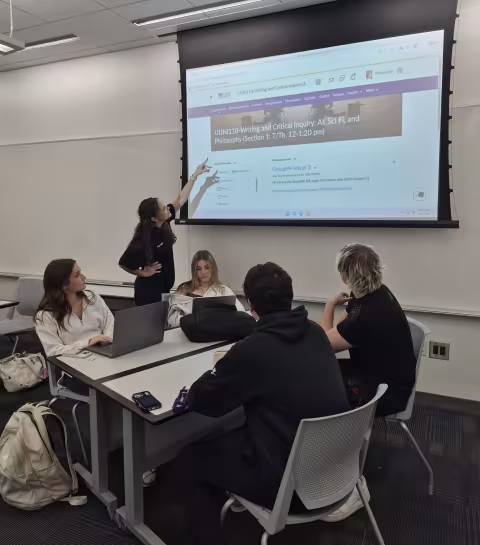
Peer mentors are a unique part of the WCI program. They share much in common with teaching assistants but play a few extra roles. Beyond assisting with classroom activities, they serve as a resource for students adjusting to college life. They are trained in mediating interpersonal conflicts and in connecting students to campus resources.
Professors can also use peer mentors as invested members of the class. Mentors take part in discussions and model positive classroom behavior. By bolstering student opinions and building on their ideas, they inspire classmates to find their voice and develop their thoughts further.
"I think it helps you connect to what the topics are," Pearsall said. "I didn't care about sci-fi, and I didn't really have any thoughts until I came to class and someone shared something, and then that gave me an idea."
That kind of exchange helps students build higher-order thinking skills, the proverbial muscle used for deep thought.
From student to mentor
Pearsall went from a quiet, detached member of the class to one of the most active voices in discussions. She became such a vital part of the classroom that, as the semester wrapped up, Muhlstock asked her to become a peer mentor.
Pearsall accepted because she knew better than anyone the impact a peer mentor can have on a struggling student, and she wanted to give back. She also saw it as a chance to develop her own craft.
"I thought that helping people write would improve my own writing skills, and I think it has, especially in revising things," Pearsall said. "It's also helped with my confidence. So now I'm realizing that I am capable."
As a peer mentor, she is now part of a network of students and faculty across campus involved in the WCI program. She credits that community as the most rewarding part of her journey.
"I think the connections I've made, like with my professor and with other peer mentors, have been super rewarding," Pearsall said.