





UAlbany Summer: Studying Empires, Greenhouses and the Control of Nature

ALBANY, N.Y. (July 8, 2026) — For Aidan McLaren, the study of early colonial history is, in part, a study of control.
During the 17th and 18th centuries, Europeans were flooded with new riches from the Americas and other colonial holdings. But it was not just gold and silver that captured their attention. It was new flowers, new animals and new foods, including something that may seem ordinary today: the pineapple.
McLaren, a PhD student in history at UAlbany, studies how those ambitions took shape inside early greenhouses, where wealthy Europeans and early Americans tried to recreate unfamiliar climates and environments in enclosed spaces.
That desire led to one of the early histories of artificial climate control.
“During the colonial era, Europeans were creating artificial climates and artificial environments in greenhouses,” said McLaren, whose dissertation focuses on greenhouses and climate in the colonial Atlantic World. “My research asks: Who owned greenhouses in early America? Why was George Washington obsessed with pineapples? What was a better fertilizer, eggshells, sheep urine or horse dung, and why did they debate about it? How did they know that plants need CO2, and what was the science behind it?”
Creating artificial climates
McLaren’s research looks at how Europeans created artificial climates and environments in greenhouses to cultivate new flora and fauna from the Americas, Asia and Africa.
Some days, he is reading handwritten documents connected to Thomas Jefferson, who owned a greenhouse at Monticello. Other days, he is scrolling through reels of microfilm, studying rare books or looking through estate records, botanical journals, shipping documents, letters, manuscripts and even poetry.
He is especially interested in how greenhouse owners tried to recreate climates that were dramatically different from the places where the structures were built. How, for example, could someone reproduce the heat and humidity of Brazil inside a greenhouse in Chiswick, England?
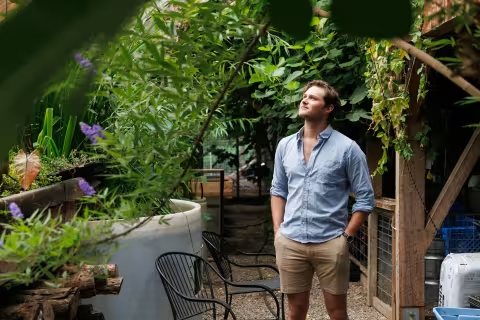
“It was controlling nature in an enclosed space,” McLaren said. “So, I look at all things that make up the greenhouse: energy, soil or fertilizer, heating devices, plant science, material construction, pineapples and ventilation.”
For McLaren, those questions are not only historical. They also speak to the present.
“I want to write a book that forces people to re-engage with nature and question our ideas of how we control it,” McLaren said. “If we can look at an early form of us controlling climates and imitating landscapes, maybe we can use those skills to create a better ecological relationship with our own environment.”
Digging through the archives
This summer, McLaren received support from the New England Regional Fellowship Consortium, which provides funding for researchers to work in archives across New England. He is using the fellowship to visit collections at institutions including the John Hay Library at Brown University, the Massachusetts Historical Society in Boston and the Newport Historical Society in Rhode Island.
The fellowship provides a $5,000 stipend for a minimum of six weeks of research at participating institutions. For McLaren, that support is essential because much of the material he needs is held in archives beyond the Capital Region, and not everything has been digitized.
“Each archive is like a mine,” McLaren said. “You may know some sources in their library catalog going into it, but you don’t always know what you are going to find.”
McLaren grew up near nearby, in East Greenbush and West Sand Lake, surrounded by the natural world. He remembers wooded landscapes, cedar waxwings and hickory trees, as well as time spent gardening with his mother and grandmother.
“My path to environmental history is like many environmental historians: I love nature,” he said. “For someone who hikes all the time, grew up in the country, how could I not be interested?”
McLaren earned both his bachelor’s and master’s degrees at UAlbany through the University’s BA/MA program. He initially focused on Ancient Mediterranean history, but his path shifted after taking a class on climate change with Christopher Pastore, now his dissertation chair.
He also credits Kendra Smith-Howard with introducing him to environmental history as an undergraduate, through topics such as ice houses and the ecological effects of animals introduced to early North America.
Now, as he works toward his PhD, McLaren hopes his research will help readers see the natural world as an active part of history.
“I love history, and I love nature,” McLaren said. “I want people to understand that there is more to storytelling than just people, but beavers, bees, lemon trees and rivers have stories. I hope by teaching I can help society reimagine our relationship with nature.”