





UAlbany Joins $10 Million Effort to Map RNA Modifications in the Human Body

By Erin Frick
ALBANY, N.Y. (Oct. 29, 2026) — Our cells contain more molecular eccentricities than we can currently count, let alone fully understand. Many of these anomalies arise in a type of molecule called ribonucleic acid, better known as RNA. Its job is to act as a “messenger” that tells cells how to operate, shaping health as well as disease. RNA takes many forms and it also carries many modifications.
The University at Albany’s RNA Institute has received more than $1.5 million to help map these modifications so we can better understand what they look like, where they occur and how they control molecular processes inside cells.
The effort is part a $10 million, multi-institution collaboration newly funded by the National Human Genome Research Institute. The Center for Multi-Scale Analysis of the Human Epitranscriptome is based at Weill Cornell Medicine and includes researchers at UAlbany, Cornell University, Duke University, St. Jude Children’s Research Hospital, the University of California, San Francisco and Stanford University.
Chemist Shenglong Zhang will lead the UAlbany team, focusing on a technology for sequencing and quantifying transfer RNA (tRNA) modifications with extreme precision — down to individual RNA building blocks. The platform technology, which Zhang developed, is called “Next Generation Mass Spectrometry-based Sequencing” (NGMS-Seq).
“Across the Center, our goal is to develop transformative technologies that can directly decode RNA sequences and their chemical modifications with unprecedented accuracy and detail,” said Zhang, associate professor in the Department of Chemistry and the RNA Institute. “By integrating our mass spectrometry-based RNA sequencing platform with complementary technologies across the Center, we aim to uncover how RNA modifications regulate gene expression, cellular function and human health.”
Decoding Molecular Messages
So far, we know that RNA molecules carry more than 170 chemical modifications which play a role in over 100 human diseases, including various forms of cancer, diabetes, Alzheimer’s and Parkinson’s. The Center aims to identify and understand such modifications across all RNA types (e.g., messenger, transfer and ribosomal), and how they influence biological processes across multiple scales — from inside individual cells to across whole tissues.
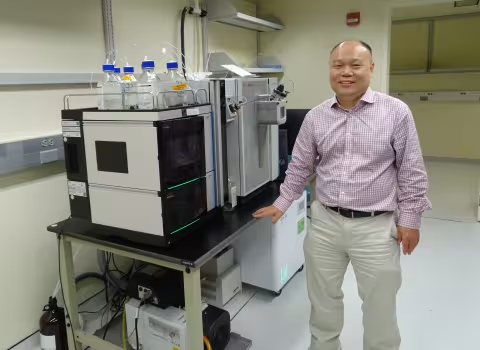
Zhang’s technology exploits the fact that every RNA building block has a unique mass. Using precise mass measurements, NGMS-Seq is able to “read” RNA one building block at a time, revealing an RNA molecule’s sequence from end to end, including all its chemical modifications. This makes it possible to pinpoint an anomaly message coded in the RNA and potentially link it to a corresponding disease.
This level of precision helps us better understand the origins of disease with benefits on two levels: It helps us identify errors that can be targeted medically, and it can also illuminate leads for new RNA-based therapeutics.
“As we dive into this new work, I’m particularly excited about the opportunity to collaborate with leading scientists across disciplines to tackle one of the major challenges in RNA biology: understanding the complex information encoded by RNA modifications,” Zhang said. “Our technology will help reveal this largely hidden layer of biological information.”
Growth Curve
This latest funding builds on recent momentum in Zhang’s lab. In 2024, his UAlbany spinoff company DirectSeq Biosciences Inc. received two Small Business Technology Transfer grants awarded by the National Institutes of Health (NIH). In 2025, the National Human Genome Research Institute, which is part of the NIH, awarded Zhang $1.6 million to expand his platform technology (NGMS-Seq) to be able to read multiple RNA modifications simultaneously. This summer, his team reported in Nucleic Acids Research a new version of the method that can separate and sequence individual RNAs from a mixed sample.
Zhang is working with the UAlbany Innovation Center and the Research Foundation for SUNY to commercialize NGMS-Seq and bring the technology to a broader user base.
“Understanding RNA modifications could transform how we study, diagnose and treat human diseases,” said Zhang. “Our work will provide foundational technologies and insights that could advance precision medicine, RNA therapeutics and the development of new diagnostic tools. Over the next five years, we hope to establish a comprehensive toolkit for mapping RNA modifications across molecules, cells and tissues, making these powerful technologies accessible to the broader research community and accelerating discoveries in RNA biology.”