





UAlbany Chemist Wins $2M to Build Protein Library, Target ‘Undruggable’ Cancer Protein
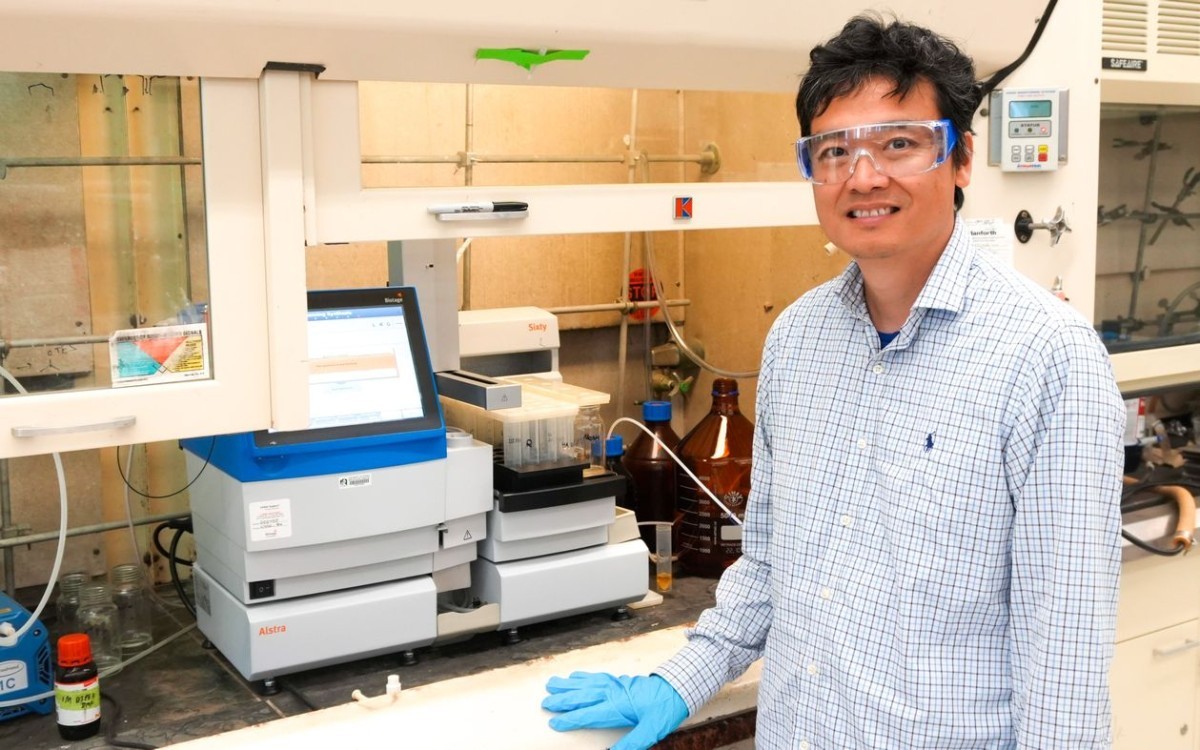
By Erin Frick
ALBANY, N.Y. (July 28, 2026) — A University at Albany chemist has secured $2 million from the National Institutes of Health to advance high-efficiency methods for building complex proteins. This work could illuminate rare brain diseases and open new paths for cancer treatment.
Qiang Zhang, an associate professor in the Department of Chemistry at the College of Arts and Sciences, focuses on synthesizing molecules known as “biologics” that are typically produced in the body by living cells. His team develops novel chemical synthesis strategies that have already enabled the production of certain medically important proteins in the lab for the first time.
At the center of this research is the prion protein, a sugar-containing “glycoprotein” found in mammalian brains that is associated with rare neurodegenerative diseases such as bovine spongiform encephalopathy, commonly known as “mad cow disease.” Prion diseases take hold when a healthy, normal prion protein misfolds, triggering a cascade of misfolding among neighboring proteins in the brain, ultimately leading to death.
“In its healthy state, the prion protein resembles a fluffy loaf of bread,” said Zhang. “When it misfolds, it forms into a flattened ‘pancake’ made of the same material but with a different shape. These misfolded ‘pancakes’ clump together and damage surrounding brain tissue, causing neurons to die off and leaving behind microscopic holes — which is why the disease is called ‘spongiform.’ The process is internally ‘infectious’ — meaning that a single misfolded pancake will bind to a normal 'bread,' convert it into another pancake, and the cycle repeats. This asymptomatic incubation period can last for years, and in some cases, decades.”
Building a protein library
Prion diseases, while lethal, are rare. However, understanding the mechanisms that trigger protein misfolding could shed light on other related diseases associated with neurodegeneration.
“In nature, different sugar structures are responsible for maintaining the shape and function of the prion protein,” said Zhang. “How sugars form on the protein might affect disease progression. My team is working to build a ‘library’ of prion glycoproteins, each with a precisely defined sugar pattern, so that our collaborators can test how different sugars speed up or slow down the misfolding process that underlies disease.”
So far, Zhang’s lab has produced prion proteins with two types of sugars; over the next five years, the lab aims to expand the library to much larger variants.
“Biologists have already developed ways to convert the normal prion protein into its misfolded form for purposes of study, but until now, they have lacked a pure, structurally defined material to understand how specific sugars influence this conversion,” said Zhang.
“Our glycoprotein library is designed to fill this gap, making it possible for researchers to identify how different sugar structures affect the pace of misfolding. Understanding which sugar patterns correspond to the slowest disease progression could spur medical strategies that direct cells to produce slower-moving forms of the protein, potentially prolonging a patient’s lifespan by extending the disease course.”
Targeting an ‘undruggable’ cancer protein
A second major research thrust in Zhang’s lab targets KRAS, a notoriously “undruggable” protein whose mutations drive pancreatic and liver cancer. These mutations lock the KRAS protein into a state that continuously fuels cancer cell growth. For decades, oncologists have struggled to target it directly.
Zhang’s group is developing specialized, chemically modified nanobodies (small antibody fragments) designed to recognize and bind to mutant forms of the KRAS protein while sparing the normal, healthy form of the protein which is present in all cells. These nanobodies are designed to neutralize or eliminate mutant KRAS, either by degrading it or by removing it from circulation. Because these proteins occur naturally in the body and break down into harmless amino acids, protein-based therapeutics may offer advantages over small-molecule drugs, such as chemotherapy, which tend to be more toxic and can generate harmful breakdown products.
“The long-term vision is to develop a platform that can generate multiple nanobody variants from a single starting nanobody using chemistry, rather than repeatedly re-engineering nanobodies through biological manufacturing, which is slower and more expensive,” said Zhang. “Over the coming years, and with support from this grant, we hope to continue developing our nanobody modification technology and identify potential leads for treating KRAS-related cancers.”