





Training a Statewide Response Network in Psychological First Aid
By Erin Frick
ALBANY, N.Y. (Aug. 5, 2026) — On a mock city block in Oriskany, N.Y., last month, 20 actors played survivors of a simulated bombing at a fictional Puerto Rico Day parade. Working across a realistic cityscape — which included a hospital emergency room, a makeshift family assistance center staged in a shopping mall and a block of apartment units — the actors roleplayed with 40 real victim assistance professionals as they moved through the scenes, practicing for the first time how they would support survivors in a genuine emergency.
This was the first full-scale test of a new, statewide effort led by University at Albany's Amy Nitza, director of the Global Center for AI in Mental Health, who is working with the New York State Office of Victim Services (OVS) to train victim assistance professionals to deliver trauma-informed, culturally responsive psychological first aid after mass casualty events. The Disaster Mental Health Preparedness Training Program, is funded by a $498,000 grant OVS awarded to UAlbany in fall 2025, and builds upon Governor Kathy Hochul’s creation of a Mass Violence Response Council to identify gaps in services and improve the local and state response to these incidents.
“Professionals working within Office of Victim Services agencies are uniquely well positioned to offer critical support to survivors of mass violence,” said Nitza, whose expertise centers on disaster mental health and trauma-informed disaster response. “We designed this training to prepare them to step in when the next mass casualty event happens. Responding to a disaster is nothing like their day job, which is why the training includes immersive simulations — so the first time they're in the field for something like this, it won't be so new. It gives them a frame for how to respond, including how to factor in culture and language, and also how to care for themselves as they help others process their trauma.”
In addition to UAlbany and OVS, the program's partners include the Institute for Disaster Mental Health (IDMH) at SUNY New Paltz and the New York State Division of Homeland Security and Emergency Services (DHSES), which operates the training facility where the exercise took place.
“When a mass violence incident occurs, victim assistance professionals are often among the first to support survivors and their families,” said Office of Victim Services Director Bea Hanson. “This training gives them the practical skills and hands-on experience needed to provide immediate psychosocial support, connect New Yorkers with critical resources, and help communities begin the recovery process when they need it most.”
The program focuses on delivering psychological first aid in the immediate aftermath of a disaster. This type of care can include making sure someone is safe and their basic needs (water, shelter, food, information) are met; listening to them closely and with patience; helping them stay calm; and connecting them with family, community or longer-term services.
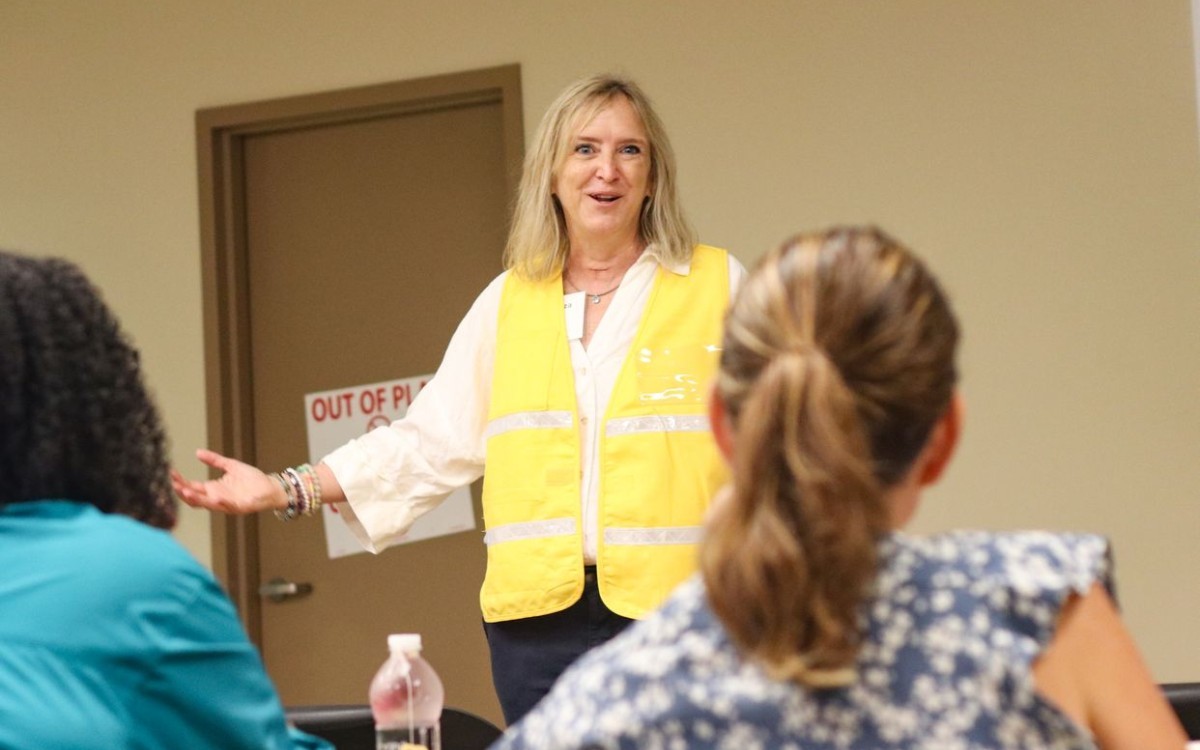
Two classroom workshops this spring laid the foundation for the immersive exercise. One of these was a supervisors’ training which covered trauma-informed supervision and self-care for those managing frontline staff. Last month's exercise, held at DHSES' State Preparedness Training Center, put these workshops into practice.
Inside the Simulation
The disaster mental health trainees included a range of victim services professionals representing domestic violence shelters, sexual assault treatment centers, victim advocate offices, the state attorney general's office, sheriff's offices, hospital-based victim programs, community organizations and the Red Cross.
During the day-long exercise, they worked through three scenarios staged along a timeline stretching beyond the immediate crisis: a hospital scene set four hours after the bombing, apartment home visits 48 hours out and a family assistance center 72 hours out.

Twenty actors played survivors, family members and other roles. The actors were trained to adjust their reactions based on how well a participant responded to each character's unique situation and needs.
The exercise also included a choreographed twist: A group of protesters arrived on the scene, intending to disrupt the family assistance center. Participants had to decide on the spot whether to engage, redirect resources or continue their work with survivors.
Meanwhile, the resource support tables in the family assistance center were staffed by actual representatives from local aid organizations.
“The goal of this training isn't just individual readiness — it's also giving agencies that don't normally work together a chance to build relationships before a real emergency forces them to,” Nitza explained.
Each participant had a chance to respond and observe in each setting, then gathered with facilitators at the end to debrief.

“New York State’s investment in the Disaster Mental Health Training Program highlights the State’s commitment to providing New Yorkers with well-trained public service professionals, ready to assist during times of extraordinary need,” said Alfred Titus Jr., director of training for the Division of Homeland Security and Emergency Services.
“By offering OVS staffers a platform where they can practice, test and fine-tune skills they learn in the classroom – including a realistic scenario-based component designed to infuse a ‘taste’ of the emotions associated with disasters and trauma response – the program aims to build participants’ confidence and response skills, while simultaneously preparing them protect their own mental health when administering care on the frontline.”
Evaluation, Evolution, Improvement
This summer's exercise is only the beginning. Over the next three years, Nitza and her team will bring similar training featuring different response scenarios to victim service professionals across New York. Part of this involves evaluating the training to ensure it helps guide improvements.
“Partnering with OVS and the University at Albany on the Disaster Mental Health Preparedness Training Program gives us a valuable opportunity to conduct a comprehensive evaluation of a multifaceted, multiyear training initiative,” said Robin Jacobowitz, interim director of the Institute for Disaster Mental Health at SUNY New Paltz.
“Because the training spans multiple years and combines classroom instruction with increasingly realistic practice, we have a rare opportunity to study how disaster mental health knowledge and skills are developed and applied. By integrating evidence from across the training program and capturing multiple perspectives on how learning is translated into practice, we hope to strengthen the program itself and also contribute to the evidence base for preparing behavioral health and other helping professionals to support individuals and communities affected by disasters and mass violence.”

Connecting Treatment and Preparedness
Fourth-year clinical psychology PhD student Sondra Tiab is working with Nitza at UAlbany to develop training materials and realistic role-play scenarios to support the Disaster Mental Health Training Program. As a graduate assistant, Tiab is diving deep into the literature on trauma-informed supervision, culturally responsive care and mental health responses to disasters and mass violence.
“This work is important because professionals need opportunities to practice supporting survivors before they are called upon during an actual mass violence event, particularly as these events have become increasingly common in our society,” said Tiab, who co-facilitated the immersive training exercise in Oriskany with Nitza.
“I have received clinical training in evidence-based treatments for PTSD, but graduate programs do not typically provide much exposure to mental health care following mass violence. This project has given me a unique opportunity to connect my interest in trauma treatment with disaster preparedness. I am learning how to translate research into practical skills that can help professionals support survivors while also caring for their own well-being during an extraordinarily difficult response.”
