





Showcase 2026: Tracking Algal Blooms Through Lake Mud
By Mike Nolan
ALBANY, N.Y. (April 24, 2026) — Katelyn Jacques, a sophomore environmental studies major, joined the Paleoclimate Lab in the Department of Atmospheric and Environmental Sciences as a student research assistant this semester.
Located at ETEC, the Paleoclimate Lab analyzes natural materials such as coral and lake sediment to reconstruct Earth’s climate history and better understand how it connects to present and future climate trends.
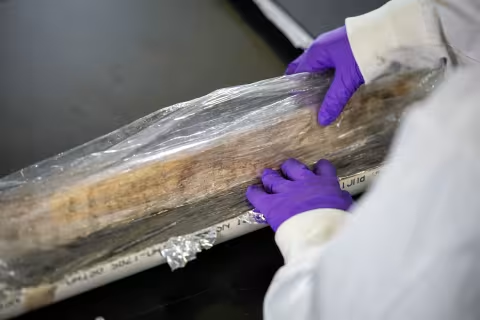
Jacques, under the mentorship of associate professor Aubrey Hillman, co-director of the lab, is currently working on a project exploring the history of algal blooms at Long Pond in Grafton Lakes State Park. To do this, she is analyzing layers of mud from the bottom of the lake, which act as a timeline of lake conditions over hundreds of years.
Her work will be on display on Thursday at Showcase 2026, the University at Albany’s annual celebration of student research, scholarship and creative activity. The daylong event will feature poster sessions, presentations, performances and exhibitions highlighting work from students across disciplines on the Uptown Campus.
We caught up with Jacques to learn more about her research and what to expect at Showcase.
What drew you to this research project and the Paleoclimate Lab?
Last semester, I took a class with Professor Aubrey Hillman in the Department of Atmospheric and Environmental Sciences, where she mentioned she was looking for undergraduate students to work in her lab. It felt like a great fit for me because I’ve always been really interested in rocks, geology and climate science.
This semester, I had the opportunity to begin my own research project in her lab. I chose to study Long Pond because I grew up in upstate New York and thought it would be really interesting to research something I'm familiar with.
How does studying lake mud help us understand past algal blooms?
Lake mud deposits in layers. The deeper you go into the mud, the further back in time you can look. By dating each layer, we can figure out when it was deposited and learn what the lake’s environment was like during that period. This helps us understand how lake conditions have changed over time and can guide better decisions to protect and improve the lake in the future.
Have you found anything surprising so far in your research?
Interestingly, the algae content has actually decreased as we get closer to the surface, which is surprising because you would normally expect algae levels to increase over time. That may be due to an increase in cyanobacteria, also known as blue-green algae. As cyanobacteria become more dominant, they can reduce the amount of other types of algae in the lake, changing the overall balance of the ecosystem.
Why is it important to study past algal blooms at places like Long Pond?
Algal blooms can be very harmful because they may cause illness in humans through contact, ingestion or even inhalation. They can also have serious impacts on animals and the surrounding ecosystem. By studying how and why these blooms occur, we hope to better understand what changes can be made to help prevent harmful algal blooms in the future.
What do you hope people take away from your project at Showcase 2026?
I hope people leave my presentation with a better understanding of how harmful algal blooms can be to the environment and how important paleoclimate research is for helping us understand how to reduce and prevent them in the future.