





Ready for Takeoff: New Partnership Offers Students Hands-On Drone Training
By Mike Nolan
ALBANY, N.Y. (Nov. 2, 2026) — Demand for drone pilots is growing fast.
Driven by advances in artificial intelligence, autonomous flight, and real-time data analytics, the drone industry market is projected to grow from roughly $69 billion to nearly $148 billion over the next decade.
Public safety is one of the fastest-growing areas, with police, fire, and emergency management agencies using drones for everything from search and rescue to disaster response.
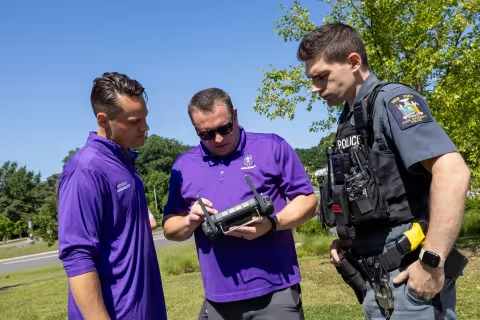
A new partnership between the University at Albany Police Department (UPD) and the College of Emergency Preparedness, Homeland Security and Cybersecurity (CEHC) is giving students hands-on experience flying unmanned aircraft systems (UAS), while also improving public safety on campus.
The collaboration was sparked by a conversation between CEHC faculty members Frank Peris, Eric Best and UPD Lt. Steven Grassmann.
“Eric and I both have a lot of law enforcement background and experience with UAS. So, we met with UPD to discuss a partnership, and it grew from there,” said Peris, a visiting assistant professor in the Department of Information Sciences and Technology. “It offers a big advantage for students, not only when entering the job market, but as a long-term career transition.”
“This partnership is great for both UPD and CEHC,” added Grassmann. “When we combine the technology and resources CEHC offers with the real-world operational experience UPD brings to the table, we’re able to build something that will serve our campus community for years to come.”
Hands-On Drone Training
Peris has been an active-duty police officer for 16 years and still maintains his position with the Town of Colonie.
Among his roles at UAlbany is running CEHC’s Drone Lab, located in the basement of Page Hall. The space, enclosed with netting and featuring black rubber flooring, offers a controlled indoor environment for UAS flight training and land-based robotics research.
“I didn’t have these types of opportunities as an undergraduate,” Peris said. “For our students, I hope this gives them a sneak peek at what it’s like to work with a real public safety agency, and a step toward a career in this field.”
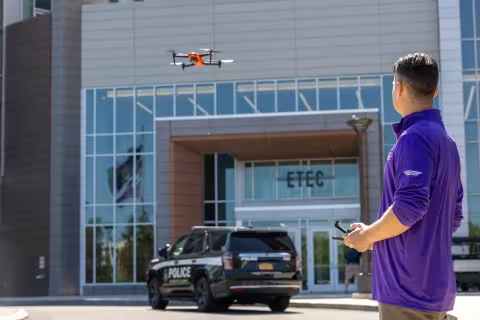
Best, a quantitative social scientist, builds tools to help security professionals respond to emergencies and refine their methods.
At UAlbany, he directs the Mobile Sensor Lab, which develops theories and technologies to advance public safety response using mobile sensors, including drones.
Drones are considered “mobile sensors” because they move dynamically to collect information from above. Best’s lab focuses on rapidly analyzing data collected by drones so first responders can use it in real time as emergencies unfold.
“I believe students are much more motivated when they see that a project they’re working on is actually making a difference. It gives their work real purpose. Remote flying is also a skill that will set them apart in whatever field they choose in the future,” Best said.
Real Flight Operations
Since launching last year, CEHC faculty and students have already flown alongside UPD at several football games and commencement, using drones to help monitor traffic and large pedestrian areas.
At a recent homecoming game, Ethan Maier, a senior studying homeland security and emergency management, piloted a mission himself.
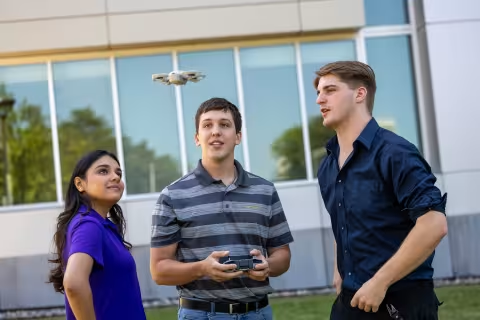
“The demand for drone operators is growing massively. In emergency management, you think of search and rescue, or fire departments using thermal technology to scope out a fire and see where the hot spots are. There are endless ways to apply drones across a wide variety of fields,” Maier said.
“This partnership is offering me an experience I could never get in the classroom," he added.
Students interested in remote flying are encouraged to attend CEHC’s upcoming Drone Night, hosted in the Drone Lab on Nov. 17 from 5 to 7:30 p.m.
Open to beginners and experienced pilots alike, the event offers a chance to learn about drone technology, practice flying in a safe indoor environment, and connect with fellow drone enthusiasts.