




Creativity Meets Code: UAlbany Students Develop New Apps at Hackathon

By Erin Delaney
ALBANY, N.Y. (April 10, 2026) — Ten UAlbany students took part in the MIT Reality Hack, a competitive technology hackathon held earlier this year. More than 300 professionals, industry experts and college students worked in teams to build extended reality (XR) apps. Five of the UAlbany students were on winning teams.
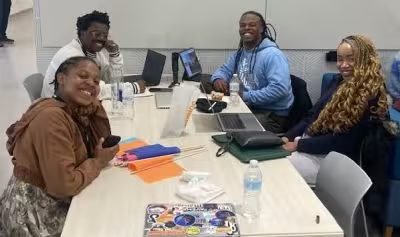
Tinashe Chinamasa, a junior and cybersecurity major in the College of Cybersecurity, Emergency Preparedness and Homeland Security (CEHC), won “Best Design in Community Hack” with her team's project, Memory Tree.
The platform, she explained, is “designed to support individuals in grief, offering a space where memories of loved ones can be held, shared and honored both personally and communally. The Memory Tree became not just an interactive experience, but a gentle ritual for reflection and remembrance.”
Miguel Santos, a junior and computer science major at the College of Nanotechnology, Science, and Engineering, was part of a team that won first place in “Game Prototyping” for their project, BattleFish.
“The player uses spears to catch randomly spawning fish between their boat and the opponent's boat,” Santos said, explaining that the fish have a range of values and special abilities. “I'm very grateful for the experience and to be able to develop my skills with new people I never would have met in any other way.”
Catherine Dumas, a visiting assistant professor in CEHC’s Department of Cybersecurity and the director of the Human-Centered Intelligence XR Lab, brought the students to MIT, where she has been a member of the Reality Hack organization for seven years.
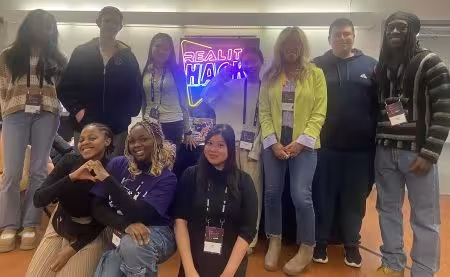
Dumas described the hackathon as “a fast-paced, highly creative and deeply collaborative international community of XR developers, researchers and industry professionals. Each year, I've been impressed by how quickly UAlbany students adapt, contribute and lead.”
The students, she said, “represented UAlbany incredibly well through their technical skills, teamwork, professionalism and creativity. I'm proud of how they showed up, supported one another, and demonstrated that our students can compete and succeed at the highest levels of Immersive Technologies and XR innovation."
Other winning student projects included:
- Brianna Williams, a junior majoring in cybersecurity, and her team won first place in “XR Health and Wellness Design and Research” with Attune, which allows users to explore mindfulness breathing practices. The app works by estimating breath rhythm and tracking stillness through intuitive regulation rather than the constraints of time, place or goal-driven attention.
- Caleb Mesicks, a sophomore majoring in computer science, and his team developed Project Clear Cue, an app designed to help autistic and neurotypical adults better identify real-time social cues. The project earned an honorable mention for “Best App for Raven Glasses.”
- Jada McCullen, a senior in informatics, and Derek Pember, a sophomore in game design & development, both were on teams that won “Best Use of STYLY.” McCullen’s team also received a runner-up honorable mention for their project, Dream Field Gateways.
The hack was sponsored by companies including Qualcomm, Meta, Caldwell, Raven Resonance, Petricore, Preview Labs, Quasar Lab, American Medical Extended Reality Association, and Flow Meditation.