





UAlbany Summer: PhD Student Bringing Energy, Wastewater Research to Nigeria
By Bethany Bump
ALBANY, N.Y. (Aug. 26, 2025) — Alfred Navokhi Apaji grew up in Wukari, a small town in northeastern Nigeria where the lack of regular electricity, clean water and waste disposal led to frequent illness for him and his neighbors.
“We battled with a lot of challenges like typhoid and malaria because people dump their wastewater in rivers and drainages, and then it becomes breeding grounds for mosquitoes and other vectors that carry diseases,” he said. “So this lack of robust wastewater treatment really affected me. I missed a lot of classes because of sickness.”
Observing how some residents of his small town were able to leave Nigeria and study abroad, bringing their knowledge back home to better their community, Navokhi Apaji was determined to study hard and get a good education despite so much illness. He got into Modibbo Adama University of Technology in Yola, Nigeria, where he studied industrial chemistry, and eventually won a scholarship to pursue a master’s degree in environmental engineering at Newcastle University in the UK.
He knew he wanted to find solutions for the illness caused by mismanaged waste back home, as well as the lack of stable electricity, which also impacted his schooling. That’s how he landed on the University at Albany’s Environmental & Sustainable Engineering PhD program for the next step in his education.
“I did a bit of research and I realized that UAlbany is the only U.S. institution that actually combines environmental engineering and sustainability in one model,” he said. “And so it caught my interest, and I said, I have to come to UAlbany to develop these robust research skills.”
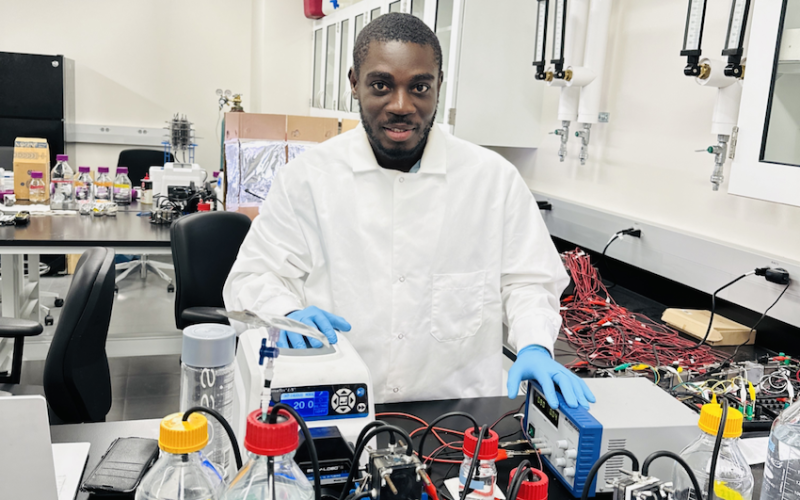
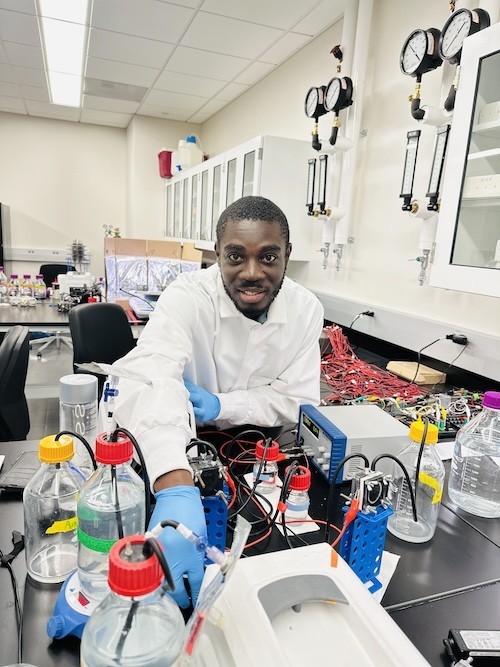
Navokhi Apaji just completed his first year as a PhD student and spent the summer working in Kyoung-Yeol Kim’s lab in ETEC, where he was focused on improving hydrogen production from wastewater using microbial electrolysis cells. Specifically, he has been designing a compact reactor that can extract hydrogen from wastewater and could have large-scale applications in wastewater treatment facilities.
“This is important as it not only reduces the cost of aerating wastewater treatment process, which consumes about 3% of the total electricity in the US, but also offers a sustainable method of producing hydrogen, a clean fuel needed for industrial applications,” he said.
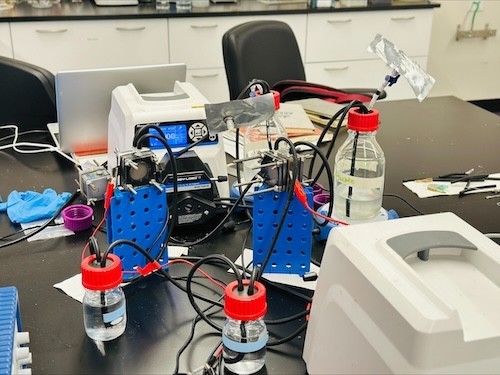
Waste streams contain hidden energy, Navokhi Apaji explained. The device he’s building uses microbial electrolysis cells and a small current of electricity to both speed up the degradation of organics in wastewater and capture hydrogen created in the process.
“This is a new method that actually uses very tiny amounts of electricity,” he said. “And so it's a huge difference in terms of costs.”
This method also requires much less physical space than traditional wastewater treatment methods, he said. The combination of low cost and space makes it ideal for use in underdeveloped and developing areas of the globe, he said.
After his PhD program, Navokhi Apaji hopes to return home to Nigeria to become a professor and open his own laboratory focused on environmental and sustainable engineering. He is also interested in the recovery of phosphorous, a key fertilizer ingredient, from wastewater, since his hometown of Wukari is predominantly a farming community, he said.
“I hope to continue to research in this field, because I believe it holds a lot of potential, especially for my home country and for my community,” he said.