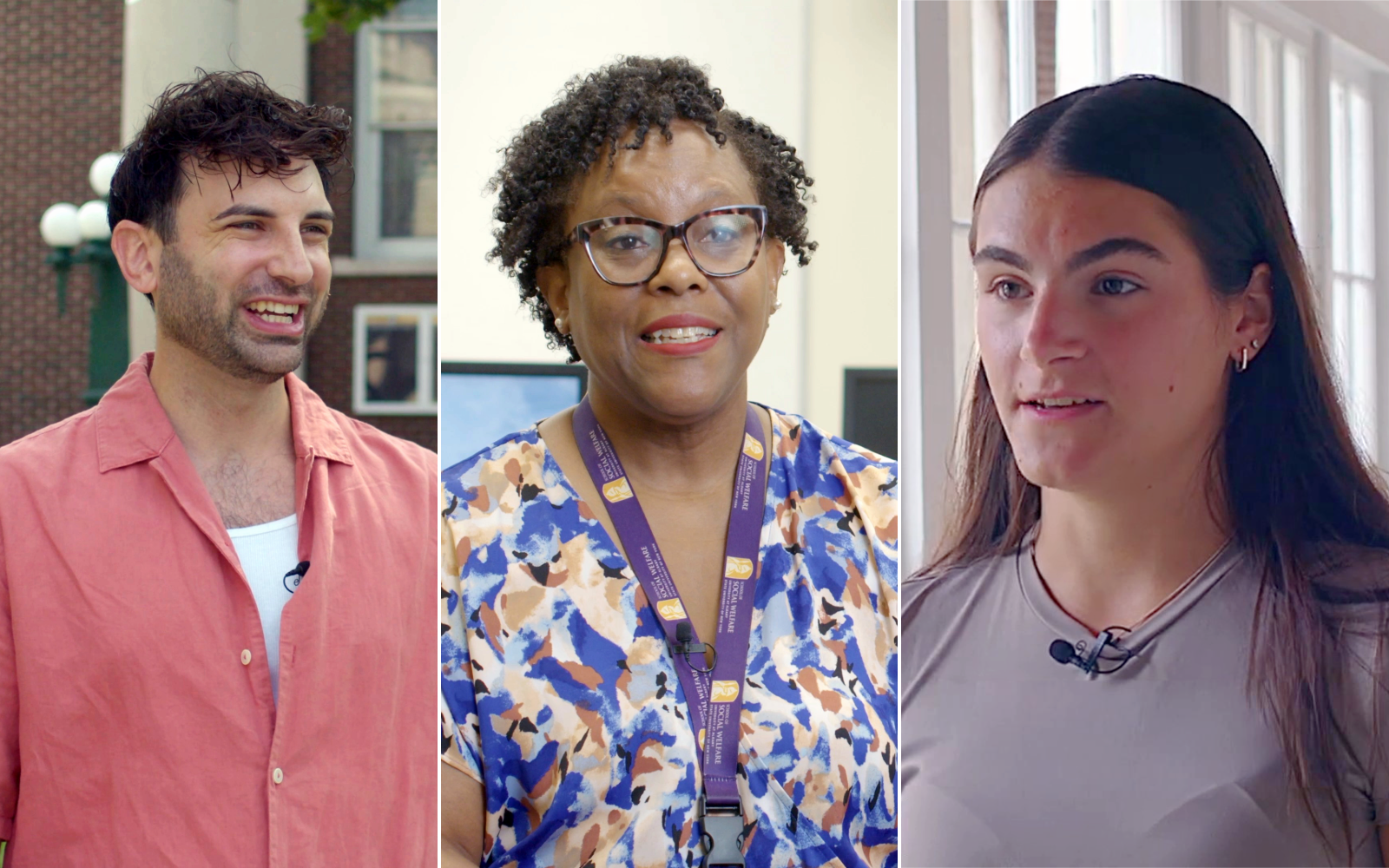


UAlbany Social Work Students Hone Skills with Professional Actors
— Video by Scott Freedman
By Erin Frick
ALBANY, N.Y. (Nov. 24, 2025) — Field practicums play an integral role in students’ learning at the University at Albany’s School of Social Welfare. In these positions, students gain experience providing clients with real support in a range of social work settings.
Before undertaking these practicums, some students in the Master of Social Work (MSW) program have a special opportunity to practice their skills with professional actors through simulated client sessions that take place via Zoom.
“Interacting with trained actors to practice counseling techniques offers students a unique bridge between theory and practice, allowing them to turn classroom concepts into lived experiences,” said Lisa DeLaMater, assistant dean and director of field education at the School of Social Welfare at UAlbany's College of Integrated Health Sciences. “Whether our students go on to work in mental health clinics, hospitals, aging services, policy work or any number of other social work positions, these early, risk-free conversations can become the foundation they draw upon when the stakes are real.”
How it Works
When students log into the Zoom session, on the other side of the screen sits not a classmate, but a professional actor portraying a client in crisis — a mother whose child has been placed in foster care, an individual with bipolar disorder who has gone off their medications, a patient in a hospital bed requiring a psychosocial evaluation. The sessions feel real, because the actors never break character.
The goal is to provide a highly realistic environment for students to practice essential social work skills in a space designed to be both safe and authentic. The actors, who are hired from the Albany-based Center for Listening and Presence, train extensively for each role. Preparation includes studying their characters’ diagnoses and histories in order to portray clients with accuracy and consistency. Once the session begins, the actors respond as a real client might — possibly with silence, frustration, vulnerability or relief.
Over the academic year, students gain experience in several different roles, each designed to mimic a distinct setting, goal and duration of time spent with the client. Some scenarios are brief and challenge the student to collect detailed personal information from a client efficiently. Others are longer, extending over multiple sessions, and allow the student to develop a deeper relationship with the client.
This diversity of experience helps students practice a variety of roles, while learning how to adapt their approach to accommodate a range of client needs.
Hear more from Taylor Philippi in this episode of The Short Version, including his efforts to promote inclusive classrooms.
Reflection and Evaluation
Each simulation session is recorded and stored in the cloud. Afterwards, the actors offer feedback through a client-perspective survey, while the students schedule a one-on-one review session with their field liaison at the School of Social Welfare. Together, they watch the video recording frame by frame, analyzing moments of engagement, assessment and intervention.
“While the review process can be a bit uncomfortable at times, the opportunity for a student to compare how they think they are communicating with how their communication style and body language actually appear to the client can be a dramatic and informative eye-opener,” said DeLaMater.
“Working with actors provides a deeper sense of reality, compared to roleplaying with classmates,” said Monique Ivey, assistant director of field education at the School of Social Welfare. “Instead of trying to ‘act’ with peers they know personally, students face realistic symptoms and behaviors that mirror the complexity of actual practice. That authenticity, coupled with the assurance that errors carry no consequences, allows them to lean into the discomfort of learning. Plus, it creates a no-judgment zone. Students can make mistakes, experiment and learn — without the risk of harming a real client.”
Beyond preparing for client interactions, the simulations help students build broadly applicable professional skills.
“Students sharpen their active listening skills, strengthen critical thinking and gain layered feedback from both the actor’s perspective and the professional reviewer’s expertise,” said Ivey. “The process builds confidence, too. At first, they’re nervous, but afterward, I hear the same thing over and over: ‘This was so great!’ Students leave feeling more prepared for real clients because they’ve already walked through the experience.”