





Students Study Film Censorship History at the NYS Archives

ALBANY, N.Y. (Dec. 9, 2025) — UAlbany students in the film studies minor received a rare hands-on look at the history of American cinema — not through a textbook but through original scripts, production files and censorship records housed in the New York State Archives.
As part of a new seminar led by Eli Boonin-Vail, director of UAlbany’s film studies minor, students visited the Archives’ Motion Picture Division this month to study documents that shaped the films audiences saw and the ones they weren’t allowed to see.
Exploring Film Censorship
Located just steps from UAlbany’s Downtown Campus, the Archives holds one of the most extensive collections of motion-picture censorship materials in the world, second only to Hollywood’s studio collections. For many students, it was their first experience handling century-old censorship notes, scene-by-scene cut lists, banned-film evaluations and correspondence between state regulators and filmmakers. The visit offered a rare opportunity to see how film history was shaped not only by directors and screenwriters but also by public officials.
"This is one of the most comprehensive archives of film censorship anywhere on Earth. I know film scholars who have come all the way from Los Angeles and Beijing to consult these files and they're right in our backyard," said Boonin-Vail, who has been working to expand opportunities for student research in the film studies minor. "New York's censorship apparatus had more influence than practically any other governmental body in the United States and our students get to learn the story of that influence directly from original documents."
“It is truly wonderful to see students so engaged with the collections we hold at the New York State Archives. Our motion picture scripts collection tells the story of shifting attitudes toward what was appropriate for public consumption,” said Brian Keough, New York State archivist. “While some scripts might have originally been censored, the collection is available for anyone to view and research.”
Hands-on Learning
The seminar drew on expertise from across UAlbany and the New York State Education Department. Legal historian Laura Wittern-Keller, a faculty expert on U.S. film censorship and author of Freedom of the Screen and The Miracle Case, consulted with the class and helped shape the archival research assignment. Students also met with New York State Librarian Lauren Moore and Keough, who provided insight into the history and preservation of the Motion Picture Division collections. Their guidance helped students understand both the legal framework behind film censorship and the archival practices that keep these records accessible.
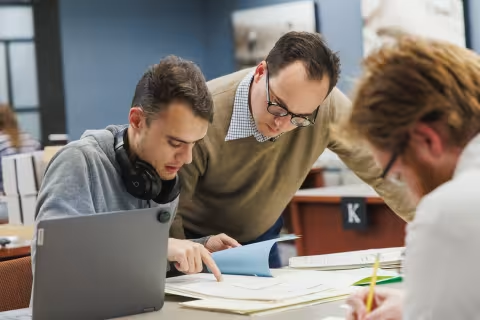
For Matthew Donnelly of Castleton-on-Hudson, the experience brought together his interests in both film and history. Donnelly, a business administration major with a minor in film studies, transferred to UAlbany from Hudson Valley Community College after considering several universities. He described the archives visit as unlike anything he had done before.
“Working with the archives was truly an amazing experience,” Donnelly said. “The motion picture division has so much material it would take years to look through everything. I have never done research like that before but everyone there was very accommodating and answered any questions I had.”
He added that the film studies minor has been one of the most meaningful parts of his time at the UAlbany, strengthening his appreciation for film and inspiring him to pursue long-term interests in the industry.
For cybersecurity major Markham Daly of Castleton, the seminar opened a door to historical research he had never attempted.
“I have never worked with official historical documents like that and it was a cool look into the past,” he said. “Our censorship essay was one of the most interesting assignments we’ve done because there was such a huge wealth of information. I was a bit afraid to work with sensitive materials but with care and intent it was no problem at all.”
Both students said the seminar and the Archives research gave them a deeper view of film as a reflection of culture, power and public values.
Donnelly hopes to work in finance after graduation but has a long-term goal of owning a movie production studio. Daly plans to enter the cybersecurity field, ideally in cyber consulting and hopes to return to UAlbany for his master’s degree.
The seminar marks the first coordinated effort to bring UAlbany undergraduates into the Motion Picture Division collections, offering students from different majors a rare chance to engage directly with the history of film censorship.
As Daly put it, “Classes teach you a ton, but experience has taught me the most. Choosing to spend some free time experiencing your field is invaluable.”
Film Studies at UAlbany
The film studies minor at UAlbany brings together courses in film history, criticism and theory and offers opportunities to explore global cinema, documentary production, screenwriting and the evolution of film as an art form.
Students from majors across campus take part in the minor, which emphasizes close analysis of films and the social, political and technological forces that have shaped them. The program also encourages hands-on work with archival materials and primary sources, which made the visit to the New York State Archives a natural extension of classroom learning.