





UAlbany Hosts Symposium on Mental Health in Communities of Color

By Erin Frick
ALBANY, N.Y. (Oct. 17, 2024) — On World Mental Health Day, the University at UAlbany’s Black, Indigenous, Latinx and People of Color (BILPOC) Faculty Advancement Initiative and the Center for the Elimination of Minority Health Disparities (CEMHD), in collaboration with Partners in Community Development, hosted “Amplifying Mental Health Wellness through the Lens of Equity: Technology and Human Rights,” a one-day symposium focusing on mental health in communities of color.
Through keynote remarks, two panel discussions and a poster session, the event explored how mental health and human rights intersect, and ways we can harness emerging tech to support mental health among historically underserved communities.
“BILPOC and CEMHD were pleased to partner with BIPOC PEEEK again this year," said Carmen Serrano, associate professor of Spanish and co-founder of the BILPOC Faculty Advancement Initiative. “Our symposium brought together local leaders, regional and national experts, community members and stakeholders for a day of learning and intentional interaction to educate employers and employees on essential aspects of mental health equity, and technology. We learned so much from the expert panelists. There is a lot to be done still, yet we all walked away from this symposium empowered and filled with ideas on how we can contribute to the well-being of others in our communities.
“We are so appreciative of the many community partners and UAlbany co-collaborators who came together to make this event possible, including the Office of Diversity and Inclusion, the Department of Languages, Literatures and Cultures, the School of Social Welfare, and the Extreme Events, Social Equity and Technology Laboratory.”
Participants included mental health experts, UAlbany faculty, researchers and community leaders. Among the featured speakers and panelists were UAlbany President Havidán Rodríguez; Moira Tashjian, Executive Deputy Commissioner of the NYS Office of Mental Health; Dr. Vanessa Bobb, Vice President of Behavioral Health and Medical Integration at CDPHP and Adrian Hale, NYS Education Department Board of Regents.
“Addressing inequities in mental health care requires a multifaceted approach that includes technology, community-based organizations and nonprofits, government agencies, and educational institutions like ours,” said UAlbany President Havidán Rodríguez. “I am proud that UAlbany can serve as a nexus for this work, bringing together experts from a variety of disciplines and backgrounds to tackle real-world problems and develop equitable solutions.
“We know that mental health impacts every aspect of a person’s life. For college students, mental health concerns are among the top reasons students cite for dropping out of college. In recent years we have made significant investments in Counseling and Psychological Services and have also worked to build community and resilience among our student body. The mental health of our faculty and staff is also a paramount concern and an area where we continue to invest. No individual or institution can tackle this issue alone. That’s why I am so pleased to see this gathering of professionals from such varied backgrounds here today.”
During the poster session, UAlbany students and faculty showcased several on-campus efforts to both advance understanding of mental health topics through academic research and provide supportive resources for UAlbany community members.
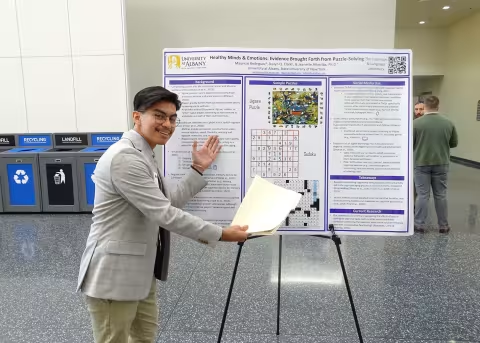
UAlbany senior and Honors College student Mauricio Rodriguez is majoring in psychology with minors in sociology and French. He is currently conducting research with the Cognition and Language Laboratory, work which he shared at the symposium.
“Currently, our ongoing research is investigating the effects of Sudoku puzzles and maze completion on human attention,” Rodriguez said. “Past research has shown us that social media use has several mental health effects such as increased presence of depression, anxiety, and worsened attention spans. We hope to find a habit that can replace social media use for younger adults, who are most susceptible to overusing social media.
Most people think that puzzles are something boring or exclusively just for the elderly, but we'd like to change that notion and show how cognitively beneficial and fun puzzles can truly be.”
Jeanette Altarriba, professor of psychology and dean of the College of Arts and Sciences, is Rodriguez’s mentor and a collaborator on the research.
“Studies of mental health and well-being have focused on the ways in which human information processing and executive functioning changes over the lifespan,” Altarriba said. “The notion of aging in a healthy way can be bolstered by engaging in activities, tasks and events that exercise our mental capacities and promote cognitive agility. This study aims to determine the types of puzzles and problem-solving activities that lead to heightened attention—an important facet of maintaining a healthy memory system.”
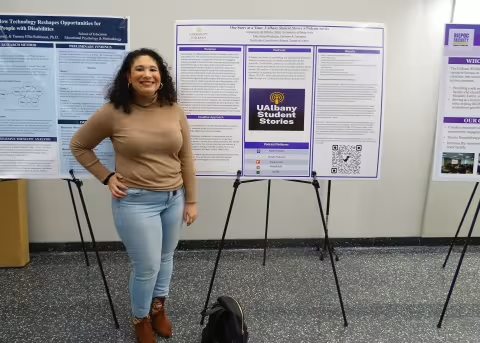
Bianca Zazzarini-Leon is a lecturer in the Department of Languages, Literatures and Cultures. She is also deeply involved in supporting the “UAlbany Student Stories” podcast series as a graduate consultant. The podcast serves as a platform for UAlbany students to share their personal experiences and also highlight on-campus resources that could support students who are facing similar challenges. Associate Professor Carmen Serrano created and oversees the podcast.
“The ‘UAlbany Student Stories’ podcast covers a wide range of topics such as clubs at UAlbany, substance abuse and alcoholism, LGBTQIA allyship and coming out stories and issues that first generation students face applying to university,” said Zazzarini-Leon. “Some of the main issues we cover relate to societal and institutional barriers that students may face before, during and after the college admission process.
“As an advisor, I've helped with generating ideas, scheduling, hosting, editing and marketing the podcast on social media. I guide the team on the learning process and how to come up with new ideas and perspectives for the podcast. I wanted to help with the podcast in order to further help students know they are not alone and navigate UAlbany.”
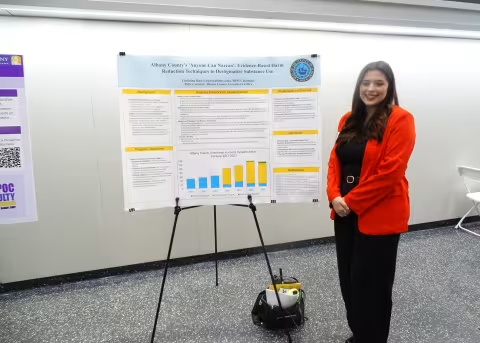
UAlbany graduate student Christina Rust is pursuing her Master of Public Health at the College of Integrated Health Sciences. She also works as a policy analyst at the Albany County Executive’s office. Rust is committed to reducing stigma around substance use and expanding access to related medical care in order to prevent overdoses and related forms of harm. Rust presented on her work with the County, and harm reduction strategies currently being implemented and/or planned. These include efforts such as installing Naloxboxes, placing Narcan and fentanyl test strips in businesses, conducting Narcan trainings and distributing wound care kits.
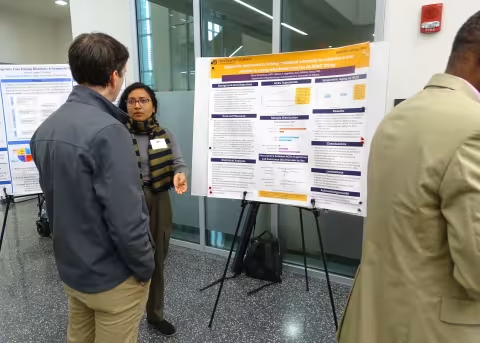
Mirza Ishrat Noor is pursuing a PhD in epidemiology at the College of Integrated Health Sciences. Noor presented a poster on “Epigenetic mechanisms linking childhood adversity to substance use disorder in young adulthood from the ‘Avon Longitudinal Study of Parents and Children’ Study.
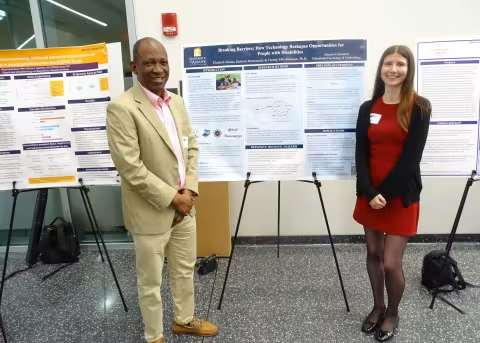
UAlbany doctoral students Elizabeth Slusarz and Zacharia Mohammed, both in the Department of Educational and Counseling Psychology in the School of Education, presented their research on ways technology—things like notetaking applications, virtual assistants and Zoom—can promote access for people with disabilities in school, work and communities. Their work also examined how technology can be leveraged to address barriers to resources, social engagement and professional opportunities.