What is Dark Matter?
Dark matter is a hypothetical form of matter that is thought to account for approximately 85% of the matter in the universe, and about a quarter of its total energy density. The majority of dark matter is thought to be non-baryonic in nature, possibly being composed of some as-yet undiscovered subatomic particles.
Its presence is implied in a variety of astrophysical observations, including gravitational effects that cannot be explained unless more matter is present than can be seen. For this reason, most experts think dark matter to be ubiquitous in the universe and to have had a strong influence on its structure and evolution.
Dark matter is called dark because it does not appear to interact with observable electromagnetic radiation, such as light, and is thus invisible to the entire electromagnetic spectrum, making it extremely difficult to detect using usual astronomical equipment.
The primary evidence for dark matter is that calculations show that many galaxies would fly apart instead of rotating, or would not have formed or move as they do, if they did not contain a large amount of unseen matter.
Other lines of evidence include observations in gravitational lensing, from the cosmic microwave background, from astronomical observations of the observable universe's current structure, from the formation and evolution of galaxies, from mass location during galactic collisions, and from the motion of galaxies within galaxy clusters.
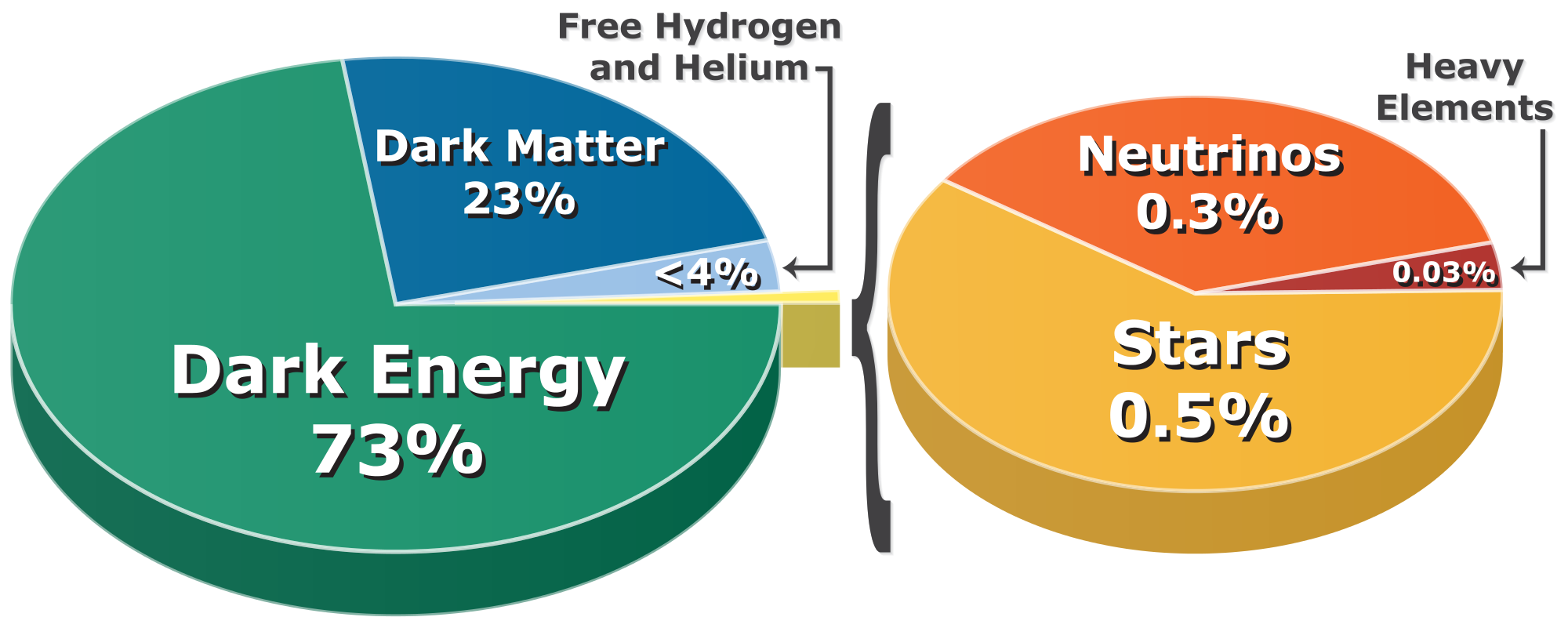
In the standard Lambda-CDM model of cosmology, the total mass–energy of the universe contains 5% ordinary matter and energy, 27% dark matter and 68% of an unknown form of energy known as dark energy. Thus, dark matter constitutes 85% of total mass, while dark energy plus dark matter constitute 95% of total mass–energy content.
Pie Chart of the Universe
The LZ detector is made of the following parts: 7 tonne liquid xenon time-projection chamber, Liquid XE heat exchanger, high voltage feedthrough, 494 photomultiplier tubes (PMTs), an additional 131 xenon "skin" PMTs, neutron beam pipes, 120 outer detector PMTs, Gadolinium-loaded liquid scintillator, existing water tank and instrumentation conduits.
The name LZ stems from the merger of two dark matter detection experiments: Large Underground Xenon (LUX) and ZonEd Proportional scintillation in Liquid Noble gases (ZEPLIN).
The LUX-ZEPLIN (LZ) experiment utilizes 7 tonnes of active liquid xenon to search for xenon nuclei that recoil in response to collisions caused by an impinging flux of dark matter particles known as WIMPs (Weakly Interacting Massive Particles (WIMPs).
The experiment is located nearly 1 mile underground in the Sanford Underground Research Facility (SURF) in Lead, South Dakota. The active liquid xenon is configured in a cylinder 1.5 meters in diameter and height, with an applied electric field to form a TPC (Time Projection Chamber).
A recoiling xenon nucleus causes a prompt flash of scintillation light, followed by delayed flash of electroluminescence. The light signals are detected by 494 photomultiplier tubes, which are deployed above and below the liquid xenon.
The central liquid xenon volume is surrounded by a thin, instrumented region of liquid xenon, an outer detector of gadolinium-loaded liquid scintillator, and a layer of ultrapure water, to identify and reduce false signals.
We project that a three-year run of the LZ experiment will achieve a sensitivity close to fundamental limits from the cosmic ray neutrino background.