


Improving Mental Health and Well-Being for Sexual Minority Women

ALBANY, N.Y. (July 24, 2026) —Long before being recognized as a group in need of support, LGBTQ+ people quietly built their own lifelines. In homes, gay bars, independent bookstores and cafes, online forums and conversations across upstate New York, community members carved out networks of care when formal systems failed to support them. And now, a research project from UAlbany’s School of Social Welfare, housed within the College of Integrated Health Sciences, aims to recognize and uplift what has worked to support LGBTQ+ people and give it structure, visibility and resources.
The project, called LGBTQ Support, Opportunities for Learning, And Community Empowerment — or LGBTQ SOLACE for short — aims to build a network of regional peer mental health support and educational initiatives for LGBTQ+ people in upstate New York. The project is starting with a focus on sexual minority women, including those who identify as bisexual, lesbian, queer or otherwise non-heterosexual, and aims to build a pipeline of LGBTQ+ community members trained to provide mental health support and suicide prevention in upstate New York.
As part of this effort, LGBTQ SOLACE’s long-term goal is to develop a free peer mental health support training program for LGBTQ+ community members. The program is designed for people who want basic skills to support those in their lives and help prevent suicide, as well as those interested in becoming registered peer support workers or pursuing degrees in helping professions. Participants will gain access to continued training and opportunities to use their skills in local settings. While the current focus is on LGBTQ+ women in upstate New York, the long-term goal is to expand the program to other marginalized LGBTQ+ groups and regions.
“We have been supporting each other’s mental health since the beginning of time,” said Angie Wootton, assistant professor and principal investigator of LGBTQ SOLACE. “Building networks of mutual aid and peer support involves recognizing the LGBTQ+ community’s strengths and capacities that already exist, and to bolster, amplify or legitimize these efforts through research and intervention development.”
Wootton began this project in 2023 after relocating to Albany and noticing the stark differences in experiences for LGBTQ+ people across New York, especially those in rural areas.
“While we tend to think of New York as a haven for LGBTQ+ life, the amount of connection and support that people receive from others who are LGBTQ+ can vary greatly by location, age, identity and more,” Wootton notes. “There have been concerns in the last few years about social isolation and loneliness, especially with the current political climate. These factors can negatively impact health, but fortunately we can remedy this with both research and community action.”
In spring 2024, the first phase of LGBTQ SOLACE received support from a UAlbany Faculty Research Award Program (FRAP-A) grant. It funded Wootton and student research assistants to identify and interview mental health and care providers in the region who serve LGBTQ+ women, and to engage LGBTQ+ women from the region in focus groups on their experiences, preferences and needs for peer mental health support programs. Results are being prepared for publication by Wootton and LGBTQ SOLACE student contributors. This phase, which continued through summer 2026, included an in-depth review of existing LGBTQ+ peer mental health support interventions, currently under review for publication.
In spring 2025, UAlbany's Minerva Center for High-Impact Practices funded two undergraduate research assistants to join the team, and in the next round of grants, re-committed to supporting two team members for the 2025-2026 academic year.
“I’m a queer person of color who’s struggled with mental health and finding adequate affirming support,” said Kyra Gerdes, a social welfare major and student research assistant employed with the Minerva Center’s support. “SOLACE is important to me because finding mental health support that views you holistically shouldn’t feel like an impossibility. In my own life I’ve found the most healing through fellow queer people, and I love that this project is rooted in that same collective healing.”
Gerdes has assisted on multiple aspects of LGBTQ SOLACE, including community outreach across upstate New York and co-facilitating focus groups. She also proposed, created and implemented a grounding meditation to conclude the focus group sessions—an addition that created a calm, supportive close to the discussions.
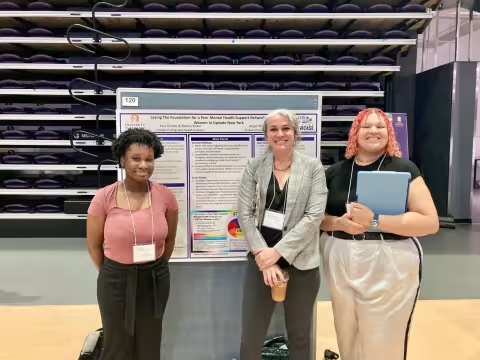
Recently, Gerdes and other team members analyzed the focus group data to learn what community members want from peer mental health support training and which interventions they believe would be most effective. In summer 2025, LGBTQ SOLACE created its Project Advisory Board, which now includes seven LGBTQ+ women from upstate New York. Members bring expertise in LGBTQ+-affirming mental health and social services, program design and implementation, and intervention research, along with strong connections to community members and local organizations across several regions. The board meets quarterly on Zoom and will help guide key decisions as the project continues to develop.
“It is important to us that this work is done in dialogue and partnership with local and regional thought leaders who are already engaged in efforts to support LGBTQ+ mental health and peer support programs, to ensure that the interventions our team creates will align with and build on those efforts,” Wootton explained. “The LGBTQ SOLACE team is committed to doing regional work that directly benefits the community, bridging the gap between research innovation and direct care for LGBTQ+ people in this area.”
In addition, Wootton placed an emphasis on student involvement in LGBTQ SOLACE, noting the diverse perspectives that students bring to research activities.
“I could not have launched this project without the fabulous team of undergraduates, master’s and doctoral students from social welfare, public health, philosophy, and women’s, gender and sexuality studies. My thinking is continually deepened by their perspectives, and the students hold me accountable to moving the research forward despite the many competing demands of my faculty role.”
“The entire experience has made me fall in love with research,” said Forrest Vildor, who started on LGBTQ SOLACE as an undergraduate student and is now enrolled in UAlbany’s Master of Public Health (MPH) program. “It’s made me want to incorporate this into my future career plans. In general, I’m so grateful to be a part of this team, which really does embody what SOLACE stands for.”
Wootton notes that there is a critical need for more mental health counselors for LGBTQ+ people — and sexual minority women specifically — in upstate New York, including both peer support workers and clinical mental health professionals. Students graduating from the College of Integrated Health Sciences are well equipped to move into these sorts of roles.
“I feel I’m a far better professional and student following this experience. It’s made me excited to engage in research and brought something that was just a hazy idea into a stark and exciting facet of my future,” said Gerdes.
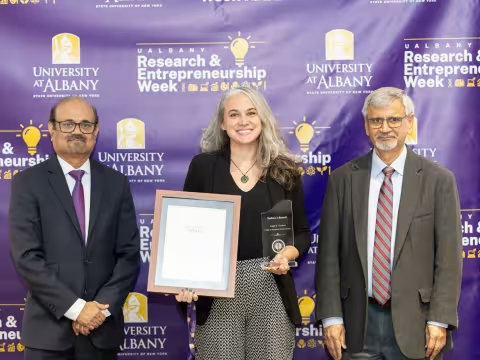
In fall 2025, Wootton received UAlbany’s Excellence in Research Award for LGBTQ SOLACE and was celebrated during Research and Entrepreneurship Week 2025, a public event that showcased the University’s research and economic potential. Wootton also received a Lavender Award for Excellence in LGBTQ+ Scholarship from UAlbany in spring 2025.
“SOLACE represents the kind of community-rooted, research-informed intervention that truly changes lives. At UAlbany, we believe in partnering with communities to build supports that are authentic, responsive and sustainable, and we are proud of everything Dr. Wootton’s team is doing in this area,” said Victoria Rizzo, senior vice dean and director of the School of Social Welfare.
The next step for SOLACE is developing free, LGBTQ+-specific peer mental health and suicide prevention training initiative, complete with the materials needed to offer the course in partnership with organizations serving LGBTQ+ women in upstate New York. The team is also assessing what might help or hinder the program’s rollout to ensure it meets community needs. SOLACE is currently seeking additional funding to support this phase and hopes to expand the training to other marginalized LGBTQ+ groups as resources allow.
“We support us!” Wootton said. “We have each other’s backs, historically, presently and always will.”