


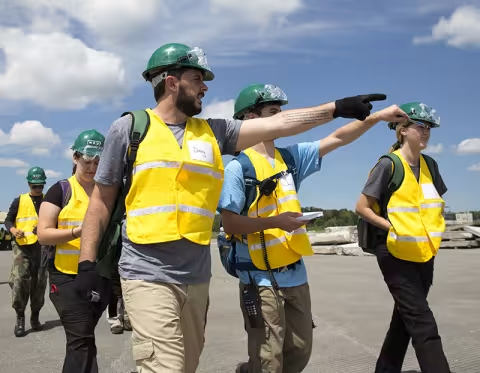
Active shooter training at UAlbany’s National Center for Security and Preparedness.

Certificate of Graduate Study in
Emergency Preparedness, Homeland Security and Cybersecurity
Online or On Campus

CEHC students engaged in training
Program of Study

Core Course: Risk Theory and Management

Explore the application of risk analysis within the field of emergency management and security. This course integrates foundational principles of risk with key concepts from economics, statistics, decision-making and social science. Through a blend of theory and practical tools, you'll gain the skills needed to assess, interpret and manage real-world risks effectively


Additional Information

See the Graduate Bulletin for program requirement details.

For more information, contact Mike Baumgardner at [email protected].

programofstudy
Program Tracks
Emergency Preparedness

Minimize risk to people, property, small businesses, nonprofits, government agencies, and corporations by evaluating hazards, responding to emergencies and disasters, and coordinating shared community resources and equipment.
 

COURSES

Required courses

  • Risk Theory and Management
  • Fundamentals of Emergency Management OR Disaster, Crisis, and Emergency Management and Policy

Sample electives: Terrorism, Public Security, and Law Enforcement; Preparedness and Response; Data Models and Decisions


CAREER PATHS

Job titles: Disaster Program Manager, Emergency Response Strategist, Catastrophe Risk Analyst

Homeland Security
Homeland Security

Secure America's towns, cities, borders, airports, seaports and waterways as a skilled member of law enforcement, immigration and travel security agencies, prevention and response teams, and mission support organizations.
 

COURSES

Required courses

  • Risk Theory and Management
  • Political Violence, Insurgency, and Terrorism OR Fundamentals of Homeland Security

Sample electives: Terrorism, Public Security and Law Enforcement, Homeland Security Intelligence, Global Security


CAREER PATHS

Job titles: Terrorist Threat Investigator, Criminal Intelligence Analyst, TSA Field Intelligence Officer

Cybersecurity
Cybersecurity

Help companies, government agencies, and nonprofit organizations protect sensitive and proprietary information from data breaches, hackers, inside threats, and natural disasters like fires and floods.
 

COURSES

Required courses

  • Risk Theory and Management
  • Principles and Practices of Cybersecurity

Sample electives: Cryptographic Protocols, International Cyber Conflicts, Multimedia Forensics
 

CAREER PATHS

Job titles: Cyber Exploitation Officer, Forensic Cryptologist, Network Intrusion Detection Specialist

Admissions Requirements

admissions
Deadlines
Deadlines
  • Fall: Rolling
  • Spring: Rolling
  • Summer: Rolling

There is no departmental assistantship consideration for this program.

Required Application Materials
  • Transcripts from all schools attended
  • Resume
  • Statement of goals

The statement is generally one to two pages discussing what you have to offer the program and what you wish to get out of the program.  It should include a brief description of the applicant's field of interest, related background, desired area of study and research emphasis or career goals.


*One or two letters of recommendation are encouraged but not required for admission.  Applicants can also supply an optional writing sample but it is not required.