




Students Find Lessons in Tuberculosis History

By Jackson Woolley, Class of '27
ALBANY, N.Y. (Oct. 26, 2026) — It was 6:45 a.m. on a Friday — so early that not even the Carillon was awake. But a group of UAlbany students were. Not just awake but excited to learn about… tuberculosis.
The destination was the Saranac Laboratory Museum, a former tuberculosis research facility that put the Adirondack village of Saranac Lake on the global map long before the nearby Olympics did.
Constructed in 1894, the Saranac Laboratory was the first lab built in the U.S. for tuberculosis research. Historic Saranac Lake restored the building and opened it as a museum in 2009.
The group from the College of Integrated Health Sciences (CIHS) included master’s students in public health and social work, doctoral students and undergraduates keen to learn more about the history of the disease that once killed tens of thousands of Americans every year, and New York’s unique role in the nation’s public health response to it.
Their itinerary included stops at the Trudeau Sanitarium and several cottages where those suffering from the disease stayed during the TB epidemics of the 19th and early 20th centuries. They also toured the modern Trudeau Institute, a biomedical research center that continues to study infectious diseases such as COVID-19 and tuberculosis today.
John Justino, director of the CIHS Center for Global Health /Global Programs at the college, has been leading this trip for 13 years.
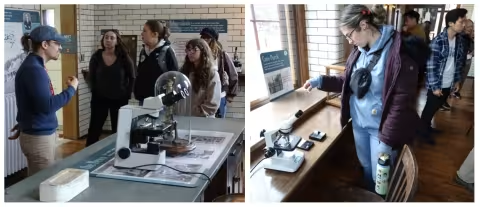
“I think it’s really important for students to complement what they’re learning in the classroom with real world experiences,” Justino said.
“It’s one thing for a teacher to talk at you for three hours and it’s another thing to actually be able to experience and see a part of history,” said Chika Uzoeishi, who is currently enrolled in the 4+1 program for public health, and has been on this trip twice before.
Catching a Vibe
Many of the students were excited for the opportunity to get to know their classmates better.
“Getting a whole day where you just get to connect with other students outside the classroom is super nice,” said Marissa Mastracco, a student in the Master of Public Health program.
“It’s a different perspective,” said Arianna Poulopoulos, a student in the Master of Social Work program. “It’s a different environment. You get to interact with people that you’ve never met. I think the common connection between us was just wanting to make sure that people in need are being taken care of.”
The Health Sciences students were joined by participants in the Albany Lifelong Learning Institute (ALLI), a program designed for older adults who want to continue their educational journey.
“It keeps your brain going,” said Chris Walcek, emeritus faculty member of atmospheric science at UAlbany and a current ALLI student. “It’s always good to keep learning things as you get old, and to just talk and communicate.”
“You’re looking at both ends of the career spectrum here,” he added. “Students starting off and then most people in the ALLI program that are mostly retired, so it’s good for them to see us.”
Learning from the Past
Beyond the interactions with the other people on the trip, the students also learned a great deal about the history of not just tuberculosis, but also of New York.
“I grew up going into Saranac, but I’d never visited the sanitarium or museum,” said Sarah Kenny, who is in the Master of Public Health program. “It’s part of an area I know a lot about, but I didn’t know this specific thing.”
While going through the museum, the students learned about the treatments and strategies used by the laboratory’s founder Dr. Edward Livingston Trudeau to help heal tuberculosis patients, and compared them to the treatments we have today.
“What really stood out was the emphasis that Trudeau had on hope,” said Kenny. “Hope is essential for the restoration of health. Maintaining hope throughout your journey in life really is an important thing.”
The students took away different lessons from the trip. While public health students focused on the infectious disease care and prevention strategies used by Dr. Trudeau and the sanitarium staff to improve patients’ health and wellbeing, social work students paid closer attention to the social aspects of Trudeau’s holistic approach to care and treatment.
“What jumped out at me was how focused Trudeau was on supporting economically disadvantaged populations, which are often overlooked,” said Poulopoulos. “The fact that he was so focused on supporting and treating the people who couldn’t afford treatment is what I look for in social work.”
The students on the trip were able to learn lessons from local history that they can apply to the world today.
“Public health is global health,” Justino said. “Every health challenge we face on the local level has a global aspect, and we can learn so much from colleagues working on these same challenges in other countries around the world.”