





Duolingo for Social Skills? Students Tackle Loneliness at AI for Good Challenge

By Bethany Bump
ALBANY, N.Y. (Oct. 26, 2026) — The pandemic arrived just as Sascha Wright was finishing middle school in Staten Island. Like so many other young people who came of age during that time of social isolation, masking and uncertainty, she found herself spending a lot of time alone asking big questions.
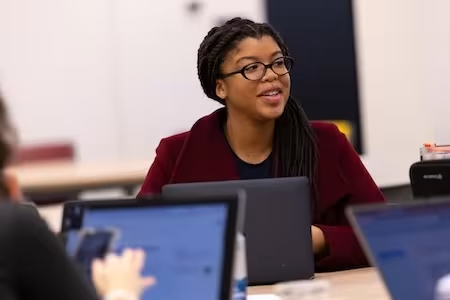
“It was an interesting time for self-discovery,” Wright recalled. “I spent a lot of time just thinking about things, and I think my interest in psychology definitely developed over that time.”
She began taking personality quizzes and asking questions about identity, behavior and belonging. Those questions followed her to UAlbany, where she is majoring in communications with a minor in sociology. They also helped inspire an idea she brought to the AI for Good Challenge: an artificial intelligence-powered platform to help people develop social intelligence and build meaningful connections.
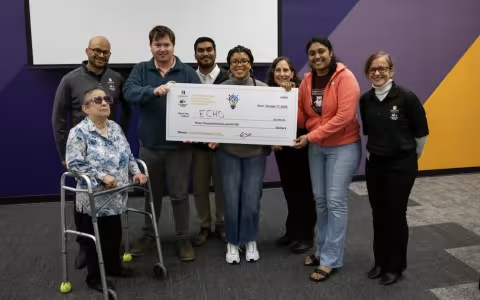
The challenge, led by UAlbany’s AI & Society College and funded by the SUNY AI for the Public Good Initiative, was held Oct. 16-17 at UAlbany. The event brought together students and faculty from four SUNY campuses — UAlbany, Hudson Valley Community College, SUNY Cobleskill and SUNY Oneonta — to develop AI-enabled solutions that address social isolation and loneliness. Wright’s team won first place out of seven teams with ECHO, a prototype that grew out of her idea.
Lessons in Connection
ECHO takes inspiration from dolphin echolocation, which allows dolphins to navigate their surroundings through signals and feedback. The proposed platform applies a similar concept to human interaction, helping students better understand themselves, practice social situations and discover opportunities to connect with others.
Described as “Duolingo, but for social intelligence,” ECHO would offer interactive lessons and simulated conversations, then recommend campus events where students could practice their skills and meet people with shared interests. The prototype was tailored to SUNY students, but could eventually be expanded to a much wider audience, Wright said.
“I think something that gets overlooked when we talk about social isolation is that it isn’t always about not having enough people or opportunities around you,” she said. “Sometimes those things are right in front of you, but you don’t necessarily know how to approach them.”
“Instead of making another event finder, we focused on teaching the ‘how’ first,” said teammate Likith Kumar Kandukuri, a sophomore studying electrical and computer engineering at UAlbany.
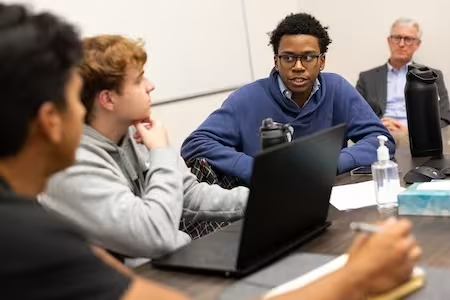
Another team took a different approach to the same problem. Edson Tembo, a freshman studying computer science at Hudson Valley Community College, said connection is a challenge on a commuter campus.
“At Hudson Valley, people go to class and then leave,” he said. “There’s not much opportunity for people to make friendships and social connections like you have at four-year colleges.”
His team proposed an AI-powered events forum to match students, especially freshmen and transfers who may have missed the early chance to find a friend group, with events and like-minded peers.
His teammate Brad Perez, a senior studying accounting and finance at SUNY Oneonta, said the challenge offered skills classes don’t.
“Coming up with an idea and then having to go in front of a panel of sophisticated judges and defend that idea is something that’s not really taught in class,” he said. “And those are soft skills that are valuable and directly translatable to any profession.”
Beyond Code: Putting People First
Another team developed an idea for connecting socially vulnerable residents with community resources during emergencies or times of isolation and distress. The range of ideas reflected the challenge’s interdisciplinary approach, bringing together undergraduate and graduate students, as well as faculty members, from fields including computer science, engineering, communications, philosophy and the social sciences.
Linda Lim, chair of computer science and mathematics at Hudson Valley, said she wants students to understand AI beyond the headlines.
“I think right now the narrative that we are getting from media is either AI is going to save the world, which is way overblown, or AI is going to destroy the world, also possibly overblown,” she said. “I want them to be able to look at it, understand how it works, and how they can use it as a tool to better our communities.”
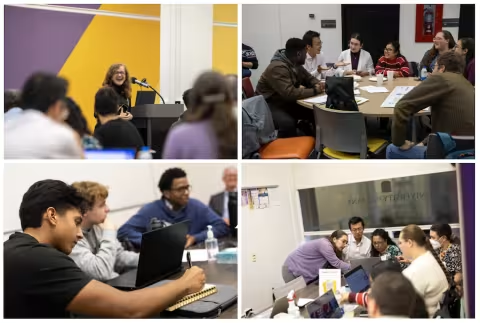
“This has not been simply a coding competition,” said Mila Gasco-Hernandez, associate director of UAlbany’s AI & Society College and a co-designer of the challenge. “We wanted the teams to think about people first: who they were designing for, what they actually needed, what barriers they faced and how their solution might create meaningful and sustainable social impact.”
The emphasis on human needs was a key takeaway for Sharmilee Rajkumar Rajan, a fourth-year computer science PhD student at UAlbany who worked on the ECHO project.
“I found it valuable to work with teammates who brought different perspectives and helped me consider the human experience behind our technical decisions,” she said. “I want to carry that approach into my research and career: listening carefully, collaborating across disciplines, and judging the value of technology by how it helps people.”
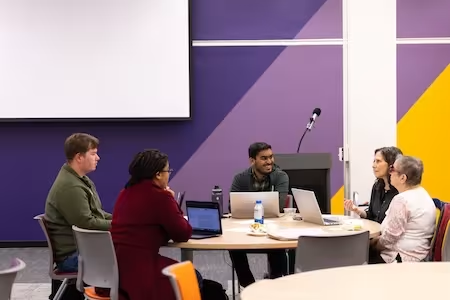
Organizers hope to secure sponsors for a larger challenge in the spring that would potentially provide teams with support to further develop their ideas.
“Over these two days, we have talked a great deal about AI, but ultimately this challenge has been about people: understanding people's needs, strengthening communities and exploring how technology can contribute to a more connected society,” said Hany Elgala, associate director of the AI & Society College who helped design the challenge.
For Wright, the competition has strengthened her interest in exploring the intersection of technology, communication and sociology.
“This experience also made me appreciate AI even more, especially when it comes to using it for something that could genuinely help people,” she said.