





UAlbany Philosophy Professor Chats AI Ethics, Empathy with Sean Ono Lennon

By Bethany Bump
ALBANY, N.Y. (Aug. 21, 2026) — Can AI ever become truly empathetic? What would it take to do so and what happens to human flourishing and relationships if it does?
These are some of the questions UAlbany Associate Professor of Philosophy and AI & Society College Director Jason D’Cruz explores with musician Sean Ono Lennon on the Sing for Science podcast, which brings musicians and experts together to explore the scientific ideas behind their most iconic songs.
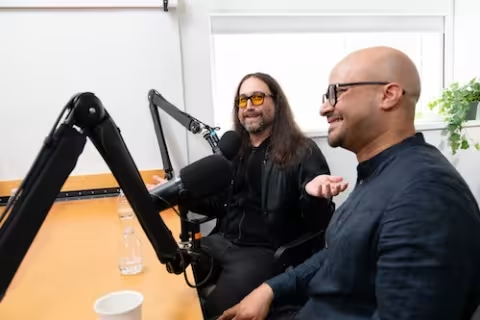
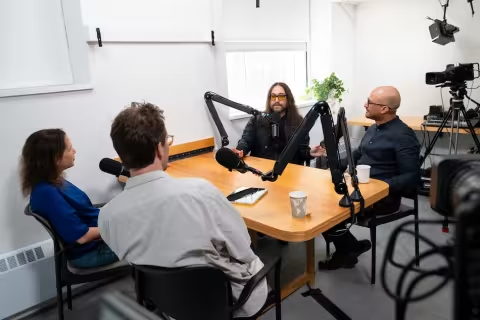
The episode, recorded at Harvard’s Radcliffe Institute for Advanced Study in June and released Thursday, was hosted by musician and Sing for Science creator Matt Whyte and also featured insight and expertise from Hebrew University Psychology Professor Anat Perry who studies the science of empathy.
D’Cruz, who served as a 2025-26 Civil Discourse Fellow at Harvard University’s Edmond and Lily Safra Center for Ethics, explores topics related to AI ethics, such as human and artificial empathy, moral psychology and trustworthiness in his research.
The conversation was inspired by Lennon’s latest album, The Great Parrot Ox and the Golden Egg of Empathy, done in collaboration with Primus frontman Les Claypool under their Claypool Lennon Delirium band. Set in the dystopian land of Cliptopia, the sweeping concept album and its companion comic book and animated shorts serve as a cautionary tale about the pursuit of optimization above all else and the importance of preserving human empathy.
Lennon explained that Cliptopia was inspired by Nick Bostrom’s famous "paperclip maximizer" thought experiment, in which an AI system that’s programmed to produce as many paper clips as efficiently as possible ends up destroying humans and the Earth — not through malice but through extreme efficiency uninhibited by human empathy.
“One thing that empathy does, I think, is it constrains us in interesting ways,” D’Cruz said. “So when we witness the suffering of another person, it gives us pause. It makes us think this is something we oughtn't to do.”
Lennon said he often jokes that he hopes AI does become conscious, because consciousness gives rise to empathy, which would make it less of an existential threat to humanity.
“I actually think the danger of AI is in it remaining a cold and kind of sociopathic machine,” he said. “In a way, what we want is for it to wake up a little bit or have some experience of existing, so that it has a chance of… contextualizing commands and relationships in a way that's adaptable and not just mechanical.”
Whether or not AI can adequately contextualize and make human-like judgments is something D’Cruz recently explored in a paper titled, Empathy and the Right to Be an Exception: What LLMs Can and Cannot Do.
Someone who finds themselves tangled up in the criminal justice system is likely to prefer a decision made by a jury of peers over a machine that uses only cold hard data to decide its fate — no matter how complex or sensitive its algorithm, D'Cruz said.
“There seems to be something really important about being able to make our appeal to another person who also has experiences and makes the effort to put themselves in our shoes,” he said.
“It’s a jury of our peers, not of our AI nightmares,” Lennon said.
“The justice system that we have is so beautiful because we have a right to be seen by and judged by our peers in our society,” he added. “If we mechanize that, it just feels very dystopian to me.”
In Cliptopia, the heroes save the world by tracking down the Golden Egg of Empathy, which is the only thing that can stop the AI system from turning the planet and everyone in it into a wasteland of paperclips.
Lennon said he’s encouraged by younger generations that are instinctually wary of AI and increasingly turning toward real-life experience.
“They're getting into real-life objects and tactility and handcrafting and making fanzines and real instruments and analog,” he said. “I see a lot of them buying old tape machines from the '80s and making albums on 4-tracks and it's clearly a reaction to the technology. I find it really heartening because it's almost like the AI is highlighting what they're lacking in their lives, and they're realizing it and seeking it out.”
D’Cruz was pleased by the wide range of perspectives and topics covered in the episode, from philosophy and science to music and psychology, and said it’s an example of the kinds of conversations UAlbany’s AI & Society College is working to foster.
“A big part of our mission is to open up these conversations between people in the arts and humanities and sciences about the social impact of artificial intelligence and how it's going to transform how we interact with other human beings,” he said. “So I felt like this was a great example of that.”
The episode is available to stream on Apple Podcasts, Spotify and other platforms, and is also available to watch on YouTube.