





5Q with Sara Lombardo: Graduate Student Earns NASA Award for Cloud Chemistry Research
By Sophie Coker
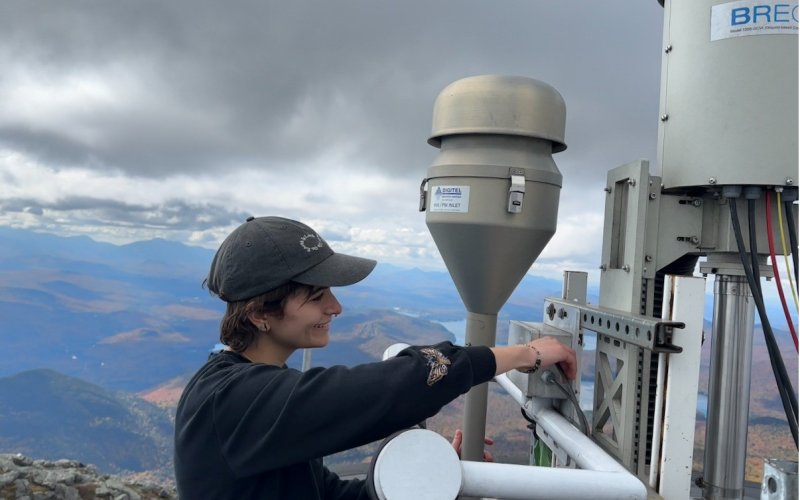
ALBANY, N.Y. (Dec. 18, 2025) — Sara Lombardo has focused their time high up in the clouds since joining the University at Albany.
Originally from Powhatan, Virginia, Lombardo enrolled in graduate school at UAlbany to study at the Atmospheric Sciences Research Center (ASRC) Whiteface Mountain Field Station. Located at the top of the summit, the field station, known to locals as the Whiteface Observatory, has collected cloud water samples for chemical monitoring for more than 50 years.
On their first day as a graduate student, Lombardo drove to the Whiteface Mountain summit with Sara Lance, a professor and researcher at ASRC, and PhD candidate Archana Tripathy. That’s when Lombardo realized there was a lost opportunity with the field station’s cloud water sampling filters, which were getting collected but not analyzed. Seeing the potential for resourcefulness, Lombardo worked with Lance and other UAlbany researchers to develop a project studying cloud chemistry at Whiteface Mountain in relation to wildfire smoke.
Lombardo received the prestigious Future Investigators in NASA Earth and Space Science and Technology (FINESST) award for their transformative microbial research project. FINESST provides support for graduate student research projects that hold scientific significance to NASA. The grant is worth up to $50,000 per year for up to three years.
This year, out of 565 proposals received by NASA in the Earth Science category, only 55 were selected for the competitive award. We caught up with Lombardo to learn more about the research that caught NASA’s attention.
What is aerobiology? How did you get interested in it?
Aerobiology is the study of life in the atmosphere. I research microbes in clouds and how the chemical and microbial content of clouds interact with one another. I took mountain meteorology as an undergraduate and later learned about Sara Lance’s lab at UAlbany, which focuses on cloud water chemistry. I reached out to Sara and started later that summer.
While at Whiteface, I met Paul Casson, the one responsible for cloud water collection during the summer. He mentioned that we filter the cloud water, but do not do anything with the filters. I quickly started drafting a plan to study the microbial content of clouds using cloud water filters.
As I started to apply for funding, Sridar Chittur of UAlbany’s Center for Functional Genomics (CFG) reached out about the cloud water microbial content. From there, the CFG has played a crucial role in teaching me how to perform DNA extractions and analysis. I owe so much to my research mentors at UAlbany. I was fortunate enough to also be able to meet Pierre Amato at the Puy de Dôme in France and expressed to him how much his research on cloud microbiology has influenced mine.
How did you get connected with NASA and what is the focus of your research with them?
My advisor Sara Lance connected me with Diana Gentry from NASA’s Ames Research Center. We drafted a grant application in 2024 that received positive feedback but couldn’t be accepted because I didn’t have a collaborator at UAlbany to help me with microbial analysis. Luckily, the Center for Functional Genomics reached out, and in 202, I was able to reapply for and received the FINESST grant. It was a testament to how crucial collaborations are and to not give up upon rejection.
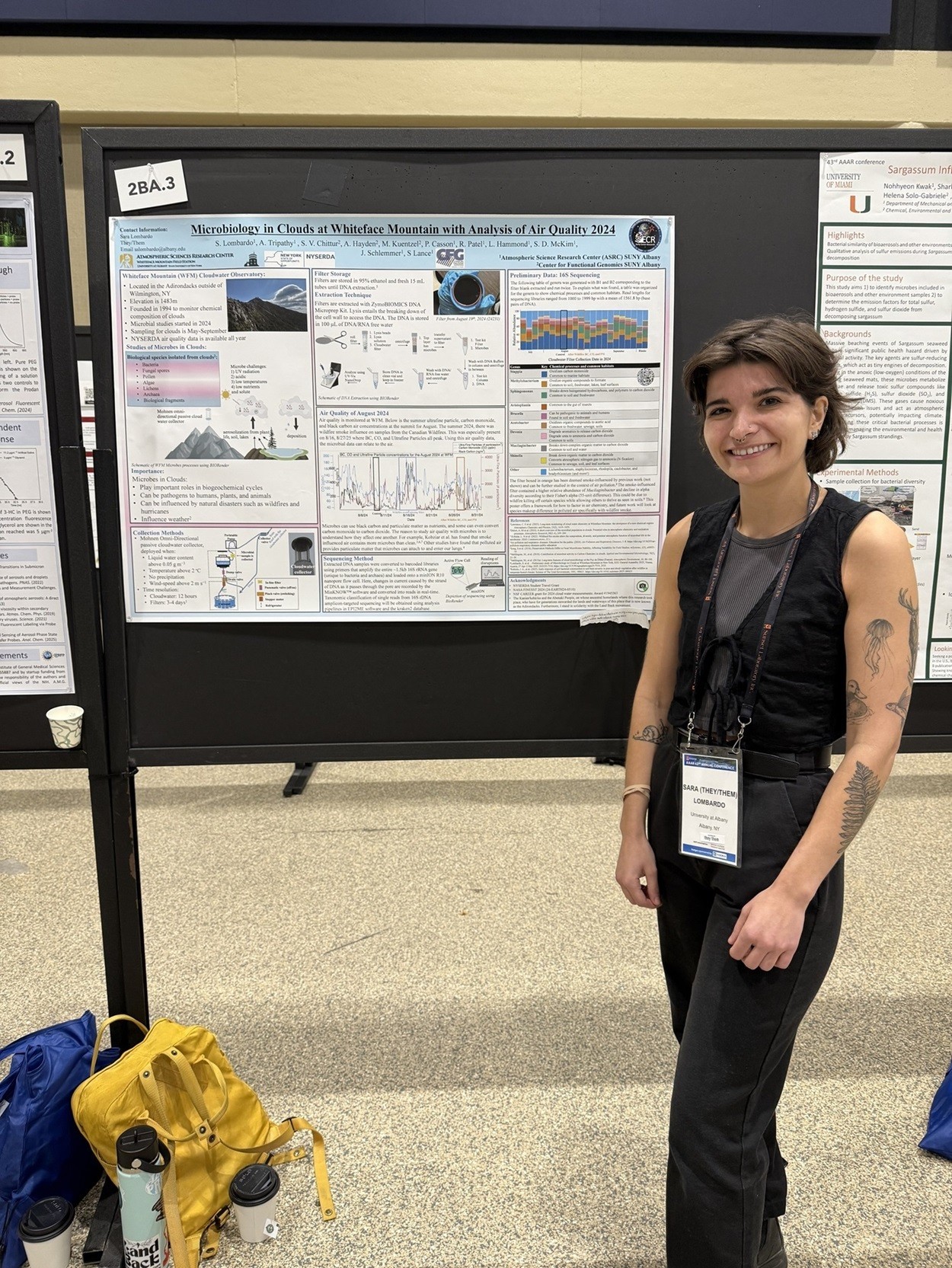
My grant aims to link the microbial and chemical content of clouds at Whiteface, study how natural disasters, like wildfires, can affect the microbiome of clouds and analyze the data through a human health lens. Ultimately, my proposed study is to add to the growing field of cloud microbiology and aid in understanding the role of clouds in disaster microbiology.
What makes the Whiteface Mountain Field Station a special place to study cloud chemistry?
The observatory was founded in the 1970s to study the impacts of acid rain. Since then, it has yielded some beautiful long-term studies that show how the chemical composition of clouds has changed over time. One of my favorite lessons from Whiteface is observing the success of the Clean Air Act amendments in making the clouds less acidic. Whiteface also provides a great control for comparison as it is a remote site, and it can offer insight into how wildfire smoke transported from Canada affects cloud water.
I would be remiss to not include that Whiteface Mountain is so beautiful, and I want to pay gratitude to the Kanien'kehá:ka and the Abenaki People, on whose ancestral homelands the observatory is located.
What does an average day of research look like for you?
It varies depending on the season. In the summer, I am working at Whiteface alongside Paul Casson in cloud water filter maintenance and other instruments. When I’m not in the field, I am conducting lab work alongside my colleague and friend Archana Tripathy. We conduct chemical analysis on cloud water for organic carbon concentrations. For the microbial analysis portion of my work, I work alongside Andrew Hayden and Marcy Kuentzel of the Center for Functional Genomics to analyze the filters for bacterial and archaea DNA.
Sanitization of equipment is probably the most difficult part of studying microbes in clouds. I also dedicate a lot of time to contextualizing my data within the larger context of the current field, which consists of paper reading, analysis of data, and talking with experts.
I think science is most beautiful when shared, so I try to incorporate outreach into my practice of science through serving as an outreach co-chair at ASRC and teaching children about the climate and atmosphere.
Why is it important to study clouds in New York and beyond?
At large, clouds play a tremendous role in biogeochemical cycles, climate and microbial cycles. I’ve been asked before, “Why don’t we just study the air?” What people may not know is that there are complex chemical and microphysical reactions that occur in clouds. Clouds have even been deemed as microbial havens, as opposed to air, because clouds provide water and nutrients. Microbes get a bad reputation because some are pathogenic, but we need microbes to live. Thus, it is important to study clouds and microbes congruously because they provide services that go beyond what we can comprehend.