





UAlbany’s AI Supercomputer Empowers Future Cyber Defenders

By Sophie Coker
ALBANY, N.Y. (Nov. 10, 2025) — As cybersecurity professionals continue to be in high demand, UAlbany students are paving the way to protect industries like business, education and government.
In Alan Wang’s Cybersecurity 301 course, offered through the College of Emergency Preparedness, Homeland Security and Cybersecurity (CEHC), students are using artificial intelligence (AI) powered by UAlbany’s advanced computing infrastructure to create incident response plans and use cases for various cyber threats.
Last October, UAlbany unveiled a powerful new AI supercomputer. The $16.5 million tool, powered by NVIDIA DGX systems, is among the largest supercomputers at a university in the United States and a central pillar of UAlbany’s AI Plus initiative — a holistic push to integrate teaching and learning about AI across all majors.
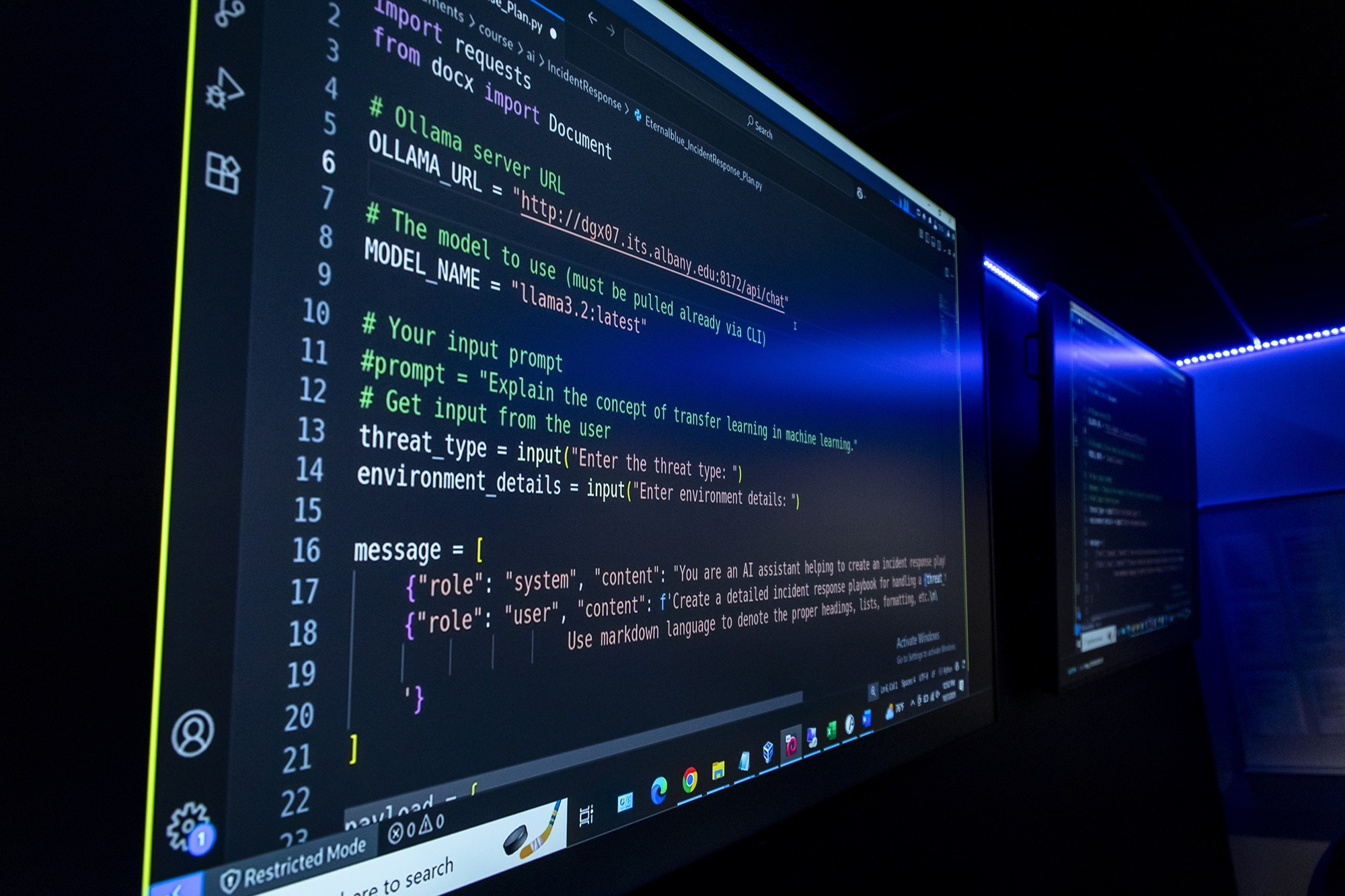
Incident response plans, which guide organizations through a rapid, coordinated response to detect and mitigate cyberattacks, could take a team of humans six to eight months to complete. Using UAlbany’s computing infrastructure, the plans produced by Wang’s cybersecurity students are created in as little as five days and responses are produced in 30 seconds or less.
These plans are especially critical for public entities, where data breaches and malicious actors threaten IT systems that store sensitive information, a concern that has become increasingly urgent as cyberattacks have more than doubled in the last five years.
“There is a lot of pressure from a cybersecurity perspective to prevent threats to government programs that collect and store vast amounts of citizen data,” said Wang, CEHC adjunct lecturer and the Security Bureau Director for New York State Medicaid and the New York State of Health Plan Marketplace.
Outside of teaching, Wang is also developing a cybersecurity-focused AI engine that can be integrated into both the state's healthcare ecosystem and CEHC’s future courses.
“The industry is growing, the technology is advancing, and we have to be willing to add new skills,” Wang said.
CYBR301 student Joshua Minerva shares a similar sentiment.
“AI is not going to take over jobs because we’ll be trained in it. We will become important assets to companies, instead of using AI without knowledge,” said Minerva, a cybersecurity major with a concentration in cyber defense.
In recent years, cybersecurity has experienced the largest growth among CEHC’s program offerings, leading to the launch of a revamped undergraduate major this semester. This echoes an explosive growth of the global cybersecurity market, projected to grow by over $325 billion by 2032.
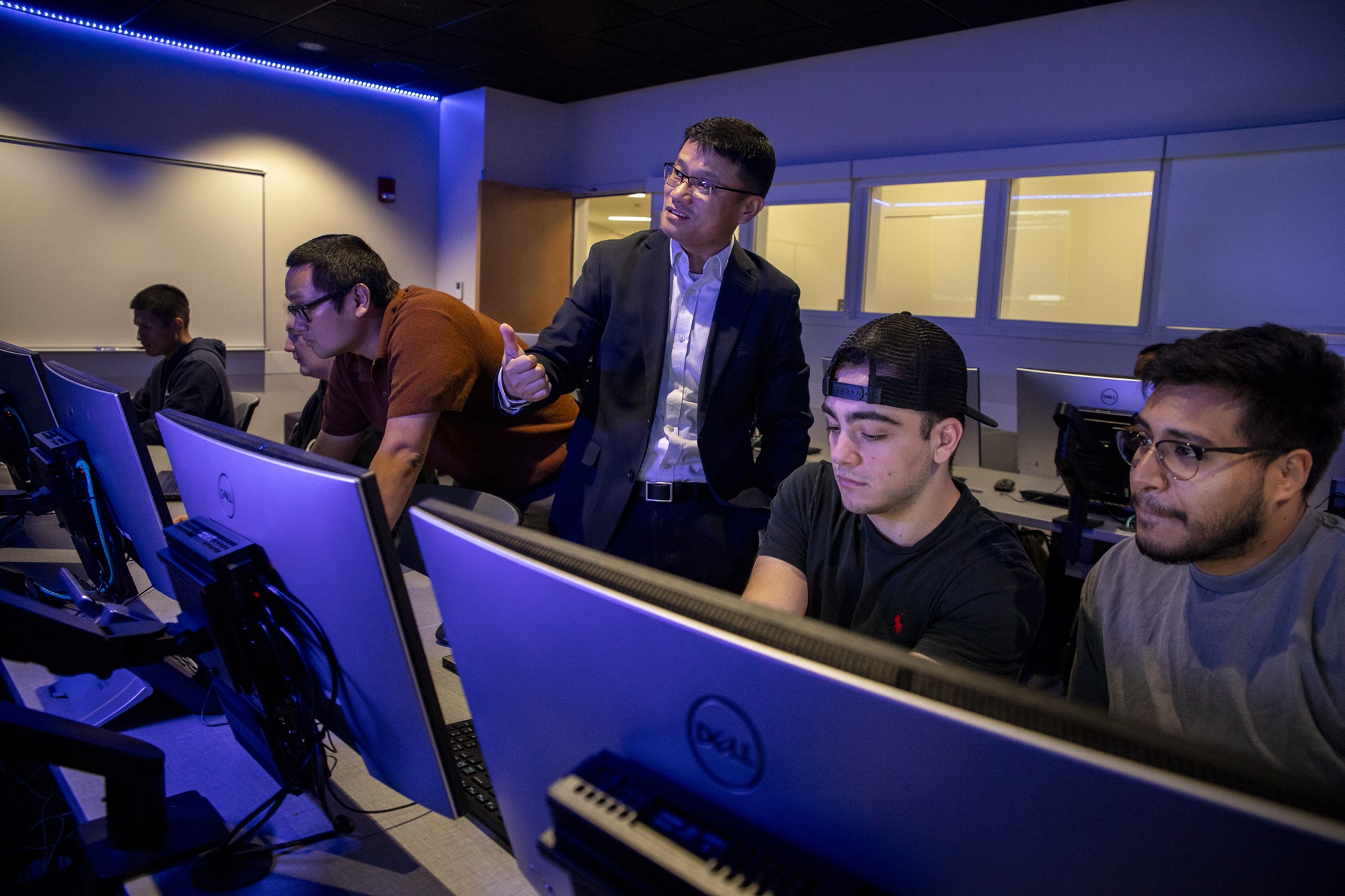
As the CYBR301 students complete incident response plans, they are also working to improve UAlbany’s AI infrastructure by analyzing the tools to help modify and change it to work smoothly.
“Having the opportunity to make programs with AI tools, utilize the infrastructure on campus with a hands-on approach and see how it operates behind the scenes is so useful,” said CEHC senior and class teaching assistant Ryan Hammond.
UAlbany's computing infrastructure not only comes with experiential learning benefits, but greater security and privacy for students, too. None of the students’ work leaves the campus engine, unlike using AI tools available through private companies, like OpenAI.
Wang is confident that the new generation of cyber professionals can and will use AI for good.
“The most important qualities to have as a person and an educator are to care about the people around you, give back and be a good role model,” said Wang. “If you surround yourself with good people, your good intentions will shine.”