


A nurse working with a young patient in a medical exam room.

Bachelor of Science in
Nursing

Program Eligibility

The BS in Nursing program is a traditional four-year degree program for first-year or transfer students who do not already have an associate of science (AS) in nursing or associate of applied science (AAS) in nursing.

If you have an associate of science (AS) in nursing or associate of applied science (AAS) in nursing from an institution accredited by ACEN, CCNE or CNEA, please consider UAlbany’s BS in Nursing completion program.

If you are interested in a non-traditional approach to earning your bachelor’s in nursing, please consider our BS in Nursing 1+2+1 program. This program allows you to graduate with your Associate Degree in Nursing (ADN) at the end of your third year and begin working as a registered nurse (RN) while you finish your academic coursework in year four.

Program of Study

programofstudy

The BS in Nursing is an 86-credit major that blends classroom learning, laboratory practice and clinical rotations to give you a comprehensive nursing education.

You’ll begin with foundational coursework in nursing, health care science and health care systems. As you progress, you’ll explore specialized areas such as mental health nursing, geriatrics, acute care nursing and more. Classroom learning is integrated with the AACN Essentials competencies and aligned with other national standards, ensuring you gain both theoretical knowledge and practical skills for real-world application.

Through laboratory-based learning, you will gain extensive hands-on experience applying and refining your nursing skills — from basic skills like vital sign monitoring and wound care to more complex responsibilities critical thinking, clinical judgement and high-level nursing care.

Finally, in your clinical rotations at Albany Med Health System, beginning in your first semester in the program, you’ll experience immersive training in diverse patient settings, including acute care, pediatrics, emergency medicine and surgical units, all under the guidance of active, practicing registered nurses.


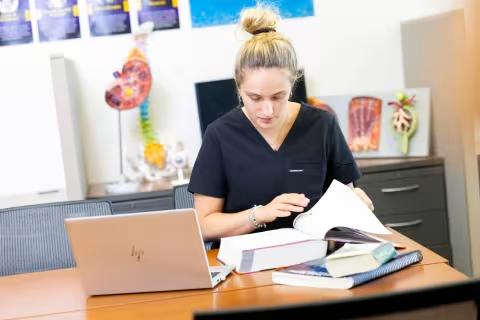
A nursing student studying with textbooks and a laptop.

Required Nursing Courses

Nursing 100-200-level

  • Nursing Practice: History, Ethics & Core Competencies
  • Nursing Practice Across the Lifespan
  • Human Anatomy & Physiology I & II
  • Med-Surg Nursing: Chronic Care & Diagnostics
  • Clinical Practice: Chronic Conditions in Med-Surg Nursing
  • Pharmacology
  • Microbiology for Health Sciences with Lab
  • Foundations of Psychiatric & Mental Health Nursing
  • Clinical Practice: Psychiatric & Mental Health Nursing
  • Med-Surg Nursing: Acute Care Essentials

Nursing 300-400-level

  • Pediatric Nursing: Developmental Care & Ped Assessment
  • Clinical Practice: Pediatric Management
  • Maternal & Newborn Care: Labor, Delivery & Postpartum
  • Clinical Practice: Maternal & Newborn Care
  • Patient Assessment, Diagnosis & Evaluation
  • Community and Public Health Nursing
  • Evidence Based Practice
  • Nursing Quality, Informatics & Healthcare Models
  • Clinical Practice: Procedural Nursing
  • Transformational Nursing Leadership and Management
  • Critical Care, Trauma & Emergency Nursing
  • Clinical Practice: Critical Care, Trauma & Emergency Nursing
  • Nursing Professional Role Practice Capstone

Additional Required Courses

Psychology

  • Intro to Psychology
  • Lifespan Development 

Mathematics

  • Elementary Statistics

Chemistry

  • General Chemistry I and Lab

Elective 

One upper-level Nursing course

Sample courses include:

  • Transcultural Nursing
  • Global Health Nursing
  • Geriatric Nursing Practice

Experiential Learning and Clinical Rotations


In the Nursing Bachelor of Science program at UAlbany, you’ll have extensive opportunities to learn hands-on in lab-based environments, immersive clinical rotations at the Albany Med Health System (AMHS) and mentorship with health care leaders.

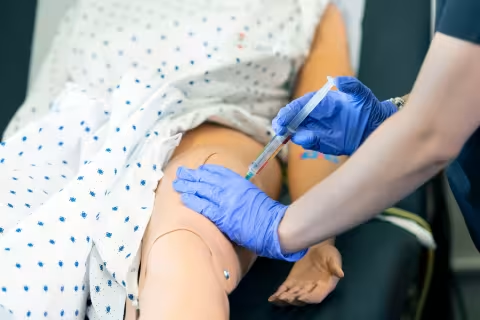
Simulation labs allow you to apply what you learn in the classroom and practice your clinical skills in realistic, controlled environments and high-stakes situations. Through this lab-based training, you’ll build confidence and competence and improve your clinical performance before you head into real-life clinical settings.

In your clinical rotations at AMHS, you’ll work with diverse patient populations across Albany Med Health System hospitals and clinics while being mentored by active, practicing registered nurses (RNs). Your mentors will provide expert guidance and real-time feedback as you gain hands-on clinical experience and develop essential nursing skills, critical thinking and a strong professional identity.


A nursing student giving an injection in a manikin's leg in UAlbany's simulation lab.
experiential

Career Outlook


When you graduate with a BS in Nursing from UAlbany, you’ll be prepared to take the NCLEX-RN licensure exam to become a registered nurse (RN) and begin professional nursing practice in a hospital, clinic or community health setting. 

Qualified nurses are in high demand, both locally and nationally, with the Albany Med Health System alone offering more than 500 nursing positions.

Potential settings and specialties with job opportunities for a Bachelor of Science in Nursing include:

  • Medical/Surgical
  • Home Health Care
  • Outpatient Care Center
  • Community Health
  • Schools
  • Mental Health
  • Maternal Newborn
  • Pediatrics
  • Critical Care
  • Emergency Departments


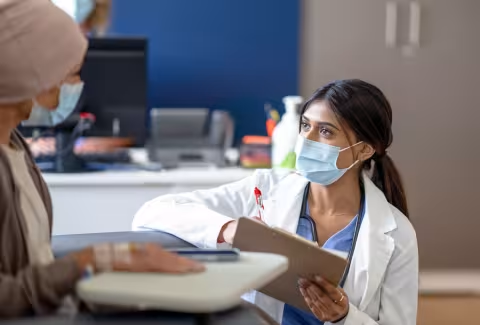
A health professional talking with a patient.
careers

Admission Requirements

  • Cumulative high school GPA of 2.5 or above
  • Required courses with grades of 85 or above for high school courses, B or above for non-credit bearing/remedial courses, or C or above for credit bearing college courses:
    • Algebra I & II
    • Biology with lab
    • Chemistry with lab


Current UAlbany Students

If you're a current UAlbany student seeking to transfer into the Nursing Program from another major, you must apply for admission through the department. In addition to your application, you must submit:

  • UAlbany GPA
  • One Letter of Recommendation from a current advisor


Application Deadlines

  • Fall: March 1
  • Spring: October 1


Accreditation

The Bachelor of Science in Nursing program at University at Albany is pursuing initial accreditation by the Commission on Collegiate Nursing Education. Applying for accreditation does not guarantee that accreditation will be granted.

admission
Student Learning Objectives


Learning objectives that UAlbany students are expected to attain through their course of study within their academic program.

Bachelor of Science
Bachelor of Science

Students who successfully complete the Nursing BS degree are equipped to achieve the following:

  • Person-Centered Care: Students will provide person-centered care, integrating the needs of patients and their families across the health care continuum, promoting holistic, compassionate and culturally competent care.  
  • Interprofessional Collaboration: Students will collaborate effectively with interprofessional teams, stakeholders and communities to promote equitable population health outcomes, enhancing the health care delivery process.
  • Evidence-Based Practice: Students will integrate research, evidence-based practice and clinical expertise to improve health outcomes and contribute to the transformation of health care.
  • Quality and Safety: Students will apply principles of quality and safety across the health care continuum to reduce risk, improve patient outcomes and enhance health care delivery.
  • Communication and Collaboration: Students will demonstrate effective communication and collaboration with health care teams, patients, families and communities to optimize health care outcomes.
  • Leadership in Health Care Systems: Students will apply leadership principles in responding to and leading within complex health care systems, advocating for change and improvement in care delivery.
  • Technology and Informatics: Students will advocate for and use technology, informatics and innovation to enhance the delivery of care, improve patient outcomes and ensure health care efficiency and safety.
  • Ethics and Professionalism: Students will integrate values, ethics, accountability and regulatory standards into their practice, providing culturally sensitive, equitable and inclusive nursing care.
  • Personal and Professional Growth: Students will demonstrate a commitment to personal growth, professional development and lifelong learning, cultivating the capacity for leadership and resilience in the nursing profession.
slo