





Convening to Eliminate Environmental Health Disparities

By Erin Frick
ALBANY, N.Y. (Oct. 23, 2025) — Last week the University at Albany’s Center for the Elimination of Health Disparities hosted its signature annual event, the President’s Forum on Health Disparities, in partnership with the Harvard JPB Environmental Health Fellowship Program. This year’s forum explored the environmental and social determinants of health and the importance of bridging disciplines for health equity research and action.
For the first time, the forum spanned two days, bringing together students, scientists, practitioners and community leaders dedicated to eliminating unjust differences in health that persist across communities locally, nationally and globally.
“This year President’s Forum was a powerful reminder of the importance of collaboration, out of the box thinking about factors influencing health, and integrating researchers with community partners to advance health equity,” said Associate Professor Elizabeth Vásquez, director of the Center for the Elimination of Health Disparities. “These kinds of interdisciplinary spaces are essential for driving meaningful change.”
UAlbany’s Allison Appleton, associate professor and chair of the Department of Epidemiology & Biostatistics at the College of Integrated Health Sciences, opened the event by framing the discussion around environmental and social determinants of health, emphasizing that health outcomes are shaped by layered risks, opportunities and exposures across the lifespan.
Harvard JPB Environmental Health Fellows presented research on the resilience of immigrant communities confronting environmental inequities, workplace heat vulnerability and the lasting effects of racism on reproductive health. Presenters included:
Betty Lin, associate professor, Department of Psychology, UAlbany
Topic: Implications of interpersonal and structural racism for reproductive health
MyDzung Chu, assistant professor, Department of Medicine, Tufts University
Topic: Environmental inequities and community resilience in immigrant enclaves
Leah Schinasi, assistant professor, Department of Environmental and Occupational Health, Drexel University
Topic: Social labor policies and worker heat vulnerability
Plenary speaker Stacy Pettigrew, executive director of the Environmental Health Sciences Center at the Albany College of Pharmacy and Health Sciences, called for translating academic research into tangible, community-based interventions and emphasized collaboration with local organizations to create sustainable solutions that address the specific needs of marginalized populations.
Roundtable discussions and a student poster session encouraged participants to explore strategies for advancing socio-environmental research and collaboration. Moderated discussions highlighted the importance of integrated models that account for individual, community and policy-level factors.
“We are pleased that many UAlbany students participated in the forum,” said Appleton. “Moving socio-environmental research to action requires interdisciplinary training and collaboration. Our students are the next generation of researchers and change makers. Their perspectives deeply enriched the forum discussions, and I believe they were able to take away meaningful insights to inform their work now and into the future."
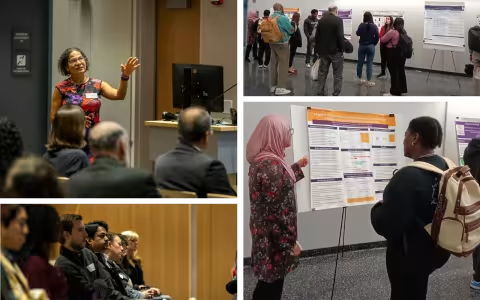
The second day opened with remarks from center Director Elizabeth Vásquez, who outlined the center’s mission and recent initiatives. Professor Erin Bell, dean of the College of Integrated Health Sciences and UAlbany President Havidán Rodríguez also addressed attendees, emphasizing the center’s growing partnerships and impact across New York State.
Over the past year, the Center for the Elimination of Health Disparities has led several key efforts, including:
- A symposium with the New York State Department of Health on best practices for collecting and using demographic data;
- Workshops with Healthy Capital District focused on reducing bias and addressing microaggressions in healthcare; and
- Community conversations on mental health and suicide prevention within the Black community, organized with the Beta Psi Boule Foundation and the American Foundation for Suicide Prevention.
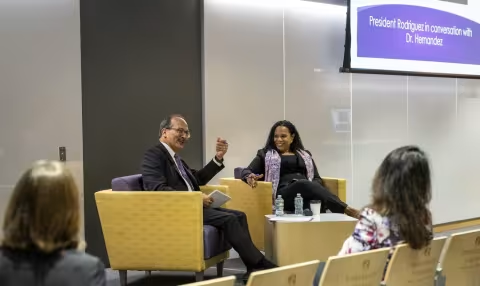
Day two activities continued with a Q&A between President Rodríguez and keynote speaker Diana Hernández, associate professor of sociomedical sciences at Columbia University. Hernández — and one of the nation’s leading voices on the intersection of energy, equity, housing and health — discussed her research and her new book, Powerless: A People’s Struggle for Energy.
Hernández underscored the reality that insufficient access to power is a widespread, yet often overlooked, challenge that puts millions at risk. Ensuring that power is accessible and affordable for all should be a public health priority.
Their conversation and Hernández’s keynote talk reinforced the forum’s central mission: advancing socio-environmental research that promotes justice, resilience and health equity across communities.