





CNSE Brings Semiconductor Workforce Programs to India

NEW DELHI, India (Sept. 2, 2025) — Students at Ramaiah University of Applied Sciences (RUAS) in Bangalore can now enroll in the University at Albany’s graduate certificates in semiconductor engineering as part of a new collaboration between the institutions.
The certificates in Semiconductor Manufacturing, Semiconductor Patterning and Processing and Semiconductor Metrology can be completed remotely, allowing RUAS students and semiconductor professionals working in India to access UAlbany’s deep expertise in microelectronics without leaving their home country.
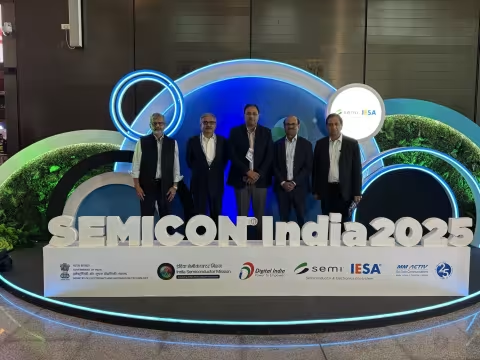
The universities announced the news Tuesday at SEMICON India 2025, a major semiconductor industry conference taking place in New Delhi.
“International collaborations like this one with Ramaiah University of Applied Sciences are critical to the mission of a globally engaged research institution and will ensure UAlbany’s excellent academic programs in nanotechnology continue to have the broadest reach possible at a time of remarkable industry growth," UAlbany President Havidán Rodríguez said. "We are excited to welcome RUAS students and look forward to a growing partnership.”
RUAS Chancellor M.R. Jayaram called the collaboration "transformative."
“The future of education will necessarily entail integrating human intelligence, artificial intelligence and technology in the generation of knowledge," Jayaram said. "We must prepare ourselves for the brave new world of nanotechnology, robotics, and artificial intelligence, but one in which we build an abiding sense of ethical conduct and purposive action for the greater good. In this backdrop, this collaboration between Ramaiah University and UAlbany will be a pioneering pathway to advance knowledge and skills in India.”
Building a global semiconductor workforce pipeline
The collaboration comes as the government of India is ramping up the country’s domestic semiconductor manufacturing capacity through the India Semiconductor Mission, potentially doubling the sector’s economic output by 2030, and as UAlbany seeks to expand the global reach of its high-tech workforce training programs.
UAlbany’s College of Nanotechnology, Science, and Engineering (CNSE) created the certificates to ensure New York has the semiconductor workforce it needs amid a series of multi-billion-dollar state, federal and industry investments across New York.
In January 2024, Rodríguez led a UAlbany delegation to India and signed a memorandum of understanding with RUAS pledging to explore joint workforce training programs and research collaborations in microelectronics, artificial intelligence, public health, cybersecurity, and environmental science and sustainability.
A delegation from RUAS visited Albany in July, including a stop at the NY CREATES Albany NanoTech Complex, which is the largest nonprofit semiconductor R&D facility in the United States and has been the academic and research home of CNSE’s Department of Nanoscale Science & Engineering since the college’s launch in 2004.
“These graduate certificates — and the additional certificates that are being developed — are a unique opportunity for engineers and technical staff working in the semiconductor industry to advance their knowledge and careers,” said CNSE Dean Michele J. Grimm. “CNSE has been an international leader in semiconductor-related research and education for two decades, and by offering these programs with an online option, we are meeting semiconductor workforce demand not only across the United States but internationally. We are proud that RUAS has recognized the strength of our semiconductor programs, and we look forward to furthering this collaboration.”
A foundation for future joint research
"We are thrilled to announce this partnership during SEMICON India, underscoring the dynamic growth of the semiconductor industry in India,” said UAlbany Vice President for Research and Economic Development Thenkurussi (Kesh) Kesavadas. “UAlbany has a longstanding tradition of close collaboration with the industry, and we are excited to offer our advanced training programs to India while also inviting future research collaborations."
A 2024 analysis by McKinsey & Co. forecast as many as 10,000 new semiconductor-related jobs in New York alone amid billions of dollars in investments by industry leaders like Micron, GlobalFoundries and IBM, as well as New York State. Much of this investment is fueled by the $53 billion federal CHIPS & Science Act aimed at advancing semiconductor R&D and onshoring chip manufacturing to strengthen U.S. economic and national security.
In 2023, New York Gov. Kathy Hochul announced the High NA EUV Lithography Center at the Albany NanoTech Complex, a $10 billion collaboration between industry and government focused on the lithography techniques central to the production of faster, more powerful and more energy efficient computer chips.
India has made a similar push. In 2021, the government established the India Semiconductor Mission to strengthen its position as a major microelectronics manufacturer, with the country’s Ministry of Electronics and Information Technology projecting the size of the nation’s semiconductor industry will double to as much as $110 billion by 2030.
Ramaiah University of Applied Sciences is one of India’s leading private universities, with a strong focus on applied learning, research, and innovation across engineering, health sciences, management, law, and social sciences.