





UAlbany Researchers Awarded $1.65M from Air Force Research Lab for Nano Fabrication, Testing

By Bethany Bump
ALBANY, N.Y. (Aug. 5, 2025) — A team of researchers in UAlbany’s College of Nanotechnology, Science, and Engineering has received a three-year, $1.65 million grant to provide fabrication and testing of nanoscale electronic devices for the Air Force Research Laboratory (AFRL).
AFRL will propose nanotechnology and electronics-based projects to UAlbany’s Department of Nanoscale Science & Engineering for fabrication and testing in the University’s 200mm Innovation Lab, the 300mm wafer scale fabrication facilities at the NY CREATES Albany NanoTech Complex, and across the NORDTECH Microelectronics Commons Hub, a regional R&D hub working to maintain the nation’s competitive edge in key fields related to semiconductors and microchip design. The goal is the delivery of cutting-edge nanoelectronic prototypes that will ultimately help address national security challenges and shore up the nation’s defense systems.
NORDTECH is funded by the CHIPS & Science Act and led by five founding members: UAlbany, NY CREATES, Rensselaer Polytechnic Institute, Cornell University and IBM.
“We’ve had a continued relationship with AFRL for over a decade now to develop new technology, and this award shows that they continue to value and trust the work we are doing in leading-edge chip development,” said Nathaniel Cady, SUNY Distinguished Professor and associate dean for research in the College of Nanotechnology, Science, and Engineering (CNSE) at UAlbany, who is principal investigator on the grant.
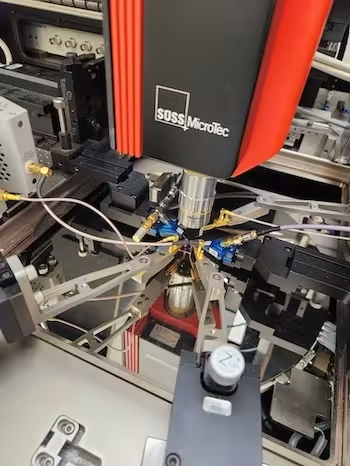
The award builds on work Cady and his research team have been doing with AFRL to develop new, more efficient computer chips that imitate the human brain. This neuromorphic chip technology relies on resistive memory devices, also known as “memristors,” which operate by mimicking synapses in the brain.
“Synapses are the connections in our brains that help us to store memories and to think,” Cady said. “So one of the key elements of the chips we work on is making memory devices that behave essentially the way a synapse does in the brain. This consumes less power and is more efficient than traditional computing.”
The technology has a broad range of applications, particularly when it comes to artificial intelligence that relies on automated tasks such as pattern recognition and autonomous navigation. Their efficient computing power makes them especially useful for devices with limited battery power, such as satellites and drones.
The Air Force is working to develop next generation materials and devices that can be used in these artificial intelligence and neuromorphic systems, Cady said.
“Our work in this project is in the earlier phases of material development and very initial device development,” he said. “So we’ll be supplying them with silicon wafer and chips that are coated with novel memory materials that our AFRL partners can work with.”
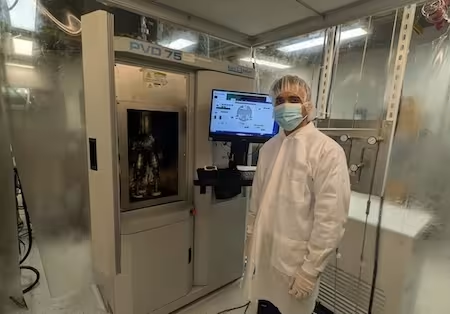
Neuromorphic chip technology has enormous potential beyond military applications as concerns about energy consumption from artificial intelligence grow, Cady said.
“For all of these AI and advanced computing systems out there, some of the biggest challenges are how do you make that computing not use up all the energy on the planet?” he said. “The more we can work on new devices and new chip technologies that are like what nature does as far as efficiency, the better, because otherwise we're going to run out of the energy needed to drive these really advanced computing platforms.”
Together, UAlbany, NY CREATES and NORDTECH have developed an extensive ecosystem of partners and customers who cover a broad range of applications of interest to the defense community. The NY CREATES-operated Albany NanoTech Complex is home to CNSE’s Department of Nanoscale Science & Engineering and serves as the nexus for NORDTECH, which is poised for prototyping activities for the Department of Defense.
“This project is an example of how the knowledge and expertise of UAlbany faculty combined with the unique environment of the Albany NanoTech Complex can accelerate the translation of research – in this case to enhance national security,” said CNSE Dean Michele J. Grimm. “CNSE’s Department of Nanoscale Science & Engineering is the only academic unit fully integrated into the Albany NanoTech Complex, which they have called their home since it opened in 1997. The creative engineering and innovation of Nate Cady’s research team combined with the prototyping and advanced manufacturing capabilities of the department and NY CREATES turn ideas into reality. Similar opportunities are being pursued by CNSE faculty with applications in human health and medicine, energy systems, and AI hardware.”