





Professor Emeritus Bromley Revisits New York's Worlds Fairs

ALBANY, N.Y. (Feb. 24, 2026) — The New York World’s Fair is one of those ideas that never really disappears. You can still see it rising above Flushing Meadows in stainless steel. You can hear it in familiar Disney melodies. You can even spot it in the shape of a car first unveiled to the public more than 60 years ago.
The Unisphere, Shea Stadium, the Ford Mustang — unforgettable. Attractions like "It’s a Small World" and the "Carousel of Progress" were designed for a temporary exhibition and then exported around the world. Long after the gates closed, the legacy of New York City’s 1939–40 and 1964–65 World’s Fairs remains woven into everyday life.
In a new study published in Planning Perspectives, UAlbany Professor Emeritus of Geography and Planning and Collins Fellow Ray Bromley examines how those two fairs — staged a quarter-century apart on the same reclaimed site in Queens — helped reshape New York City and its region for generations.
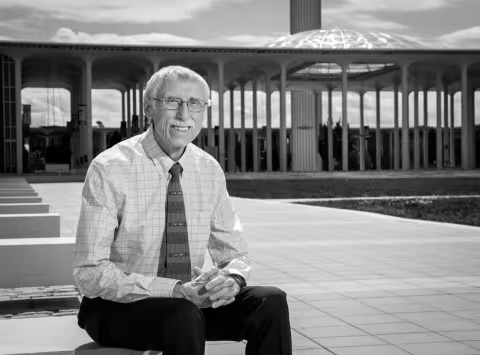
“What interested me was how events that were meant to be temporary became drivers of very long-term change,” Bromley said. “They were experiments in how cities imagine their futures and then build them.”
From 'ashes' to a global stage
Both fairs rose from the same unlikely ground. The site in Flushing Meadows had once been a marshy dumping ground known as the “Valley of Ashes,” a bleak industrial landscape memorably described in F. Scott Fitzgerald’s The Great Gatsby. In the 1930s, city leaders and planners saw an opportunity to reclaim the land and transform it into a global stage.
The first fair, held in 1939 and 1940, was officially themed “The World of Tomorrow.” Its sweeping vision emphasized modern technology, efficiency and progress. Visitors passed through the towering Trylon and Perisphere to view “Democracity,” a massive model of a future America organized around highways, streamlined cities and coordinated regional planning.
The optimism of the fair collided almost immediately with world events. As World War II broke out in Europe, international participation shrank and several nations withdrew from the fair altogether in its second year.
“It’s striking how closely the fair’s fortunes tracked the geopolitical situation,” Bromley said. “It was conceived as a celebration of peace and progress, but it ended up unfolding alongside the collapse of international order.”
Despite its financial losses, the fair permanently altered Flushing Meadows. Roads, landscaping and public facilities built for the event laid the groundwork for what would become one of New York City’s largest and most complex parks.
Robert Moses and modern New York
Any account of the World’s Fairs, Bromley argues, ultimately leads back to Robert Moses, the unelected public administrator who played a major role in reshaping New York in the 20th century.
Moses held a constellation of powerful posts over several decades, overseeing parks, bridges, highways and large-scale redevelopment projects across the city and region. Though controversial, his influence on New York’s physical landscape is difficult to overstate.
Moses directed the land reclamation for the 1939-40 fair and later returned as president of the 1964-65 World’s Fair Corporation, effectively bookending his career with the two events.
“The fairs gave Moses a rare opportunity,” Bromley said. “They provided a public-facing justification for massive investments in infrastructure, especially expressways, parkways and parkland, that would shape the region for decades.”
Under Moses, the fairs functioned as planning tools, accelerating highway construction, improving regional access to Queens and positioning Flushing Meadows as a long-term development hub. What appeared temporary to visitors was, in many cases, carefully designed to leave a permanent imprint.
From spectacle to lasting legacy
By the time the 1964-65 fair opened, the tone had shifted. This was the Cold War era, defined by space exploration, consumer confidence and the dominance of the automobile. The fair’s symbol, the Unisphere, a massive stainless-steel globe, was designed to be permanent, unlike most of the structures from 1939.
Corporate exhibits took center stage. General Motors revived its popular Futurama exhibit, once again envisioning a highway-centered future. Ford introduced the Mustang, a car that would quickly become an American icon. Walt Disney contributed several attractions, including "It’s a Small World," blending entertainment with an idealized message of global unity.
“These exhibits weren’t just about showing off technology,” Bromley said. “They were shaping expectations about mobility, consumption and how Americans would live.”
The second fair also left behind institutions that continue to define the park and the city: the New York Hall of Science, the Queens Museum and its Panorama of the City of New York, and Shea Stadium, which opened days before the fair and became home to the New York Mets for more than four decades.
Neither fair ended in financial success. Both closed with notable deficits, a fact that has long fueled criticism. But Bromley argues that focusing on the balance sheet misses the broader impact.
“The real returns weren’t immediate,” he said. “They came through tourism, redevelopment momentum and the clustering of major facilities that followed.”
Today, Flushing Meadows-Corona Park hosts major sports venues, museums and international events, including the U.S. Open tennis tournament. More than $10 billion in new development projects are underway nearby, including a soccer stadium and a recently approved casino. In Bromley’s view, the fairs served as stepping stones as opposed to endpoints in a much longer process of urban transformation.
“These fairs show how ideas about the future become embedded in physical space,” Bromley said. “Once that happens, those ideas shape a city for decades — sometimes in ways no one fully anticipates.”