





From Footprints to Fingerprints, UAlbany Forensics Club Puts Students on the Case

By Jackson Wooley, Class of '27
ALBANY, N.Y. (Oct. 15, 2026) — Ever wondered how to lift a fingerprint? How to build a DNA profile from a single strand of hair? How to analyze blood splatter?
The University at Albany’s Forensic Science Club is the place to go.
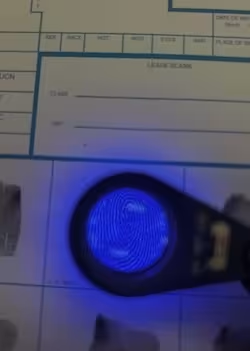
Restarted in 2023 following a pandemic hiatus, the club serves as a place for students looking to go into forensics to develop their skills or for others who are just interested in learning more about the field.
"I ended up switching my major completely junior year because of the club," said Laylin Horvath, a senior majoring in criminology and psychology, and the club's social media chair. "I just joined for fun and then I ended up finding a new career interest."
The club allows students to expand forensics beyond the classroom environment, developing practical skills to go with the theoretical.
"Students can learn hands-on skills that are relevant and that you wouldn't necessarily get in the classroom," said Christine Bergeron, a forensic science student in UAlbany's master's program and the club's vice president. "Also, it provides us with a forum where we can interact with other students who have the same interests. We are all here because we love forensics, even if it's not on a professional level."
Following the Evidence
The club throws a number of events including footprint casting, criminal profiling workshops and numerous guest speakers. Guest speakers range from experts working in the field to FBI recruiters.
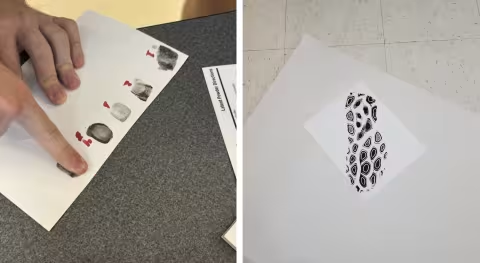
They recently held an event where students were taught about the history of footprint analysis. They then had students make their own footprints to test their skills.
"People from the FBI and the other guests who come talk to us are so impressed with what we're doing that they want to come back," said Catherine Pilkington, a sophomore majoring in chemistry with a concentration in forensic science and the club's secretary.
"Literally every activity we do can go on their resumes," added Bergeron. "We use professional training videos and teach them the actual techniques they need, so all of it counts as professional training."
Investigating Academics
The club not only helps with students career prospects, but with their academic prospects too.
Undergraduate students in the College of Emergency Preparedness, Homeland Security and Cybersecurity can use their club participation toward their required experiential learning hours needed to graduate.
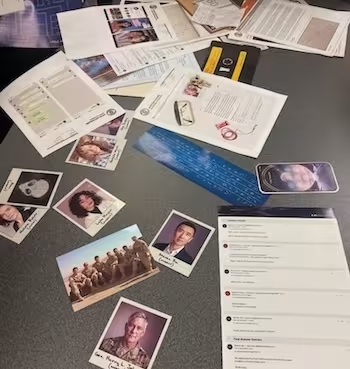
"It's used by a few of our members to complete their degree requirements," said Bergeron. "So, we're helping them graduate and build their resumes and provide them with professional contacts."
"Having the opportunity to get hands on, to take what you've heard, what you've read, or what your professor told you and physically do it, is what makes it stick," said Abby McDermott, a molecular biology and biochemistry sophomore who serves as the club's treasurer. "Even if members go into a related science field or any science field, understanding how things work in a different field can give them insight into doing their own job better."
But above all, the club is a way for passionate students to build community and learn more.
"Hopefully, they walk away learning a little bit about science," said Bergeron. "We always like to teach about science, so we expose non-science people to science techniques."