





Ask an Expert: Why is it Foggy on Mountaintops and Not Close to the Ground?
ALBANY, N.Y. (Sept. 1, 2026) — Justin Minder, professor of Atmospheric & Environmental Sciences at the College of Arts and Sciences, is an expert in mountain weather and how terrain shapes local conditions like clouds and fog.
Minder answers today’s question: Why is it foggy at the top of mountains and not close to the ground?
Minder: This comes down to what fog actually is. Fog is just a special kind of cloud, one that touches the ground. So, the real question is why do clouds tend to form up at mountain elevation rather than down where we're standing? That answer has to do with how air behaves as it moves and rises.
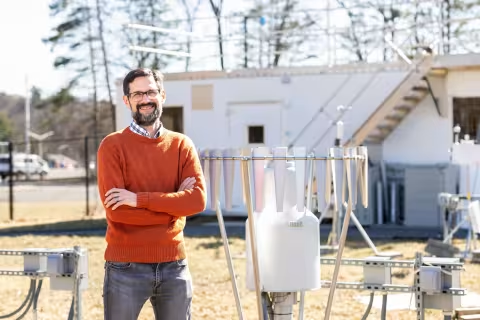
One mountaintop location where we often see foggy conditions is UAlbany's Whiteface Mountain Field Station, located at nearly 5,000 feet above sea level in the Adirondacks. Sometimes fog occurs because the mountain is protruding upwards into a pre-existing layer of clouds aloft that's already sitting at that elevation, regardless of the terrain below. Other times the mountain can make its own clouds, which are called "orographic" clouds. These are often formed due to winds pushing moist air up and over the mountain.
As that air rises, it expands and cools. Once the air cools enough, it can no longer hold onto as much water vapor, so the vapor begins to condense into the tiny liquid droplets that make up a cloud. Down at the surface, especially away from the mountain, the air isn't going through that same lifting and cooling process, so conditions don't reach that same condensation point as often.
This effect can be seen in two videos of Whiteface: one looking at clouds forming over the mountain from a distance, and one from a ridgeline high on the mountain, where you can watch the fog roll through at eye level.
The frequently cloudy and foggy conditions on Whiteface, combined with UAlbany's unique field observatory there, have made it a prime place to study cloud chemistry up close, rather than just from satellite images or from the ground looking up.
Curious about something — anything? Send us your question and we'll find an expert to answer.