





UAlbany Students Plant Trees Along South Pearl Street in Albany
By Mike Nolan
ALBANY, N.Y. (Sept. 9, 2025) — A team of University at Albany students are focused on making the city of Albany greener.
Over the summer, UAlbany students from the Hudson-Mohawk Climate Corps, an initiative led by the Institute for Transformational and Ecosystem-based Climate Adaptation (ITECA) at UAlbany, prepared and planted more than 200 urban trees, including many along South Pearl Street in Albany.
It marked the beginning of a project aimed at expanding Albany’s urban tree canopy. Trees help improve environmental health and strengthen urban resilience to extreme weather such as heat waves, flooding, wildfire smoke and severe storms.
Through a $50,000 award from UAlbany’s Strategic Allocation of Resources (StAR) program, the students are also growing native, climate-adapted native tree seedlings in UAlbany’s greenhouse and open-air nursery sited on a plot of land near Indigenous Quad.
The StAR funding is also supporting an on-campus urban soil amendment lab, where students can test and amend soils to ensure optimal growing conditions for the urban street trees.
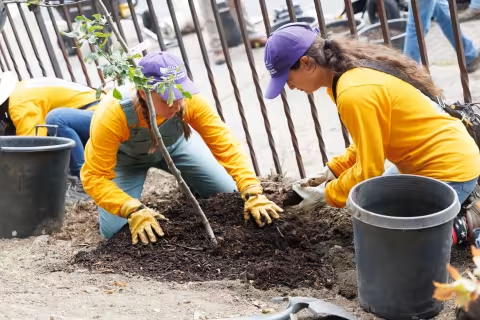
“We’ve recruited students at UAlbany and trained them in ecosystem-based adaptation and urban climate forestry,” said Ríobart Breen, ITECA director and lecturer in the Department of Geography, Planning, and Sustainability at the College of Arts and Sciences. “We provided lots of hands-on education in tree biology and soil science. So, as they started the work this summer, they understood the science behind it and will be prepared to go into these emerging career paths.”
In September 2023, researchers in the Department of Geography, Planning, and Sustainability received $5 million from the U.S. Department of Agriculture’s Forest Service to launch the Urban CAFÉ DAY initiative, aimed at reducing extreme heat in urban heat islands and expanding access to trees and green spaces in communities and neighborhoods in the city of Albany.
The funding was, in part, used to establish ITECA, which is focused on using nature-based solutions to adapt to climate change and revitalize Albany’s urban forest, and doing community empowerment and local sustainable economic development.
Studies show that trees in communities are associated with improved physical and mental health, lower average temperatures during extreme heat, increased food security and improved economic opportunities. Trees also help to reduce the urban heat island effect, which occurs when human-made surfaces like concrete, asphalt and buildings, which absorb heat, cause a city to experience much warmer temperatures than nearby rural areas.
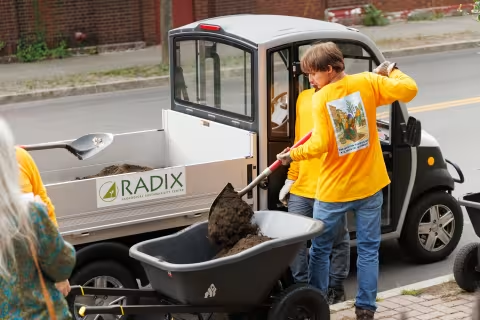
“We are planting trees in Albany as part of an urban climate forestry initiative to help address the extreme heat impacts of climate change and to reduce the urban heat island effect,” said Breen. “Our intent is to plant the trees in locations where, as they grow, they will provide shade over sidewalks for pedestrians. It also adds to the urban tree canopy. This collectively reduces the temperature of the heat during the summertime.”
ITECA students spent the last month on South Pearl Street and other urban streets ripping out invasive vines and plants, testing and amending soil, and then planting trees on sites adjacent to public sidewalks with approval from the private property owners, who will work with the students to water the trees and care for them.
The student crews plan to continue to maintain the trees — many of which will grow edible fruit including apples, paw paws, pears and plums.
“Climate change is one of the most pressing issues of our lifetime. That’s why I’m excited to work on a project that is replicable across other cities and can truly make a difference,” said Sky Eigen, a graduate student in the Biodiversity, Conservation and Policy program, staff member at ITECA and crew lead for the Hudson-Mohawk Climate Corps. “People should know that when they come to UAlbany, as long as they have a passion or mission in themselves, they’ll have an opportunity to find a researcher doing the work and go for it.”
In addition to working with city of Albany leaders, the students are working closely with the Radix Ecological Sustainability Center, a nonprofit organization in Albany’s South End. Radix runs various programs related to food and climate justice, including growing and planting street fruit trees, tending neighborhood food gardens, offering youth employment and education and hosting community composting.