





UAlbany Experts Share Insight on Disaster Preparedness After Texas Floods

By Mike Nolan
ALBANY, N.Y. (July 14, 2025) — Over the July 4 weekend, Central Texas was struck by catastrophic flash flooding that has now claimed the lives of at least 132 people. The flooding was triggered by an extreme rainfall event, where 10 to 15 inches of rain fell in under two hours.
Among the hardest hit areas was Kerr County, where floodwaters ripped through Camp Mystic, destroying camp structures and dragging children and staff downstream.
With questions now being raised about disaster preparedness as communities face more frequent and severe weather events, leaders in New York and across the country are turning to the University at Albany’s research and expertise.
Governor on Campus
Following the Texas floods, Gov. Kathy Hochul visited UAlbany’s ETEC research and development complex on Friday to share an update with New Yorkers on the state’s preparedness around extreme weather.
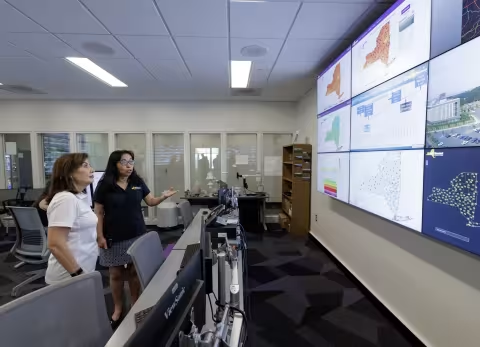
The visit included a tour of the State Weather Risk Communication Center, a first-of-its-kind partnership between UAlbany and the New York State Division of Homeland Security and Emergency Services that leverages the University’s expertise in atmospheric sciences to help state and local emergency managers prepare for and respond to severe weather.
The governor also toured the headquarters of the New York State Mesonet, the nation's most advanced and largest early warning weather detection network. The Mesonet, operated by UAlbany, is comprised of 127 standard weather stations and five other advanced networks. The sites are spaced an average of about 17 miles apart across the state and equipped with automated sensors that collect weather data in real time.
After the tours, the governor was joined by New York State Division of Homeland Security and Emergency Services Commissioner Jackie Bray and State Weather Risk Communication Director Nick Bassill for a live briefing from the College of Emergency Preparedness, Homeland Security and Cybersecurity's Ops Command Center.
“New York is leading the nation in building a strong connection between weather experts, emergency managers and the public — which is critical as our state faces increasingly frequent and extreme weather,” said Bassill. “From hurricanes to lake effect snow and everything in between, the State Weather Risk Communication Center at UAlbany is working daily to help state and local emergency managers better prepare for and respond to severe weather events. I want to thank Gov. Hochul and Commissioner Bray for their continued support and remain committed to making our communities safer and more resilient.”
Meeting with Emergency Officials
Jeannette Sutton, an associate professor at the College of Emergency Preparedness, Homeland Security and Cybersecurity, was in San Francisco in the days following the Texas flooding event.
She met with emergency management officials in San Mateo County, taking a closer look at how their alerts are delivered during disasters.
Sutton specializes in disaster and risk communication. She recently completed a multi-year project for FEMA to develop a dashboard that helps emergency managers write effective messages for public alerts and warnings.
“We need a lot of training, and we need the resources to help people to get trained,” Sutton told NBC News. “They are generally facing a blank text box that says, ‘insert message here.’ And you can imagine that in a situation where there’s a lot of stress and uncertainty, writing a message from scratch is very difficult.”
Sutton also spoke with other national media outlets including The Atlantic, Washington Post, NPR and Christian Science Monitor.
Other Expertise in the News
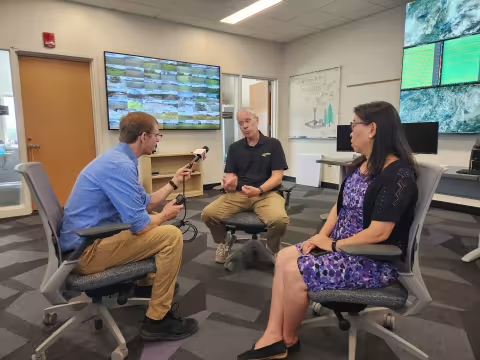
Along with at Friday’s press event, the State Weather Risk Communication Center and the New York State Mesonet were highlighted in a report by WNYC as tools to help improve the state’s response to extreme weather.
The report was shared over the weekend on NPR-affiliated networks across New York. It included interviews with Bassill, Director of UAlbany’s Atmospheric Science Research Center Chris Thorncroft, and Director of the New York State Mesonet June Wang.
Amber Silver, an associate professor at the College of Emergency Preparedness, Homeland Security and Cybersecurity, shared her thoughts with NPR about the spread and acceptance of weather-related conspiracy theories.
Aiguo Dai, a Distinguished Professor in the Department of Atmospheric and Environmental Sciences, spoke with Time Magazine about the conditions that caused the Texas floods.